Music, Motor Control and the Brain
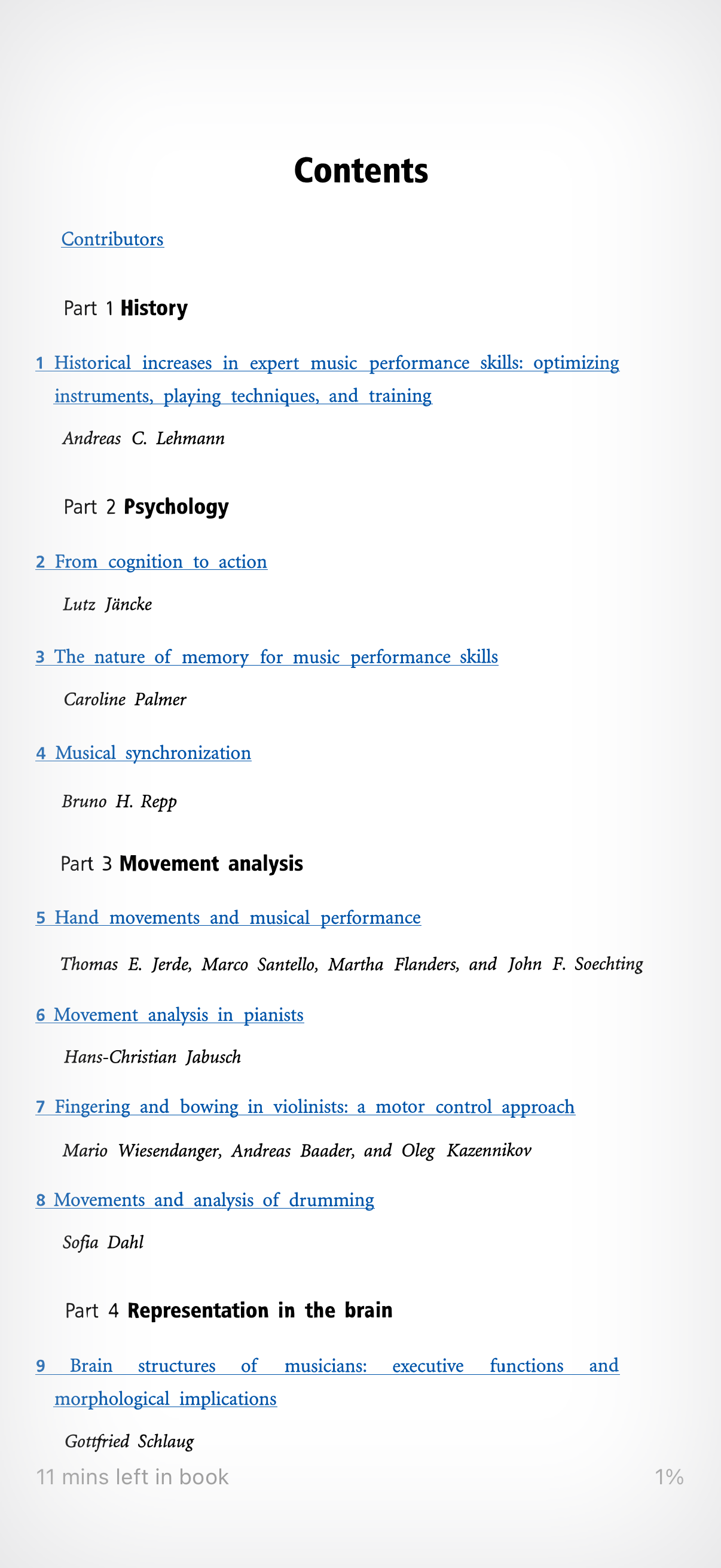
I would like to discuss how the brain and nervous system learn and play music based on the papers in this book entitled “Music, Motor Control, and the Brain.”
I purchased the Kindle version, which is still rather expensive, so, I will read and try to summarize the findings of one of the papers.
I have posted the table of contents. You can select one of the two images that show the table of contents by clicking on them separately.
Perhaps people could vote on which paper appeals to them the most. There are papers specifically related to pianists.
Note: I am not a brain researcher, although I once dated one. She messed with my brain, lol.
I am just curious how the brain learns and plays music.
FYI, for people who might be interested,
16 replies
-
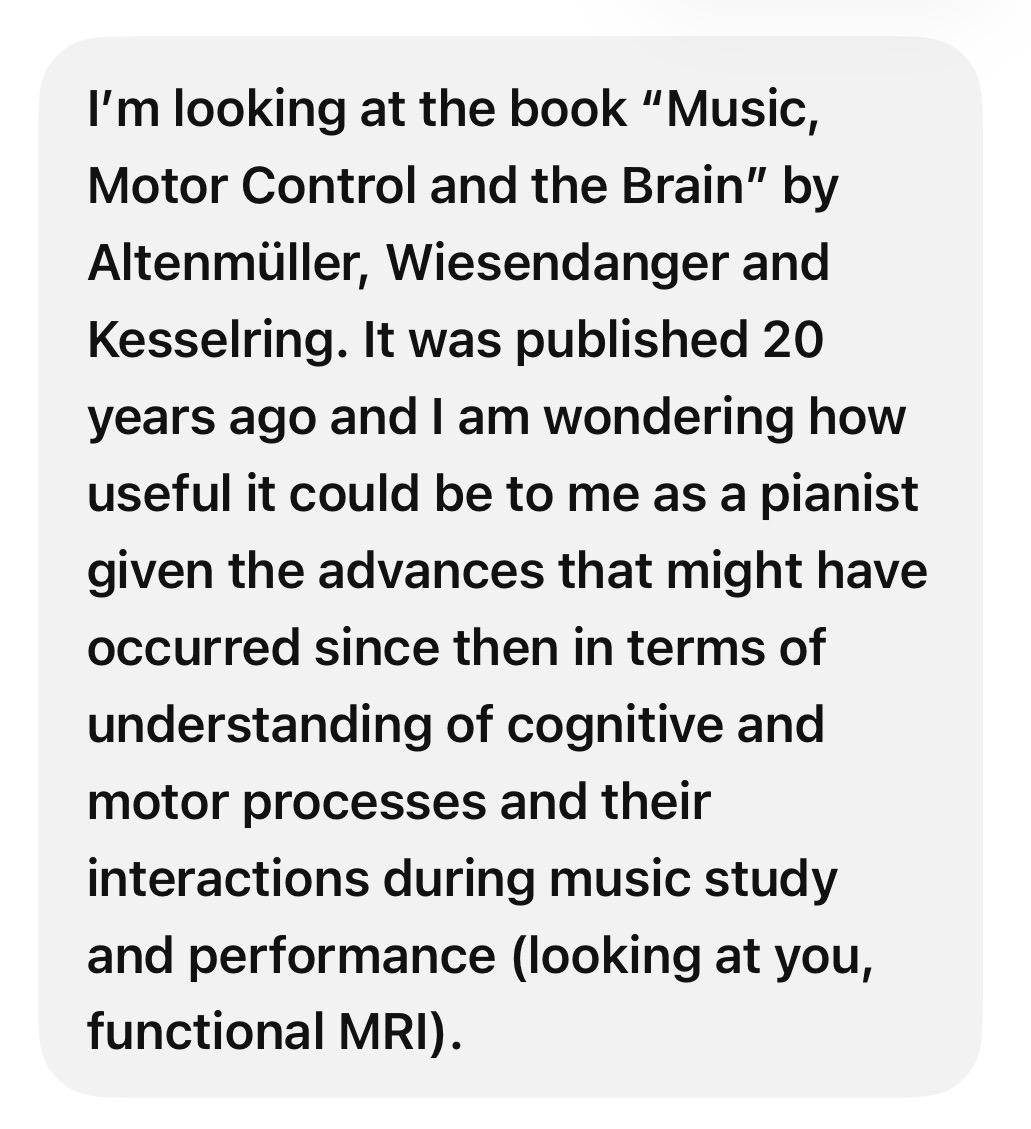
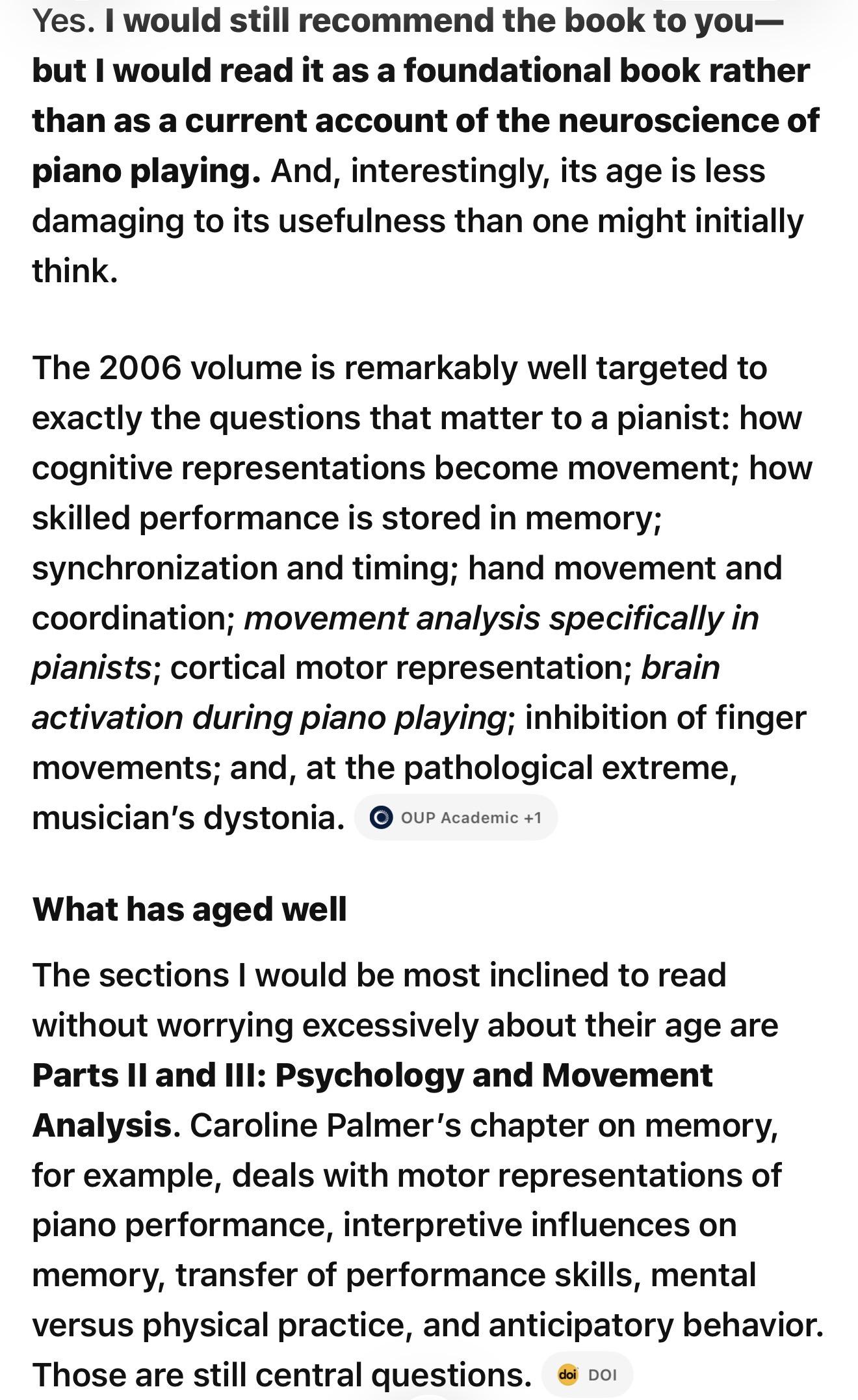
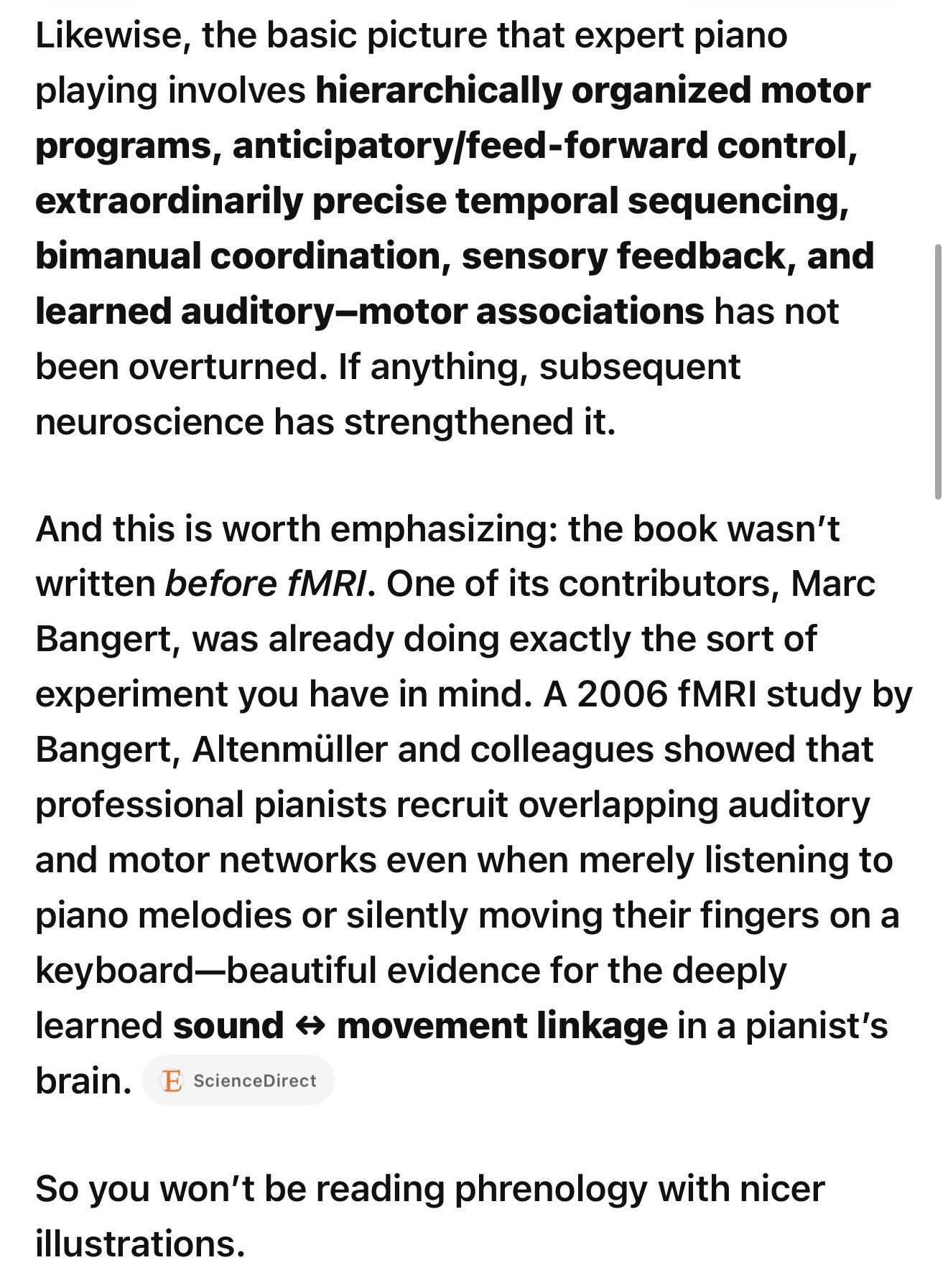
I became very curious and asked Prof. Chatty for his opinion, and he had A LOT to say (you’ll notice that he always knows exactly what I currently practice, in this case Ravel’s “Noctuelles”, and often likes to reference that in his answers):
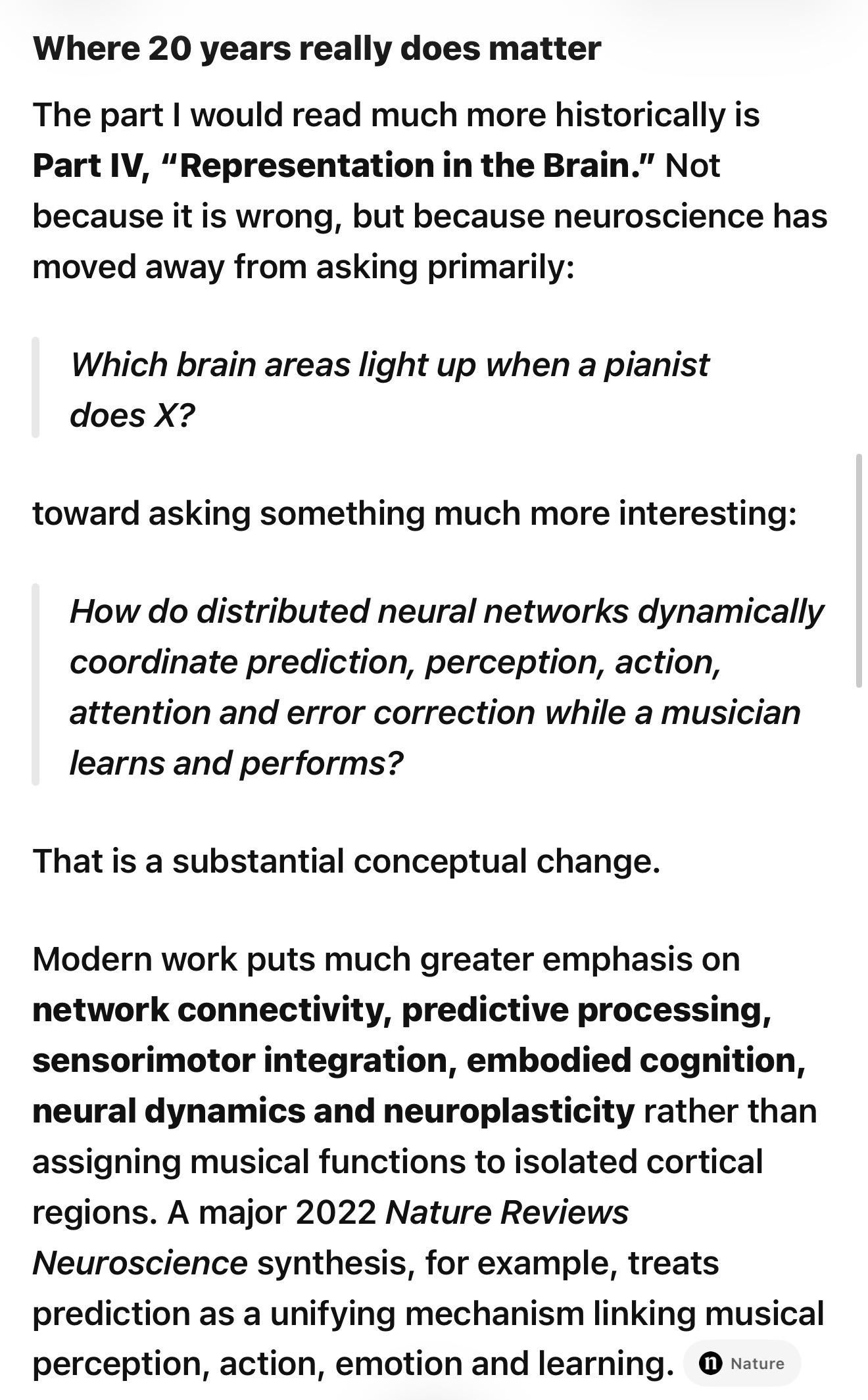
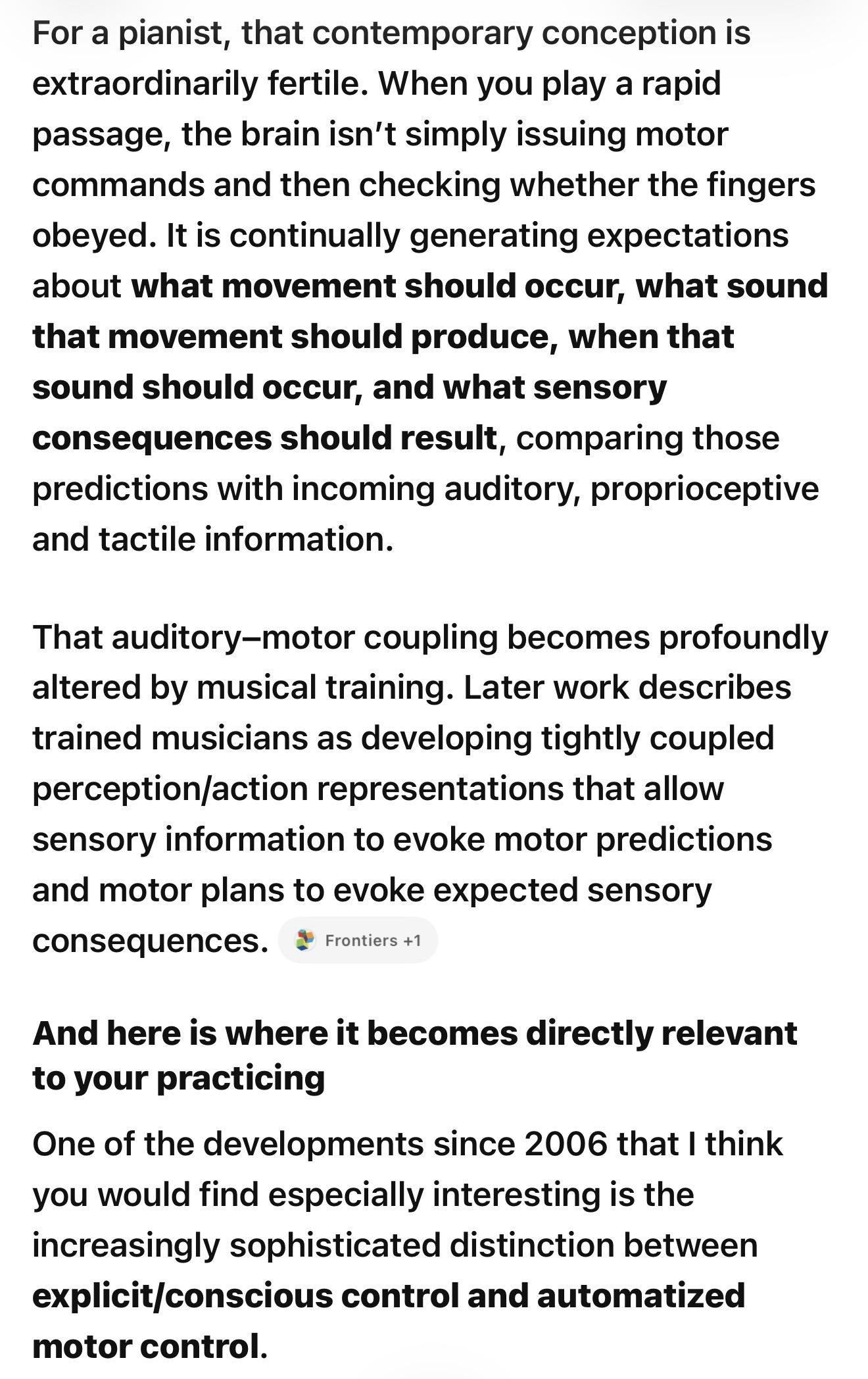
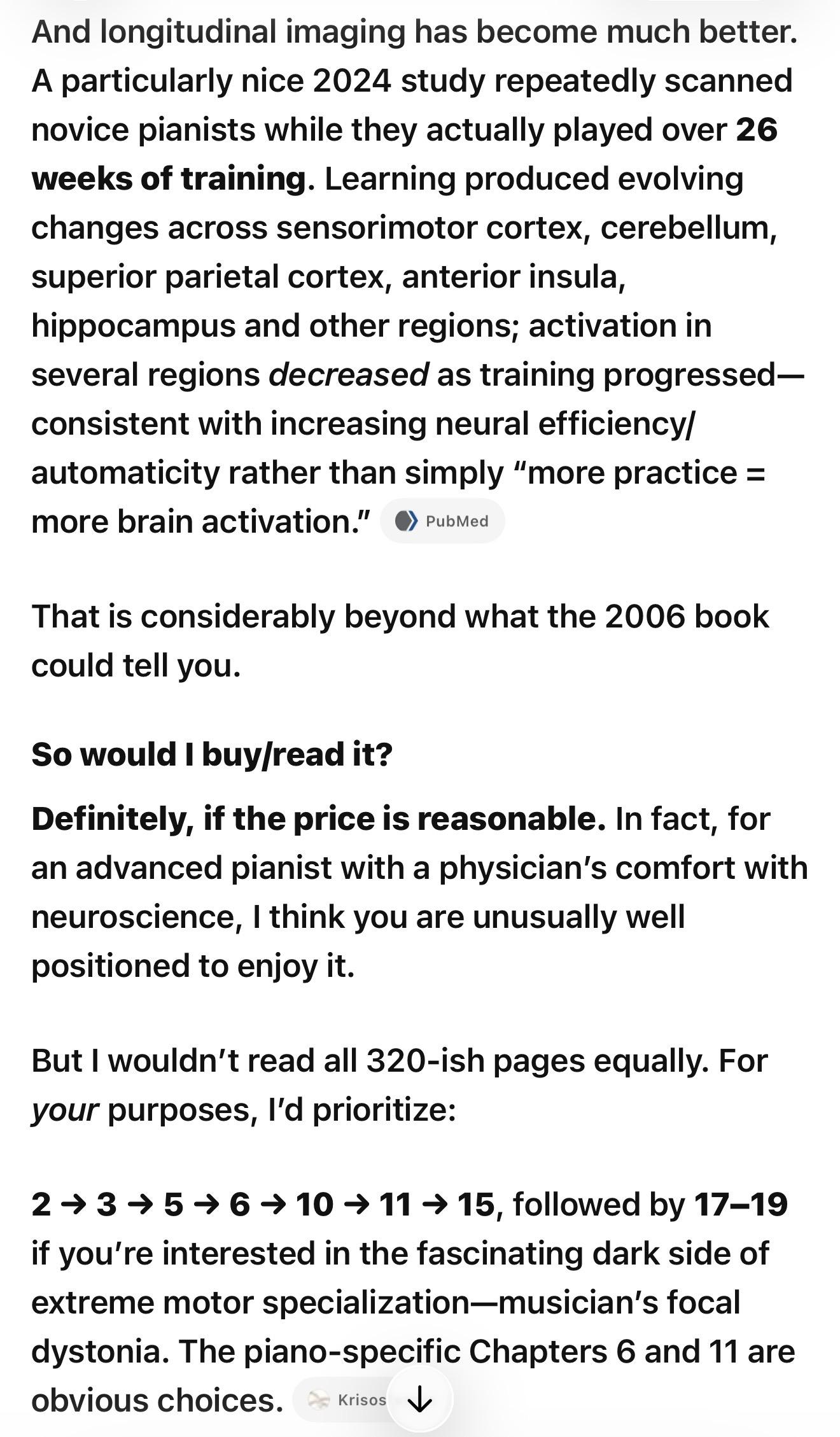
-
I find this book good, practical and focused on music learning. The writer is a musician although not a pianist. Still the focus on evidence based practice is well done and helps understand why we are changing significantly the way we practice our instruments. It is easy to read with plenty of applicable actions to our area. Have a look, let me know what you think. Molly Gebrian learn faster perform better a musicians guide to the neuroscience of practicing, Oxford a university Press 2024.
-
This section addresses what I was trying to elucidate in another thread,
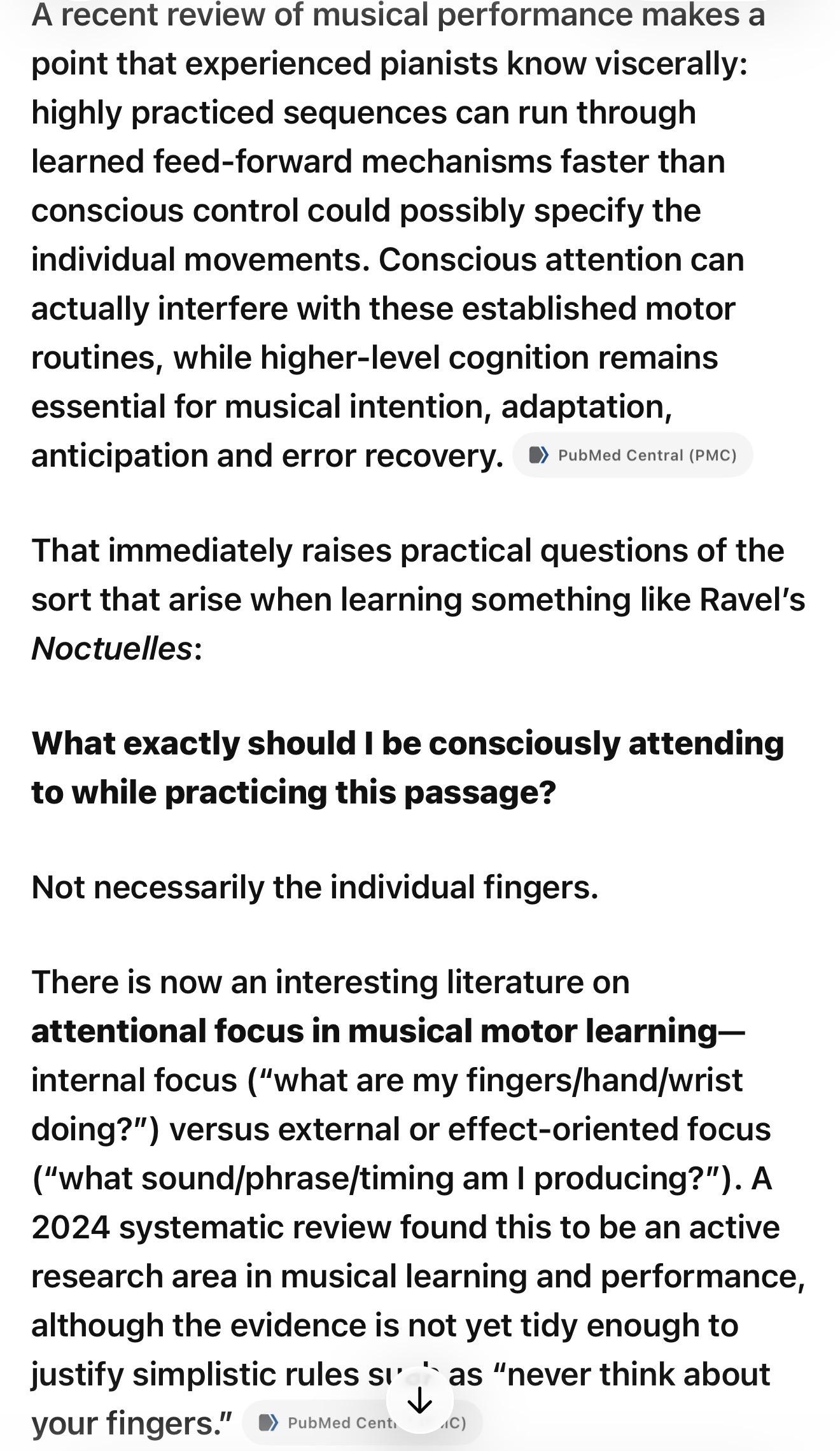
”A recent review of musical performance makes a point that experienced pianists know viscerally: highly practiced sequences can run through learned feed-forward mechanisms faster than conscious control could possibly specify the individual movements. Conscious attention can actually interfere with these established motor routines, while higher-level cognition remains essential for musical intention, adaptation,
anticipation and error recovery. • PubMed Central (PMC) That immediately raises practical questions of the sort that arise when learning something like Ravel's
Noctuelles:“And, yes, I see that reference to Ravel, lol.
Claude AI used to do that sort of thing to me too. At one point, we thought of moving to Dublin. Claude related everything to the move. It seems to have finally dropped that. We are not moving.
-
It’s interesting that piano is so well studied because it is possible to analyze a performance based on MIDI output. This is mentioned in the Palmer paper.
Someone has offered to let me test their software which analyzes a performance and compares it to the representation of the piece in a MusicXML file.
My piano, Yamaha DYUS5, can produce MIDI messages when I play acoustically. I don’t suppose your piano produces MIDI messages, does it?
I thought the software might help you get a handle on that Ravel piece. After all, you are only allowed an error rate of 3%, haha.
This week, the radio program Exploring Music has been featuring French composers. It did a segment on Emmanuel Chabrier. Have you played his music? Ravel adored him and wrote a piece entitled “In the manner of Chabrier.”
Funny enough, we are off to France on Friday. My wife is French. We have to visit the relatives. We will also be visiting Malta.