Mastering Tricky Passages and answering your questions!
Thu May 14 at 11 AM - 12 PM PDT
Event by Team

Welcome, everyone. 

If you’ve been sitting with questions about your playing, fingering, tricky passages, or musical roadblocks you haven’t quite cracked yet, this is a great moment to bring them out.


Whether it’s something small that’s been nagging you or a bigger challenge you’re ready to work through, every question is worth asking. Join us live today for real-time guidance and problem-solving!


Leave any and all questions below!

24 replies

null
    • priscillayam
    • 7 days ago
    • Reported - view

    Hello dominic

    I need help with Schubert impromptu No 3 Gb the Left Hand trills in bar 53-54 ends in f chord , fingering , very awkward to make the chord in the nest bar. 

    also the coda, bar 75 and 78 trills in left hadn't. what would be the dynamic of these long hairpins?  thank you Priscilla 

    • priscillayam
    • 7 days ago
    • Reported - view

    sorry, I uploaded 2 sets of photos but forgotten to press "reply" button for the text. 

    • Barbara_Sunseri
    • 6 days ago
    • Reported - view

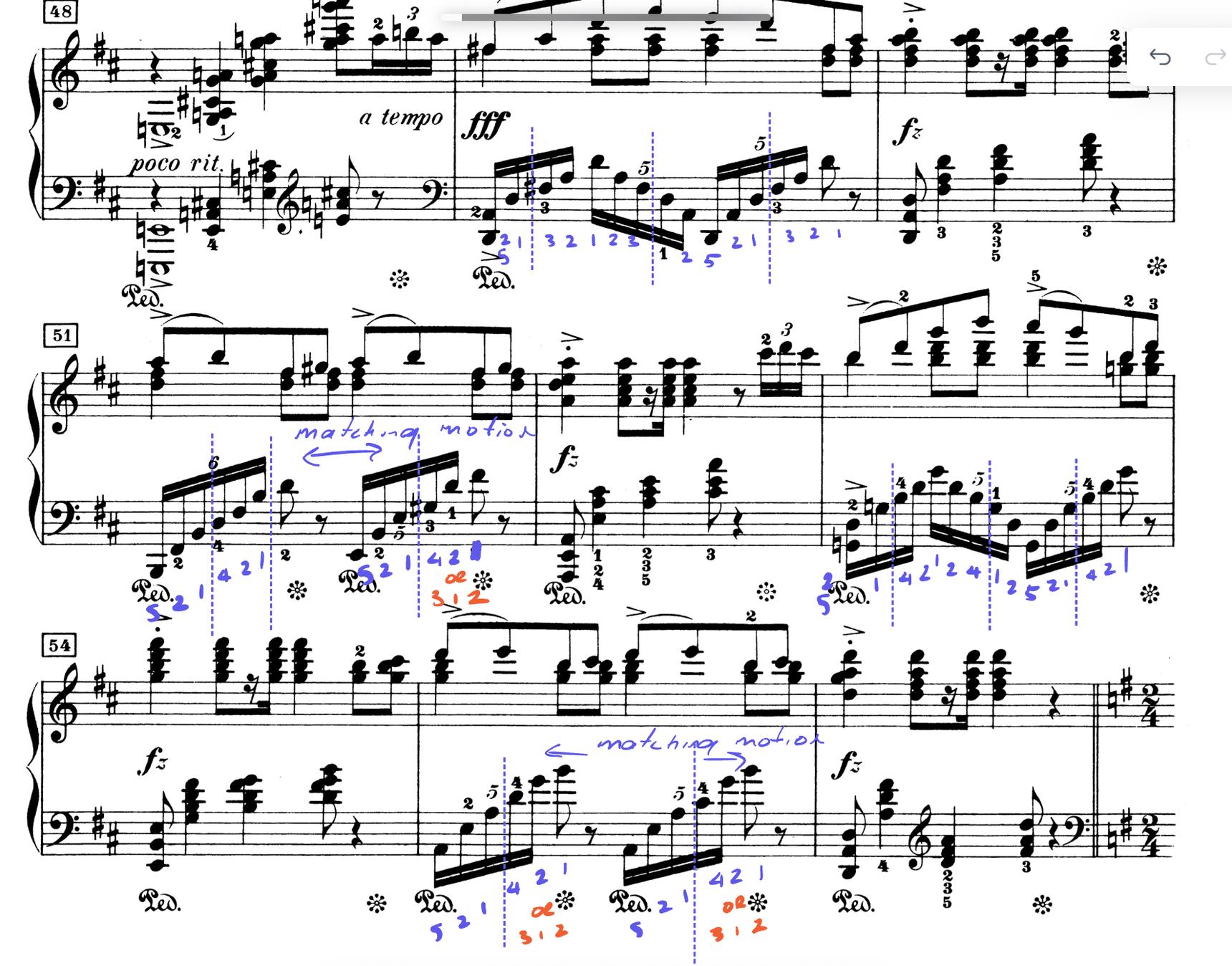
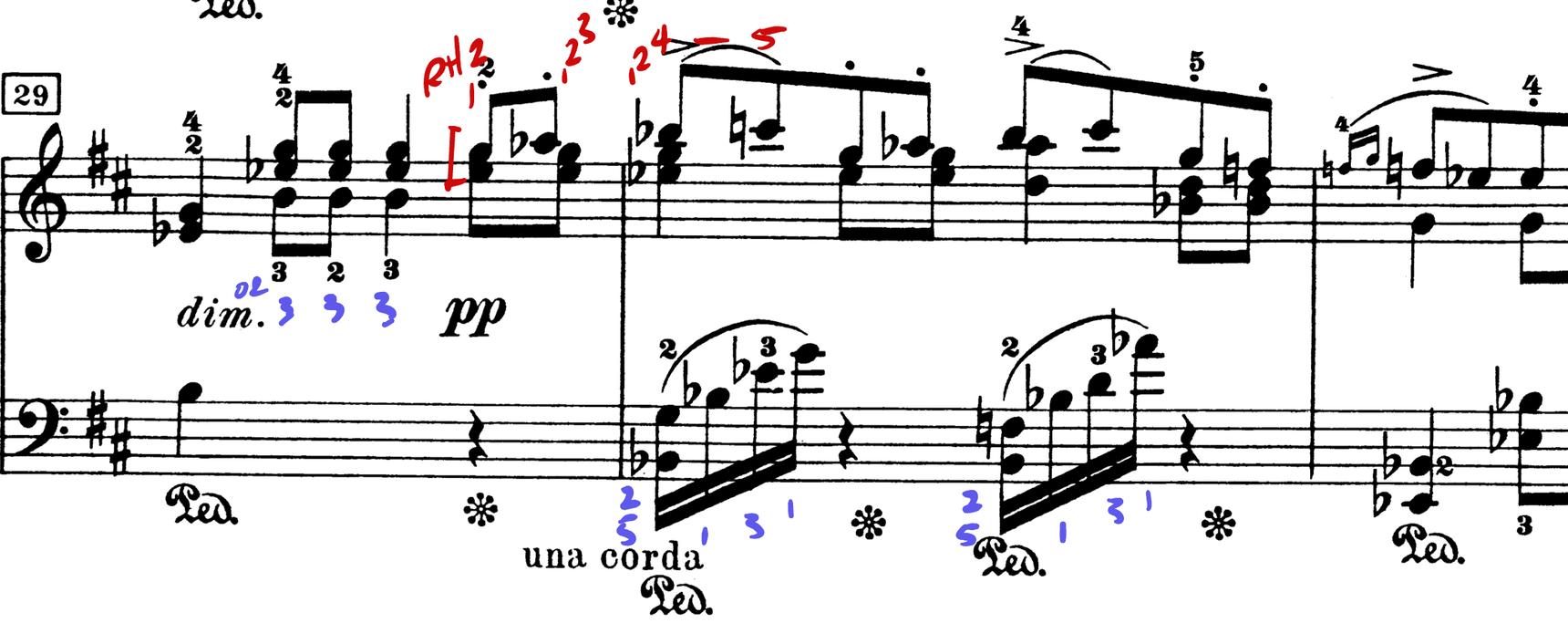
    Hi Dominic.  I'm learning Grieg's Wedding Day at Troldhaugen and I need fingering help with the arpeggios in measures 29, and 49-55.  Thanks so much!

      • hot4euterpe
      • 4 days ago
      • Reported - view

       Hi Barbara! Since this event is 2 weeks away I thought I'd share what I would do for fingering. I have a pretty average sized hand and I like fingering that lets me keep similar motions within a series of figures.  

      mm. 29-30:

       mm. 49-55: (orange fingering for alternative depending on reach / comfort. Dotted lines show hand position logic)

      • Barbara_Sunseri
      • 4 days ago
      • Reported - view

       Thanks so much, Dustin!  I hadn't considered using the 4th finger in the 5-2-1-4-2 sequence.  I'll definitely give it a try!

      • Noel_Nguyen
      • 3 days ago
      • Reported - view


      I agree with Dustin's excellent fingerings except for two minor differences:

      - In the first LH group of bar 30 I'd play (52)132 instead of (52)131 because there is less of a position switch that way.

      - In bar 51 LH I would play 521 542 1, 521 52 1. Yes, going from a 1 to a 5 looks scary on paper (especially to a 5 on a black  key!), but I just find my fingering more comfortable and I play that passage with more consistent accuracy that way.

      This being said, I'd avise to follow Dustin's fingerings rather than mine IF in doubt, because his are more conventional, but do recommend to experiment and chose.

      • hot4euterpe
      • 3 days ago
      • Reported - view

       You should of course try different options and see what you like. For this particular piece, a number of options will work. With that in mind, I should add a quick explanation for some of my suggestions / alterations because you will find them useful to consider for arpeggios in other pieces:

      For the first part of m. 30, you can indeed play 52 - 1 - 3 - 2 (as Noel suggested), or even 52 - 1 - 4 - 2. However, the reason I would avoid these here are:

      • They are less efficient; the thumb will get to the G quicker because it is the first possible finger to arrive.
      • 3-2 will often lead to a person creating an undesired stretch between these two fingers and / or a raised wrist. A 3-2 finish is more useful when the final note is a black key since 234 are naturally raised and longer. The thumb naturally sits lower.
      • Finishing on 1 allows for the smallest movement of the wrist and helps you to then 'propel' your arm calmly in the other direction for the next arpeggio. 

      For mm. 51 and 55, it can be tempting to play in groups of 3 that each start with finger 5. This is definitely an important technique at times, but it is not really necessary for this short figure or tempo (you will encounter a need for it in Liszt and Debussy though!). It also comes with several unnecessary risks:

      • players tend to misfire under pressure when they hop the 5 up the piano in an arpeggio
      • it disconnects your hand from the piano for a moment putting more reliance on the pedal and increases the likelihood of a bumped note as your rapid shift to 5 becomes unintended acceleration into the key.

      You can absolutely make either way work though. My suggestions are aimed at efficiency, a calm arm and wrist, and a connected sound from the fingers. =)

      • Noel_Nguyen
      • 3 days ago
      • Reported - view

        My suggestions are also aimed at efficiency, and also speed, easy accuracy, and reliability in actual performance situation 😜.

      And while we're at it, I would play the first group of bar 55 as 521 52 1! I'll spare you the theory/explanations/blabla. What can I say, maybe I've been playing too much Liszt lately, or more probably I'm just a heretic.

      • Noel_Nguyen
      • 2 days ago
      • Reported - view


       said:
      What can I say, maybe I've been playing too much Liszt lately, or more probably I'm just a heretic.

       Hmm, now I'm a bit puzzled. I was ready to destroy my own suggestions, but then did a quick survey of videos and the first very good performance in which I could really see the fingerings (the excellent and reliable Nikolai Lugansky, thanks to the reflection of his hands on a very polished fall board) in bar 51 used "my" fingerings... flawlessly. And frankly it didn't seem like he was taking "unnecessary risks".

      • Mom, fitness instructor, lover of music
      • Michelle_Russell
      • 2 days ago
      • Reported - view

       Thurmond spent the month of March working with Filippo Gorini, and one of the many wonderful things he taught in their lessons was: fingering is a very personal thing, so find what works for you (and keep it consistent!). Unless it's Chopin's fingering, then use what Chopin wrote!! 😄

      • Noel_Nguyen
      • 2 days ago
      • Reported - view

       Thanks, yes it's very personal, in this case just Lugansky and I, it seems. Strange pair, I know, and severely lopsided in talent (he king, me pawn).

      • Mom, fitness instructor, lover of music
      • Michelle_Russell
      • 2 days ago
      • Reported - view


       said:
      (he king, me pawn)

       Haha! That gave me quite a chuckle - especially since I won a chess game against Thurmond with a pawn (granted, Thurmond helped me win because he couldn't contain his joy at seeing a good end game, even if it was on my part and not his!). Don't discount Pawn Power....

      • Barbara_Sunseri
      • Yesterday
      • Reported - view

       Thank you, Noel and Dustin, for these detailed suggestions!  I looked at both and I'm actually doing a hybrid of the two!  I appreciate your comments so much!

      • Barbara_Sunseri
      • Yesterday
      • Reported - view

       Thank you, Noel and Dustin, for these detailed suggestions!  I looked at both and I'm actually doing a hybrid of the two!  I appreciate your comments so much!  

    • Mom, fitness instructor, lover of music
    • Michelle_Russell
    • 2 days ago
    • Reported - view

    Any general advice for maintaining relaxation in the right hand while learning the Bach Little Prelude in c minor (BWV 999)? Things that have helped: I have changed the fingering my teacher gave me in some places, such as beginning in measure 7, he had me playing 1-2-4; switching to 1-3-5 in some places helped enormously. Moving a little more quickly and practicing in shorter sections has also helped. But I still start feeling uncomfortable tension as I get into the piece, especially where the intervals are larger and the RH crosses midline (measure 26-29 is a good example - leaning back and to the left does help somewhat here). Thanks for any suggestions.

      • hot4euterpe
      • 2 days ago
      • Reported - view

       Hi Michelle =) This great piece has been played by students a number of times in my studio over the years. You are describing an issue that often comes up. The most common issue with RH tension in this piece is the RH is staying fixed in place with the thumb floating over its low note with fingers 4 and 5 stretching to their notes creating a 'bent' hand when they are played (similar to "ulnar deviation position"). The wrist should constantly be moving sideways toward the outer part of the hand so these notes can play without tension by having the wrist support them, then move back toward the thumb. The thumb should remain at rest position and not try to stay in place on the keys just to be ready for its next note - the wrist will bring it back when it is time. Then a quick moment for the hand to 'breath' before doing it again for the next figure.

      Other than that common issue, a light touch and quick (but gentle) release of the fingers so as not to get stuck in the keys (which causes the wrist to be restricted) are also helpful!

      I can of course only make assumptions based off your description so you may feel you are already doing these things. Hopefully something in that is useful to you though =)

      • Mom, fitness instructor, lover of music
      • Michelle_Russell
      • 2 days ago
      • Reported - view

       Hi Dustin! Thanks for the input. I am releasing my RH thumb from the key, but upon further inspection I noticed that I am not relaxing it. So while it does move with the hand in the sideways motion, the thumb is not "at rest." I'll spend some time with that, intentionally releasing tension in the thumb, and see how it goes. Again, thank you! 

    • Unfrozen Barroom Piano Player
    • Peter_G
    • Yesterday
    • Reported - view

    MORE ON THE MIDDLE PEDAL!

    Hello everyone, including  ,    

    To all those interested in the “Middle Pedal” discussion during the Apil 22 “Tricky Passages” LiveStream, I have posted an audio-only recording of myself using the Middle Pedal in the Rachmaninoff E Major Prelude, as performed in a student recital given on May 19, 2000 as part of a Continuing Ed “Piano Performance Seminar” at New England Conservatory. I’ve re-uploaded the score so you can follow along...(page 2 of the PDF.)

    The section featuring the Middle Pedal starts at 2:20.  There you will hear a complete descending E Major Scale, played legato, starting with the E above Middle C, right in the middle of the piano, while both hands are also flying around to other registers, making it impossible to hold the E major scale notes and play the others at the same time.  . I addressed this by grabbing the scale notes with the Middle Pedal as soon as I could without interference from the surrounding notes. I thereby managed to play the scale legato and the surrounding notes staccato (on purpose, I might add!).

    The scale begins on the first measure of the next to the last staff. Some of the notes I could hold, but others I needed the pedal for, and those are circled in red

    I dug this out of an old box of tapes in my basement, and was surprised to hear that I seemed to have pulled it off. There is a generous allotment of mistakes elsewhere but not in that section. So you will be able to hear why I was so interested in cultivating this technique.

    The recording is made on a CASSETTE, copying off a Digital Audio Tape (DAT), using a quickly cobbled together inexpensive stereo microphone set up.  No video of course. (pocket size movie cameras weren’t invented in those days!)

    I took this seminar 8 times during a 4 year span from 1997-2000, and managed to stagger through all 24 Rachmaninoff Preludes, generally 4 per semester, in recitals like this.  Somewhere I have cobbled together  a single cassette featuring all of the Preludes, which I may post some day if I have sufficient temerity.

    My present day goal is to re-do and polish all of these pieces, now that I have a nice piano of my own and advanced recording technology, all in my own home!

    I have taken the liberty of cc’ing:  Noel, Doug and Dominic himself, as they all offered thoughts and suggestions, I hope that others will find it interesting also.

    Hope you enjoy it! 

    Peter Golemme
      • Noel_Nguyen
      • Yesterday
      • Reported - view

        off-the-charts clarity! The trade-off is that it is rather difficult to play it any faster, but here the tempo sounds good to me! I personally would play it faster, with half-pedaling the sustain pedal, but don't let me deter you from your exquisitely sophisticated approach!

      • Unfrozen Barroom Piano Player
      • Peter_G
      • Yesterday
      • Reported - view

       hey Noel,

      Thank you so much for the feedback. And you can take it as a given that I will always be interested to know how you would approach a piece, even where it’s radically different from my approach.

      Back then, I did play this a little faster in the class sessions, but I was missing badly onsome of the chords, so I slowed it down and took some breaths here and there and ended up with many fewer misses!

      And as always with these preludes,, I find the chord patterns so beautiful that I would hate to whizz by them even if I could.

      I have a recording of rachmaninoff playing this prelude, , and I believe he does it much faster. With perfect clarity, of course.

      • Der Wanderer
      • FRANZ_SCHUBERT
      • Yesterday
      • Reported - view

       Peter, this is just fantastic!  And you played all 24 too!  I am going to demand that you get them all back through some Unfinished Business priorities and give us a nice complete concert program of the complete set very soon :-)

      RE: And as always with these preludes,, I find the chord patterns so beautiful that I would hate to whizz by them even if I could.

      You are right on the money here!  A discussion perhaps for another day but as every day passes as I sit at the piano and spend time with music these days I am becoming a stronger proponent of going in the opposite direction of speed.  Exactly opposite direction perhaps to a fault but I don't care (since I'm right about this ;-))

      As to the last two lines of this Prelude what you did is remarkable.  I just tried this out at the piano and the uncoordinated me couldn't do it.  I have never been good at the skill of pedalling (I'm working at this Unfinished Business as well) and felt if I could or had to use my feet with that much skill I should become an organist!

      Tell me if I have your method down?  You press the middle pedal with your left foot in addition to pedalling regularly with your right foot?  If so, then you press the middle pedal just after playing the note you want sustained?  In this case you only used the middle pedal five times on the circled 3 half notes and 2 whole notes and only for the duration of those note values?  The rest of the notes in the descending scale you can hold or can easily be heard like in the last bar of the second last line?

      This is difficult for me (but I've never played or practised this Prelude).  Especially trying to connect the volume of the descending diminuendo scale between the middle pedalled notes and the not middle pedalled notes.  Somehow, there is time needed in the action to return to normal after lifting the middle pedal too?  Maybe not much time but a little?

      Sorry for the lengthy response as I am just trying to think the process through and this is how my slow brain works it through these things.

      • Unfrozen Barroom Piano Player
      • Peter_G
      • 8 hrs ago
      • Reported - view

       Hi Doug, first of all no need to apologize for a lengthy comment! one of the main reasons I joined Tonebase was to interact with other musicians, sharing ideas and commentary and opinions. So I'm always happy to hear what others are thinking. 

      Let me try to answer your questions about how I did this. First I'd like to say that it does take practice so don't assume you can't do it.  You can't convince me that you, Doug, are so unco-ordinated that you couldn't stomp your left foot down on a pedal at a specific time if your brain was prepared for the moment when it arrived. 

      So what do I do?  You are correct that I only used the Middle Pedal on those 5 circled notes..  The 5th note is optional because actually I can reach all those lower notes (which span only an octave) while still holding it down.  And yes I do all my regular pedaling with the right foot. Regular pedaling is very intuitive to me, so much so that I am hardly aware of it, and that's not something I would want to disrupt. 

      So I use the left foot exclusively for the other pedals, namely the Middle Pedal and the Una Corda (have not yet worried about what to do if both were needed at once!) . It's a very specific thing that you have to practice, especially as as to the timing.

      The vertical lines drawn on the score show exactly when I stomped down on it. You'll see that the vertical lines mean it had to be stomped on exactly between the 2 eighth notes in the bass, as indicated. The preceding bass notes had to be fully released before the stomp and the stomp had to be fully executed before the 8th notes that followed.  Also, the exact moment was not the same each time. For example with the D# and B, the stomp happend before the next  8th note, and with the lower E, it came after the second 8th note to allow for releasing the lower quarter-note E, and for the G#, the RH had to reach a 10th on the beat which I could not reach at that tempo and so I rolled it, with the G# and the stomp both coming a split second before the 8th note on the beat.

      I practiced this over and over again, to get the stomp in exactly the right spot. It eventually became easier to do at slow tempos, and eventually my foot relaxed to the point where it was no longer a stomp . Then it was just a matter of very gradually speeding it up. Over and over and over to the point where it was hard-wired. 

      Noel is right that trying to place the stomp into the middle of 2 eighth notes does put an upper limit on how fast you can play this part, but like you, I think the piece still sounds really nice at a "slower" tempo like this (which was just about as fast as I could ever hope to play it anyway).  

      Releasing the pedal was totally non-critical in comparison. It did not need to be nearly as precise.  The note was usually well-decayed before the next right hand note, so holding it for too long didn't create a blur.  The Middle Pedal, unlike the una corda, does not move the keyboard, at least on my piano, so there's nothing to adjust there.  So I did not really need to practice releasing the pedal  very much. The main concern was to be ready for the next stomp.

      Give it a try.  Just like other difficult passages, the main thing is to practice it VERY slowly until you can get it exactly right, and then gradually speed it up.

      P.S. Dominic has a great Live Stream on pedalling, although it deals mostly with the regular pedal and the una corda. If you're working on your pedaling, you'll find some invaluable content there.

      • Der Wanderer
      • FRANZ_SCHUBERT
      • 8 hrs ago
      • Reported - view

       Thanks Peter for your explanation.  I will give it a try.  Regarding the pedal, yes, slow practice and lots of practice makes things easier eventually.  However, I am learning everything on my own (I have no good teacher) and so pedalling has always been a little allusive to me.  It is an art form in itself I think when a well trained musician goes beyond the basics and can adjust on the fly based on the room acoustics or apply only a 1/4 or 1/2 press or fluttering and as a listener you can't even tell they have used any pedal - this is a real skill and talent I hope one day to master too.

      And then there is Rachmaninoff.  Off and on I've been working on Op. 23 Nos. 6 & 7.  And I dream of being able to play Nos, 8 and 9 next.  I just love this music but I do find Rachmaninoff quite hard to play / learn.  In the mean time, I will continue to look up to you and Noel just knocking this stuff out of the park.  (Noel:  I recently listened to you play the Sonata and you made it look so easy !!)

      • Noel_Nguyen
      • 8 hrs ago
      • Reported - view

         Just to be clear, I do like to play fast(ish), but as a listener I prefer things on the slow side of normal. So, knock yourself out with the middle pedal and record those 24 preludes for my enjoyment!

Content aside

Attendees

Stats

  • 24Replies
  • 154Views