Sight Reading app recommendations

Hi, I'm wondering if anyone can recommend a good app / website for improving sight reading? I have downloaded the Schafer exercises recommended by Dominic, but I'm also hoping to use an app.


I have a digital piano, so can use midi for feedback. Also I have an iPad, so can use iOS apps. Seems a shame not to make use of the technologies available to me!


Thank you!

24 replies

null
    • Teacher
    • Mariana.1
    • 3 yrs ago
    • Reported - view

    Hi Victoria, 


    READ AHEAD I find well structured and is built with progressive increments in mind. 

      • Super keen adult beginner
      • Victoria_Chan
      • 3 yrs ago
      • Reported - view

      Mariana Thank you! I'll check that out.

      • Carol_Chua
      • 3 yrs ago
      • Reported - view

      Victoria Chan Victoria Chan 

    • Carol_Chua
    • 3 yrs ago
    • Reported - view

    Hi Victoria. Check out Facebook group called sight reading community. 

    You get sight reading tips David Holter is hosting a 3 day free workshop starting 27 sept.   It's a nice community with regular sight reading tips.  I have also completed the Sparks sight reading course.  Here you get personal tuition and visual exercises.  You might want to check it out. 

    • Carlodiminico
    • 3 yrs ago
    • Reported - view

    I would recommend Piano Marvel with a midi keyboard.

    • Statistician, Researcher
    • Steve_Coffey
    • 3 yrs ago
    • Reported - view

    Dr. Kate Boyd has a couple of youtu.be videos on sight reading, including one where she reviews four such apps.

    • Steve_Simpson
    • 3 yrs ago
    • Reported - view

    Check out Piano Marvel at https://pianomarvel.com/ . I use it and it works great.


    It's also highly recommended for sight reading by Josh Wright. 

    https://www.joshwrightpiano.com/

    • Peggy_Taylor
    • 3 yrs ago
    • Reported - view

    Look into Piano Marvel - well worth it if you stick with it.   It has assessment tools to help you see where you are and to track your improvement, plus you will have access to their huge library.  The Sight Reading assessment goes from very beginning to Advanced (Bach WTC, etc). you will need midi keyboard and laptop.  You can read the repertoire in their library from tablet on acoustic piano, but only the midi setup will do the sightreading assessments to show you exactly which notes/rhythms you got correct (green notes) and where errors occurred (red notes)  You receive a score for each exercise or piece.

      • Super keen adult beginner
      • Victoria_Chan
      • 3 yrs ago
      • Reported - view

      Peggy Taylor Sounds good. Thank you, I'll have a look.

    • Charles_Burns
    • 6 mths ago
    • Reported - view

    Hi Victoria, great that you have a MIDI keyboard and an iPad, that combination opens up the most useful options.

    One app worth looking at that does not get mentioned as often in these threads is Piano Tree (piano-tree.com). It was built specifically around sight reading rather than song learning, which makes a real difference. It uses real pieces rather than generated exercises, gives real-time feedback on both pitch and rhythm through MIDI, and sequences difficulty in a way that feels genuinely musical. The level structure goes from single melody lines right through to four-voice chorales and Bach-style writing, so there is a long runway. Works well on iPad with a MIDI keyboard and there is a free trial.

    Piano Marvel also comes up a lot and has a large library with a useful assessment score if that kind of tracking motivates you. The interface is dated but it is functional.

    The key thing with any of these tools is daily short sessions rather than occasional long ones. Ten minutes every day beats an hour on the weekend. And whatever you use, do not stop when you make a mistake. Keep the pulse going. That habit matters more than which app you choose.

    Good luck with it!!

    • Akzent oder Diminuendo?
    • Maria_F
    • 6 mths ago
    • Reported - view

    I struggle with sight-reading (I can read slowly at an intermediate level) and would also appreciate recommendations. I do not have a keyboard or an iPad, so many apps do not work for me. I have tried Sight Reading Factory and did not find it especially helpful. 

    • Noel_Nguyen
    • 6 mths ago
    • Reported - view
      • Akzent oder Diminuendo?
      • Maria_F
      • 6 mths ago
      • Reported - view

       I already have. It was helpful, but my issue isn't lack of knowledge as much as complete lack of talent (and the fact that I have dysmusia/musical dyslexia). 

      • Noel_Nguyen
      • 6 mths ago
      • Reported - view

       Interesting diagnoses that I have never heard of! At the very least you are medically literate.

      • Akzent oder Diminuendo?
      • Maria_F
      • 6 mths ago
      • Reported - view

       I think dysmusia is more common than one may think, especially in those with absolute pitch who can work around it by playing by ear. 

      Erik Satie almost certainly had dyslexia and dysmusia, and Chopin and Beethoven probably had dyslexia (but not dysmusia). 

      • Noel_Nguyen
      • 6 mths ago
      • Reported - view

       From a quick survey of the literature I don't think most doctors would know about dysmusia. But then again the medical field is known for not being so quick to recognize new entities. Even focal dystonia is considered fairly new.😬

      • Akzent oder Diminuendo?
      • Maria_F
      • 6 mths ago
      • Reported - view

       No, it is not well-known outside of "dyslexic students struggle more than average with sight-reading." 

      I am not formally diagnosed but my teachers and I am 99.9% sure I have it, and my experience of reading sheet music is nearly identical to dyslexic people's descriptions of their experiences of reading words. 

      • Noel_Nguyen
      • 6 mths ago
      • Reported - view

       One thing to keep in mind is that the medical field being so slow to recognize new clinical entities is not necessarily a bad thing. It prevents potential harm that could come from hastily accepting proposed treatments that may turn out to be harmful in the long run... That's one of the reasons it always takes a very long time for notions to go from alternative medicine to mainstream medicine, if ever.

      But enough academics for tonight! I'm going back to the piano now to refill my mind with good stuff!

    • Adult pianist · Founder of SightReader
    • Bret_Cameron
    • 4 days ago
    • Reported - view

    I’d like to throw my hat in the ring, with the disclosure that I built this app myself! 🎩

    As someone who struggled with sight reading for a long time, I had a widening gap between what I could play and what I could read. I could learn a Grade 6 piece over a few weeks, but put something new in front of me and I was back to Grade 2. Most apps I tried either drilled single notes or taught songs, and neither really closed that gap.

    So I built SightReader. It’s a library of graded pieces, from beginner through Grade 8, with live feedback on pitch and rhythm as you play.

    The Schäfer exercises you mentioned are one of the things SightReader recommends first, but the app includes lots of other great studies as well!

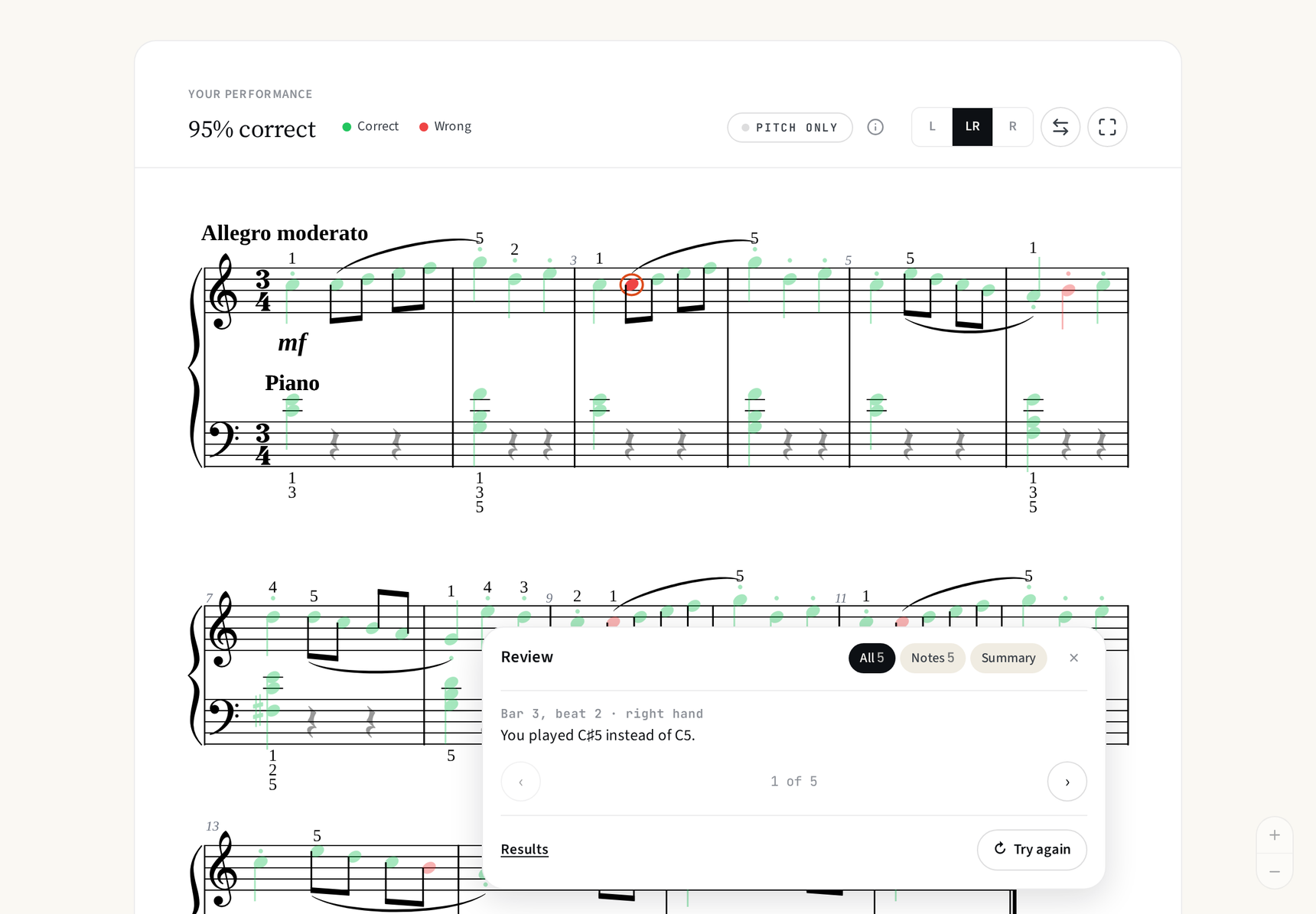
    You can use a MIDI keyboard, or just the microphone on an acoustic piano. After each piece, it shows you exactly where you went wrong, which helped me see whether my problem was the notes or the rhythm. There’s a permanent free tier if you want to try it.

    Happy to answer questions, and keen on feedback if anyone gives it a go!
      • Larry_K
      • 4 days ago
      • Reported - view

       Very cool! I will try it.

      I have been talking to Claude AI about building a multi-pass post hoc analysis tool which will give me feedback on rhythm, hand alignment, and missing or wrong notes. 

      I think a post hoc tool makes the analysis problem easier. Any analysis of interpretation is outside of the scope of the project.

      I would like your option about building such a tool. 

      I have an acoustic piano, a Yamaha DYUS5 that can output MIDI as I play acoustically. I can also record can play back mechanically.
       

      • Adult pianist · Founder of SightReader
      • Bret_Cameron
      • 4 days ago
      • Reported - view

       That's great, hope you enjoy it - and let me know if you have any thoughts!

      I think using Claude to build a "post-match review" is a great idea, though you may find SightReader already does similar to what you're looking for. 

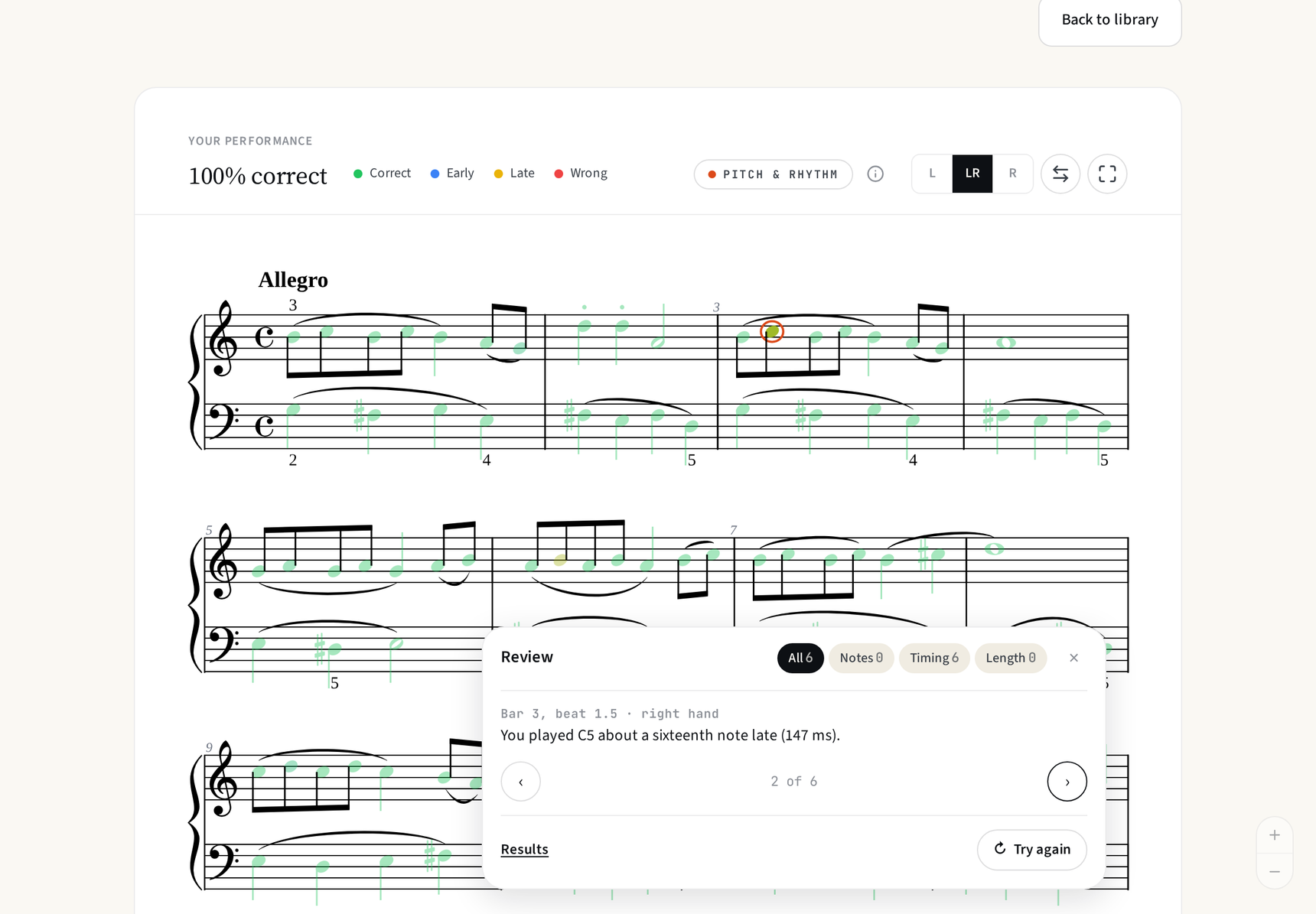
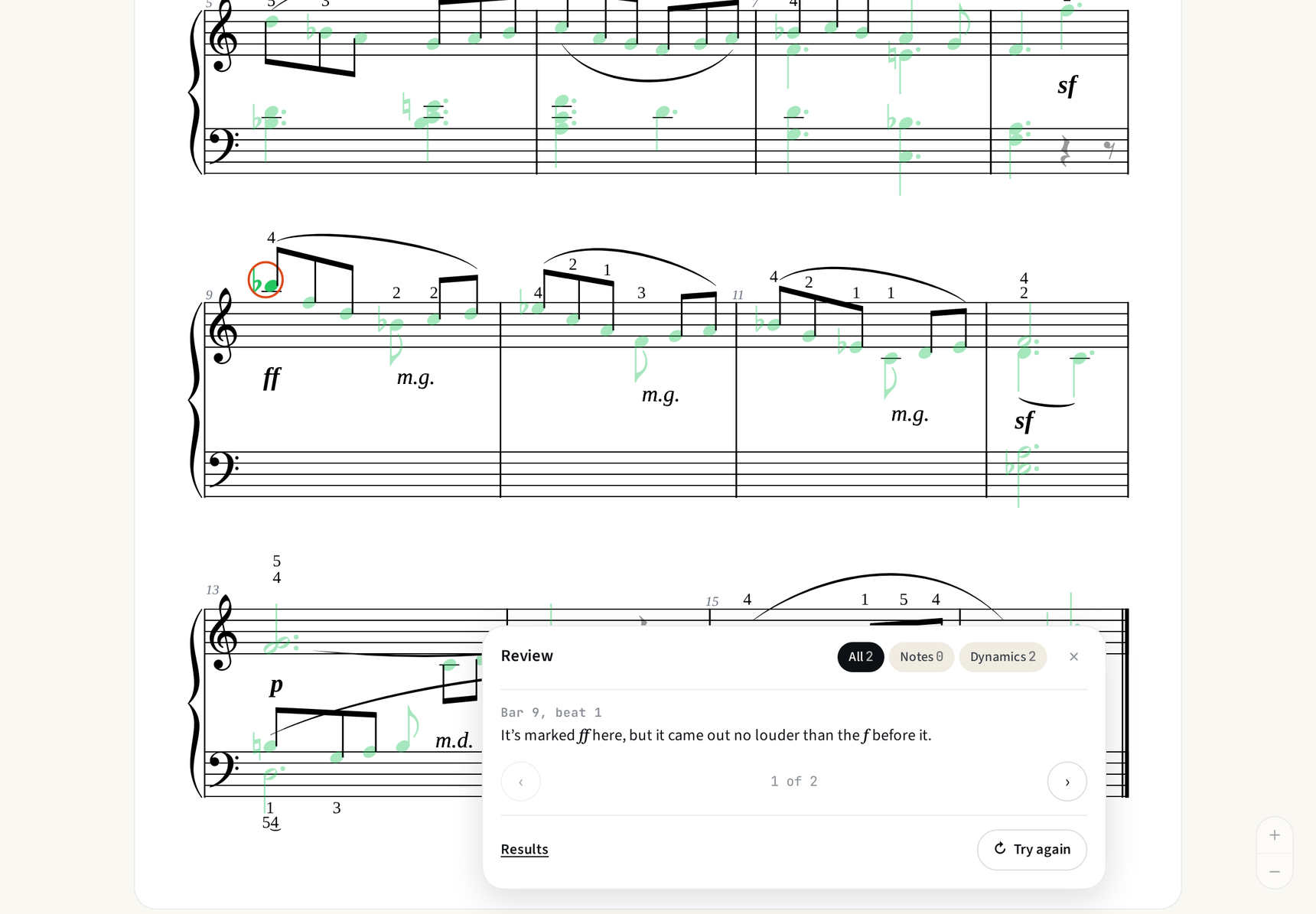
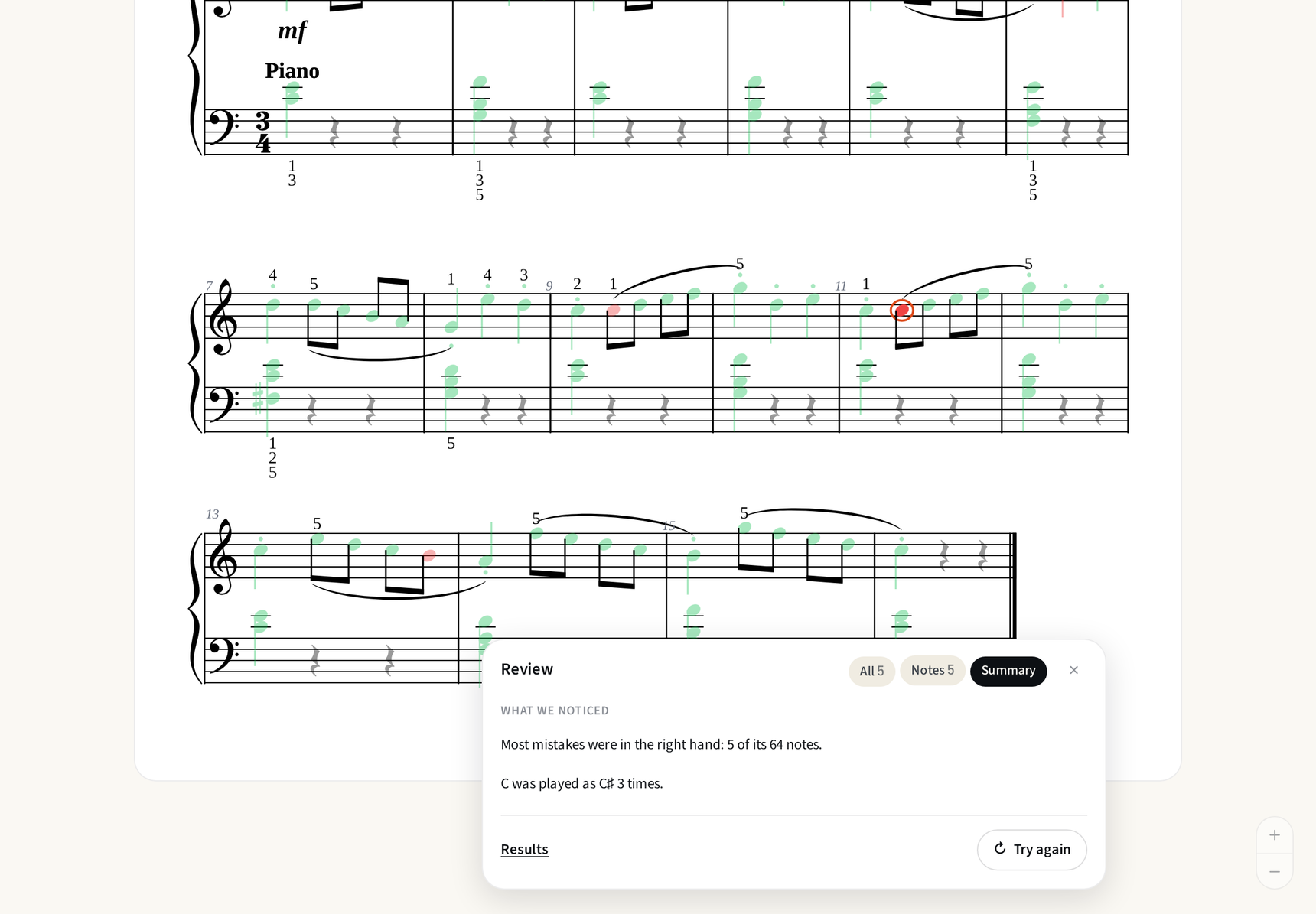
      After playing, you can get feedback on pitch, timing and dynamics (see screenshots below). It's also possible to upload your open pieces, if you have (or can get) a MusicXML version of them.


      • Larry_K
      • 4 days ago
      • Reported - view

       I can get MusicXML for any piece I am working on by writing it up using the StaffPad app with an Apple pencil on my iPad Pro and exporting in MusicXML format.

      Claude says I get this from post hoc analysis,

      ”

      What "post hoc + piano + intermediate/advanced" changes

      • Global alignment is possible, so two or three passes beat any online approach. Early passes build a tempo model, and later passes use it to resolve ambiguities.
      • Rubato is expected. At this level, "tempo error" mostly can't mean "differs from the marked BPM." I'd define two modes:
        • Self-consistency (default): flag unintended unsteadiness, such as rushing, stalls, or uneven subdivisions.
        • Target tempo: compare against the marked or user-supplied BPM (useful for metronome practice).
      • Precision beats recall. Advanced players quickly ignore a tool that cries wolf, so every flag carries a confidence score, and ambiguous regions go into an "uncertain" bucket instead of being flagged.
      • Piano-specific hazards are chord spread, hands that aren't together, ornaments, and repeated figuration (an Alberti bass makes a missed note alignable almost anywhere).

      Pipeline: three passes

      1. Coarse alignment. Pitch-dominant matching with a loose time prior gives a rough path and a first tempo curve.
      2. Refined alignment. Re-run the DP with the tempo curve as the time prior, which fixes ambiguity in repeated patterns. Iterate once or twice.
      3. Note-level matching and classification. Resolve the matched slices into note-level results, then run the timing analysis on the matched notes.”

      Are you doing post hoc analysis or live analysis? 

      • Adult pianist · Founder of SightReader
      • Bret_Cameron
      • 4 days ago
      • Reported - view

       This is very interesting.

      For SightReader it's a mixture of live analysis (for pitch and rhythm) and post hoc analysis.

      In the post hoc section I have:

      • Dynamics (this could be live, but isn't because it's too much visual clutter alongside pitch and rhythm feedback)
      • Repeated patterns in the playing (such as a repeatedly misplayed pitch). 

      There is maybe room to do more. Right now, I only show what can be measured with a high degree of confidence. So for example dynamic feedback only identifies clear dynamic mistakes, rather than anything that could be more subtle.

      Any rubato would also currently be marked as a mistake, but I think for a tool like this which is training reading ability, it's better to mark against strict time than being overly generous!

      • Larry_K
      • 4 days ago
      • Reported - view

       I agree that strict time is better than assuming rubato. 
       

      Here is my conversation with Claude, 

      https://claude.ai/share/0c68a8eb-3983-42df-b77f-8c8b9744b1ec

      I have a software background but not a music analysis background.

      I pushed Claude to write some code in Smalltalk, an environment that allows for live programming. Any method on any object can be halted in the debugger, rewritten, and execution continued from that stack frame.

      This had the unfortunate effect of making it more difficult to use some Python libraries. If you want, I can ask Claude to generate Python instead. 


      What did you write your app in?

      Let me know if any parts of that conversation are useful to you. There are some good sources for music analysis in the thread, including a paper by Nakamura.

      Maybe you could introduce an offline matching mode.

Content aside

  • 23 hrs agoLast active
  • 24Replies
  • 1482Views
  • 13 Following