Week 2: Getting into the Practice!
Week 1 was about choosing your piece and getting your bearings.
This week, we settle in and actually live with the music a bit.
As you practice, start paying attention to your first honest reactions.
A few prompts to get you thinking (and sharing below!)
- What feels easier than you expected?
- What’s proving more difficult or stubborn?
- Are there any spots that keep pulling your attention?
- What’s one clear goal you want to focus on this week?
No need for polished thoughts or solutions. Early observations are incredibly valuable, and chances are others are noticing the same things.
Share a few lines below about how it’s going so far. If you want, feel free to post a short clip or a marked-up score too.
Happy Practicing!
56 replies
-
I'm playing a piece by Zdenek Fibich op 41 no 4 entitled Poem...It has a lot of crescendos and diminuendos with rubato...just like real love...for my wife of 40 years...conrad
-
Liszt, Consolation No. 3
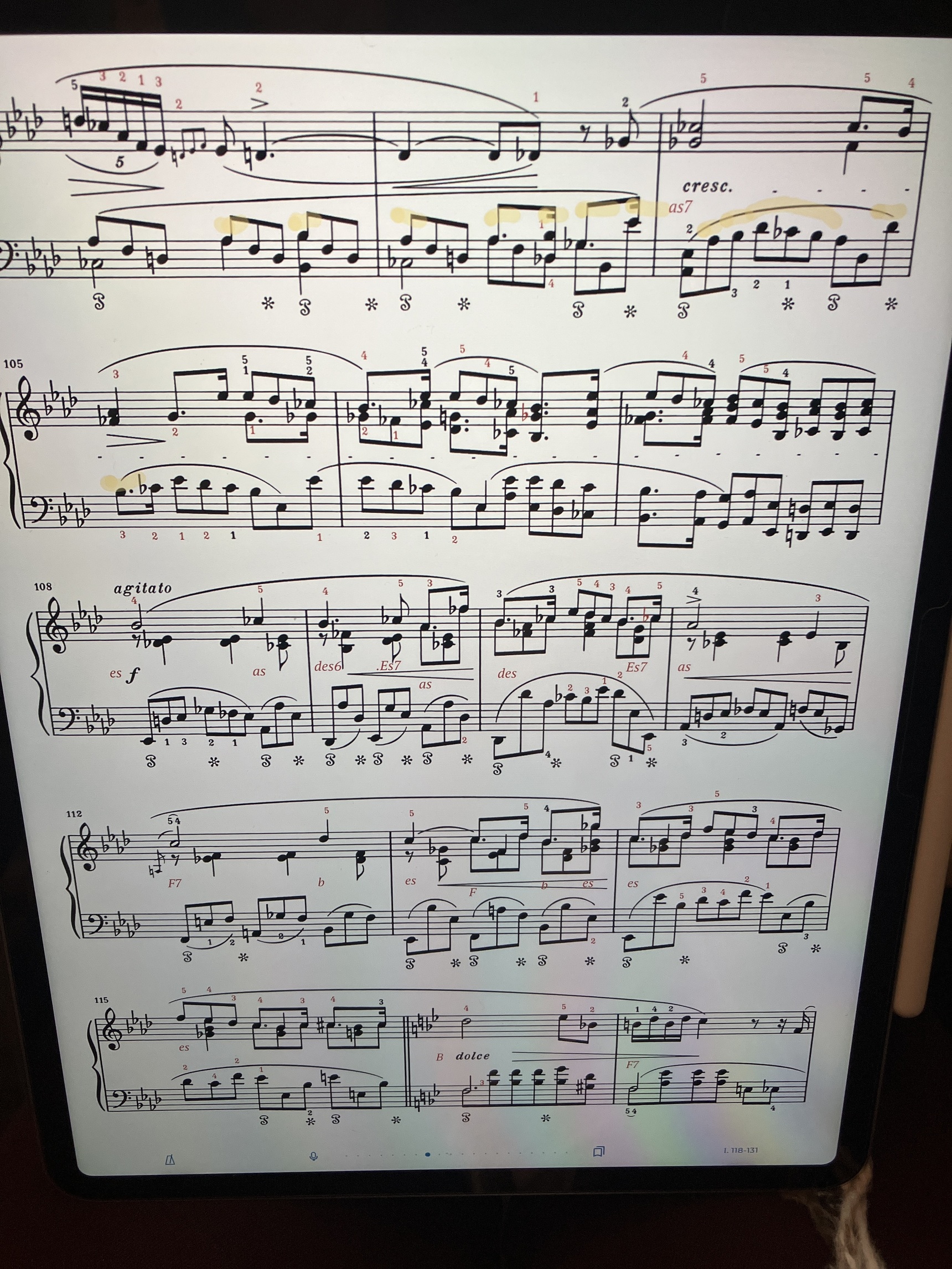
This piece has long tied D flats in the bass. When I chose it, I didn’t know that there were debates about whether to use the sostenuto to keep the D flat. Would appreciate thoughts on this issue, as well as on the use of the una corda (if any).
-
(Transcription of the Adagio from Rachmaninoff's Symphony no.2)
- What feels easier than you expected?
Learning the text! I know I complained a lot about this step because I find it the least pleasant one, but I'm glad it's behind me now.
- What’s proving more difficult or stubborn?
Since this is a transcription of instruments with sustained tones to the piano, I find myself pushing on the keys after hitting them, as if I could still manipulate the sound after the key has been struck! I have to keep reminding myself to release the pressure to a minimum as soon as I hit each key!
Another surprise challenge, since this is such a romantic piece, is that I sometimes struggle to contain the emotions! I have been playing mostly virtuosic music over the past year, so it has been a long time that I haven't played something that hits closer to home. Even though this is no programmatic music, I can't help but think of an extra-musical meaning, and to me this is a piece about saying goodbye to an impossible love. This takes me very far from the notes, and then I suddenly forget where I am in the piece! Oh well, it's still just week 2, I'll get there eventually. And btw, I'm not sure I made that up, the thing about the idea of saying goodbye / letting go. I'm pretty sure I read it somewhere that it was the meaning that the composer intended for this piece. And no, it's not Eric Carmen's (in)famous song "Never Gonna Fall in Love Again" that is incidentally quoting this piece 😂! (Although I have nothing against Mr. Carmen😆.) I just remember it was from an article, perhaps online. Maybe someone can confirm from a biography or other source?
-
Chopin Prelude in A (opus 28 no. 7)
What feels easier than expected? Putting hands together
What's proving more difficult or stubborn? Soft dynamics and voicing LH
One clear goal for this week: Complete learning of RH, especially the double 6th sections (maintaining relaxation, working on "thumb-thumb" paintbrush action, etc.)
-
https://youtube.com/shorts/x4czi_faa1Q?si=cecl3UKJobFJHv_O
This is the part of Chopin op.61 - some wrong notes here. 😂 I want to memorize it really stable. I am still searching around what’s next. And I am not sure how to play - how fast, how much rubato here and there. So I‘ll try different versions. Thanks for this challenge. It always brings me forward. I am looking forward to your pieces. 🙋♀️
-
Here's my status-check Take from Week 1 of the Challenge:
Intermezzo, as written:
Next, here's the same piece as a "tune" -- just playing the melody with the chords as though from a "lead sheet", without worrying about the specific notes (used as a device to help memorize the structure and to play around with the melody):
Intermezzo, as a "Tune":
What was "easier" then expected: the RH chord arpeggios: once chords and voicings were identified, the notes for the arpeggios fell right into place (mostly!). Also, the memorization went more easily than expected (though not all the way there yet), after mapping out the structure and realizing that some sections repeated themselves exactly, except for being in different keys.
Difficult & stubborn: The leaps, the co-ordination in the Coda, and the two 'easier' sections where the LH interjects a little chromatic melody line (mm.14-15, & mm. 29-30). Also, didn't realize that I was hammering the bass octaves so heavily, until I listened to my recording!
Attention spots: The climactic leaps to the 13th of the chords, mm. 11, & 26, and two beautifully dissonant voicings of diminished chords, which I THINK are Diminished 7th chords in a 6-4-2 voicing, with added 13th on the top (is there such a thing??), which amounts in essence to an F chord played on top of a Gb root + diminished 7th chord (m. 10 - which I'm calling an A diminished 13th), and a Bb chord played on top of a B root & diminished 7th chord (m 25, which I'm calling a D diminished 13th). I'll post a full harmonic analysis later.
Goals for Week 2:
1. Get all the notes confidently learned and memorized!
2. Explore the expressiveness of the melody (I noticed when playing it as a "tune" that I wanted to treat the melody much more gently than when playing it as written, where I leaned towards the dramatic, and making it more powerful -- perhaps the ideal is somewhere in between).