Week 2: Getting into the Practice!

Week 1 was about choosing your piece and getting your bearings.

This week, we settle in and actually live with the music a bit.


As you practice, start paying attention to your first honest reactions.


A few prompts to get you thinking (and sharing below!)

  • What feels easier than you expected?
  • What’s proving more difficult or stubborn?
  • Are there any spots that keep pulling your attention?
  • What’s one clear goal you want to focus on this week?


No need for polished thoughts or solutions. Early observations are incredibly valuable, and chances are others are noticing the same things.


Share a few lines below about how it’s going so far. If you want, feel free to post a short clip or a marked-up score too.

Happy Practicing!

27 replies

null
    • Conrad_Winn
    • 4 days ago
    • Reported - view

    I'm playing a piece by Zdenek Fibich op 41 no 4 entitled Poem...It has a lot of crescendos and diminuendos with rubato...just like real love...for my wife of 40 years...conrad

    • Karen_Sam
    • 3 days ago
    • Reported - view

    Liszt, Consolation No. 3

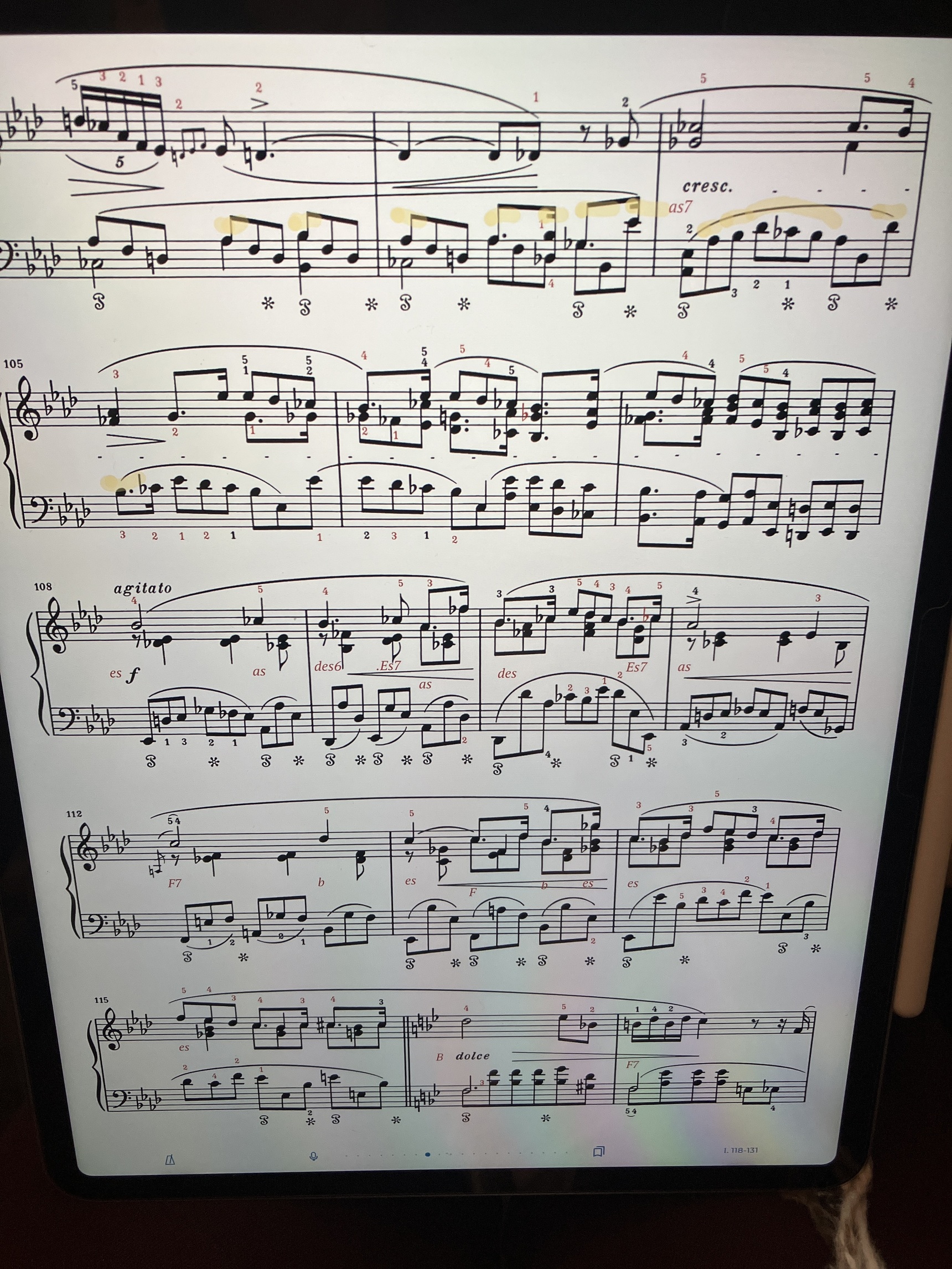
    This piece has long tied D flats in the bass. When I chose it, I didn’t know that there were debates about whether to use the sostenuto to keep the D flat. Would appreciate thoughts on this issue, as well as on  the use of the una corda (if any). 

      • hot4euterpe
      • Yesterday
      • Reported - view


      This is a great piece. You can absolutely use the una corda. Liszt used it often and not just for pianissimo passages; he also used it to differentiate the tone / sonority of a section. The sostenuto is more a personal choice. If I remember correctly, Liszt did get to experiment with the early sostenuto pedal and I think mentioned this consolation as an example of what textures could benefit from it. It was composed before the sostenuto existed though, so you could go either way. In the end, whatever gives you the most convincing sound / performance. Look forward to hearing it =)

      • Karen_Sam
      • 3 hrs ago
      • Reported - view


      Pressure’s on! 😅

      According to Wikipedia, Liszt did mention Consolation No. 3 as an example. He also said to exercise restraint. I think bar 3 is the only place where the sostenuto can be used. The other long D flats occur with notes in the treble clef and the sostenuto will hold those notes as well.

      Now to figure out the una corda.

    • Noel_Nguyen
    • 3 days ago
    • Reported - view

    (Transcription of the Adagio from Rachmaninoff's Symphony no.2)

    - What feels easier than you expected?

    Learning the text! I know I complained a lot about this step because I find it the least pleasant one, but I'm glad it's behind me now.

    - What’s proving more difficult or stubborn?

    Since this is a transcription of instruments with sustained tones to the piano, I find myself pushing on the keys after hitting them, as if I could still manipulate the sound after the key has been struck! I have to keep reminding myself to release the pressure to a minimum as soon as I hit each key!

    Another surprise challenge, since this is such a romantic piece, is that I sometimes struggle to contain the emotions! I have been playing mostly virtuosic music over the past year, so it has been a long time that I haven't played something that hits closer to home. Even though this is no programmatic music, I can't help but think of an extra-musical meaning, and to me this is a piece about saying goodbye to an impossible love. This takes me very far from the notes, and then I suddenly forget where I am in the piece! Oh well, it's still just week 2, I'll get there eventually. And btw, I'm not sure I made that up, the thing about the idea of saying goodbye / letting go. I'm pretty sure I read it somewhere that it was the meaning that the composer intended for this piece. And no, it's not Eric Carmen's (in)famous song "Never Gonna Fall in Love Again" that is incidentally quoting this piece 😂! (Although I have nothing against Mr. Carmen😆.) I just remember it was from an article, perhaps online. Maybe someone can confirm from a biography or other source? 

    • Mom, fitness instructor, lover of music
    • Michelle_Russell
    • 3 days ago
    • Reported - view

    Chopin Prelude in A (opus 28 no. 7)

    What feels easier than expected? Putting hands together

    What's proving more difficult or stubborn? Soft dynamics and voicing LH

    One clear goal for this week: Complete learning of RH, especially the double 6th sections (maintaining relaxation, working on "thumb-thumb" paintbrush action, etc.)

    • Kerstin
    • 3 days ago
    • Reported - view

    https://youtube.com/shorts/x4czi_faa1Q?si=cecl3UKJobFJHv_O

    This is the part of Chopin op.61 - some wrong notes here. 😂 I want to memorize it really stable. I am still searching around what’s next. And I am not sure how to play - how fast, how much rubato here and there. So I‘ll try different versions. Thanks for this challenge. It always brings me forward. I am looking forward to your pieces. 🙋‍♀️

      • Piano Player with Day Job (for now)
      • Peter_G
      • 2 days ago
      • Reported - view

       Very nice Kerstin, Op. 61 will be a worthy companion to your Chopin Sonata which you have played so well.  This little section gets so complex, especially towards the end! I think I would find it impossible to memorize, but it looks like you've got that covered already  I will enjoy watching your development progress of the passage as you decide what you want to do with rubato etc. 

      • Kerstin
      • 8 hrs ago
      • Reported - view

       Hi Peter! Thanks. Yes it is a really difficult piece. But I have fallen in love❣️This part is okay. There are other parts memorizing looks impossible, especially the part before. It needs time. 🙋‍♀️ This is the page before. 🤣🫣🤣

    • Piano Player with Day Job (for now)
    • Peter_G
    • 3 days ago
    • Reported - view

    Here's my status-check Take from Week 1 of the Challenge:

    Intermezzo, as written:

    https://youtu.be/4-LOZl2mpzg

    Next, here's the same piece as a "tune" -- just playing the melody with the chords as though from a "lead sheet", without worrying about the specific notes (used as a device to help memorize the structure and to play around with the melody):

    Intermezzo, as a "Tune":

    https://youtu.be/wd1DE-ivqCs

    What was "easier" then expected: the RH chord arpeggios: once chords and voicings were identified, the notes for the arpeggios fell right into place (mostly!). Also, the memorization went more easily than expected (though not all the way there yet), after mapping out the structure and realizing that some sections repeated themselves exactly, except for being in different keys.

    Difficult & stubborn:  The leaps, the co-ordination in the Coda, and the two 'easier' sections where the LH interjects a little chromatic melody line (mm.14-15, & mm. 29-30).  Also, didn't realize that I was hammering the bass octaves so heavily, until I listened to my recording!

    Attention spots:   The climactic leaps to the 13th of the chords,  mm. 11, & 26, and two beautifully dissonant voicings of diminished chords, which I THINK are  Diminished 7th chords in a 6-4-2 voicing, with added 13th on the top (is there such a thing??), which amounts in essence to an F chord played on top of a Gb root + diminished 7th chord (m. 10 - which I'm calling an A diminished 13th), and  a Bb chord played on top of a B root & diminished 7th chord (m 25, which I'm calling a D diminished 13th). I'll post a full harmonic analysis later.

    Goals for Week 2:  

    1. Get all the notes confidently learned and memorized!

    2. Explore the expressiveness of the melody (I noticed when playing it as a "tune" that I wanted to treat the melody much more gently than when playing it as written, where I leaned towards the dramatic, and making it more powerful -- perhaps the ideal is somewhere in between).
      • PViseskul
      • 3 days ago
      • Reported - view

       pretty amazing start to week 2! I love both versions 😊

      • Kerstin
      • 3 days ago
      • Reported - view

      Absolutely nice playing. 🌟

      • Piano Player with Day Job (for now)
      • Peter_G
      • 2 days ago
      • Reported - view

        Thank you very much Priya. I'm looking forward to hearing what you do with your Rachmaninoff piece in this challenge.  My piece here is short and fairly simple in comparison, but it's perfect as something I can learn well in a relatively short time and then hopefully use to work on some of the suggestions for expression that I expect we will get of out of this challenge.  Hopefully in week 2, with the piece more confidently memorized and practiced, I can work more on nuance and expression.

      • Piano Player with Day Job (for now)
      • Peter_G
      • 2 days ago
      • Reported - view

       Thank you for listening Kerstin. I'm off to a good start with this piece and will now focus on attempting to create a more refined and expressive performance by Week 5.

    • PViseskul
    • 3 days ago
    • Reported - view

    Rachmaninoff Elegie op 3 no 1 - I just about finished working out the fingering and those hand crossings/redistribution on the last page, so the practice this week will be mostly to get a handle on the final page esp the dramatic descending thirds ending.

    So far, the soft, double passage in the middle was much easier than I had anticipated, and the big passage that follows is slowly sinking in now after a bit of deconstructing the patterns on LH.

    Hope to find time to record and share a snippet this weekend.

    • Sachi
    • 3 days ago
    • Reported - view

    Mendelssohn-Hensel: Melodie op.4 no2

    What feels easier than you expected?

    - Playing middle layer/ accompaniment with both hands. 

    What’s proving more difficult or stubborn?

    - Left hand needs to jump after bass note and play middle layer accompaniment. 

    What’s one clear goal you want to focus on this week?

    - I need to get to know the piece more. Listen to recordings and make notes on my score: how good recordings do articulation, ideas of rubato, dynamics. 

    • Amateur piano enthusiast
    • Marc_M
    • 3 days ago
    • Reported - view

    I'm learning Scriabin's Op. 11 No. 11. It's a passionate prelude that starts with big minor vibes (obsessively returning C# in the base) and ending in B major, after an extended B pedal section.

    The left hand in the piece is rather wild and is constantly traveling up and down three octaves playing chords with extensions in an unusual pattern, usually at p and occasionally at pp or ppp.

    My plan: Focus on the left hand, getting it count-able and up to speed, and learn to sing the melody and counter melodies while playing it. Then add the right hand.  Challenge so far: learning the left hand has been going slow. It's not easy to get it into muscle memory. But I'm getting there! There are certain elements that are easier than they look, namely, the left hand's eighth notes on beats 4, 5, and 6. They're often played with the thumb, so making them stand out is natural. 

    I'll focus on finishing the left hand this week. We'll see if I can! Might be hard if I want to also do the Two Week Intensive I found out about yesterday. 😅

    To give a flavor of the challenge of the piece, here's an excerpt. 

    • Jenna_Nydam
    • 3 days ago
    • Reported - view

    I'm learning "Kind im Einschlummern" by Robert Schumann. I love it so much!

    1. Easier than I expected:
       - playing very soft dynamics, especially in the bass
    2. Proving more difficult or stubborn:
       - playing with fluency/even tone and playing longer lines
    3. Spots that keep pulling my attention:
       - measures 17 - 20 (a lot of tied notes)
       - measures 21 - 24 (RH taking over briefly for LH)
    4. One clear goal for this week:
       - shaping m. 1 - 8
       - slow practice m. 17 - 24; be clear where the melody is

    • tonebase_user.271
    • 2 days ago
    • Reported - view

    Traumerei-

    What feels easy- The writing style. It is unique but makes sense and is very pianistic.

    Stubborn- Focus, I'm working on scriabin op 11 with my teacher and have my own piano things for my job so I just haven't had all the time to work and sit with this piece. I have up until the first repeat and the ending. I need to find better practice habits to be efficient with my Piano workload.

    Pulling my attention- Well the most obvious thing is the quarter note=100 in my henle urtext edition. This seems to be not the best tempo and after some research it is entirely possible Schumann did not mean 100bpm. Most great recordings of this piece are quite slow. I've been phrasing it weird and kind of trying new things with it. I am definitely playing it too fast but I am having fun with it. For example during the eighth note passages at the end of measures I am slightly rushing them just playing around with rubato to find how I would like to interpret it. 

    One clear goal this week- Whole piece under fingers.

    • Doug_Weiss
    • 2 days ago
    • Reported - view
    • What feels easier than you expected?

     - Nothing!  Absolutely nothing


    1) Faschingsschwank aus Wien: Fantasiebilder Op. 26, No. 2 - Romanze, in g minor by Robert Schumann

    • What’s proving more difficult or stubborn?

     - Counting.  I am struggling with the rhythm of the triplet within the main motif.  Seems straightforward but the tempo is slow and this becomes a challenge for me.

    • Are there any spots that keep pulling your attention?

     - In addition to nailing the triplet rhythm there is one spot that has a ritardando written in three bars in a row.  It's very hard to feel confident that I'm returning to the original tempo each time and how.

    • What’s one clear goal you want to focus on this week?

     - I want to come to some conclusion on how I want to interpret this Romanze.


    2) Bunte Blätter Op. 99, No. 10 - Präludium in b-flat minor by Robert Schumann

    • What’s proving more difficult or stubborn?

     - Working out the fingering

    • Are there any spots that keep pulling your attention?

     - In bars 1 & 3 some stretches of a 10th in the RH are proving to be a challenge.

    • What’s one clear goal you want to focus on this week?

     - Slow practice / learn the notes


    3) Wandererfantasie Op. 15 - Adagio in c-sharp minor by Franz Schubert

    • What’s proving more difficult or stubborn?

     - Starting out too fast.  This is essentially a theme and nine variations roughly.  If you don't think about the ending variations and what is possible there this creates a problem because it is so easy to start too fast.  Figuring that out and setting the metronome for that is the only way I can judge the correct beginning tempo.

    • Are there any spots that keep pulling your attention?

     - Oh yes!  There are plenty of challenges in the first three pages but I have made good progress there.  The last five pages will keep my attention for a long, long time.  A few pages have two full lines for each bar.  Not sure I've ever seen something like this before.  It is really a stunning masterpiece of mathematics disguised as heavenly beauty.  

    • What’s one clear goal you want to focus on this week?

     - Slow practice of the ending working out more fingering.  Main focus also on the LH work

    • Christina_W
    • 2 days ago
    • Reported - view

    Hi - I'm new, and this is my first challenge and sharing a recording of any kind.  I chose something pretty short and simple - Field's Nocturne No.5 in B flat major because I have limited time and am not a quick learner.  

    What feels easier than expected?  I didn't expect to get my hands around it so easily in a week.  It's been pretty easy to learn.

    What's proving difficult?  Randomly hitting wrong notes.  There's no specific difficult passages - I just seem to always go to a few wrong notes, so I am trying to think harmonically and do some slow, focused practice.

    One clear goal for this week?  Do at least three "practice recordings", so I can listen and look for ways to improve, as well as feel less anxiety when I hit record!  

    • Sara.4
    • 2 days ago
    • Reported - view

    Brahms Intermezzo Op118 no 2

    A piece more difficult than it appears (stretching my technical skill, with its complex inner voicing and polyrhythms). I found Garrick Ohlsson‘s tutorial insightful for overall understanding, but far too premature, since it contains no hints on fingering or rhythm. So, I’m doing my own fingering and find it a bit difficult to decide in some places whether to allow something more comfortable or something that allows better legato. For example, I’m working through mm 34-37. Is it common for the left hand to take some notes? 
     

    I appreciate this challenge to force me to dedicate to a piece, to return to measure by measure basics, fingering and slow practice, which have neglected for 25 years since my training as a teen. 

      • PViseskul
      • Yesterday
      • Reported - view

       It's completely ok to redistribute the notes between the hands as you have done here (I also took the B to LH). Btw my Henle copy on have the B in bar 36.

      • Sara.4
      • Yesterday
      • Reported - view

       thank you Priya! And nice reminder for me to look at Henle for fingering. I tend to rely on my subscription access (musicnotes) because those are free for me, but they typically don’t have fingering and can even risk having incomplete or erroneous notes and markings. 

      • PViseskul
      • Yesterday
      • Reported - view

       even with Henle Urtext I still change plenty of the suggested fingerings 😂 We all have different hands/fingers that fit each passage differently after all 😊

Content aside

  • 1 Likes
  • 2 hrs agoLast active
  • 27Replies
  • 140Views
  • 20 Following