Week 2: Getting into the Practice!
Week 1 was about choosing your piece and getting your bearings.
This week, we settle in and actually live with the music a bit.
As you practice, start paying attention to your first honest reactions.
A few prompts to get you thinking (and sharing below!)
- What feels easier than you expected?
- What’s proving more difficult or stubborn?
- Are there any spots that keep pulling your attention?
- What’s one clear goal you want to focus on this week?
No need for polished thoughts or solutions. Early observations are incredibly valuable, and chances are others are noticing the same things.
Share a few lines below about how it’s going so far. If you want, feel free to post a short clip or a marked-up score too.
Happy Practicing!
56 replies
-
Here's my status-check Take from Week 1 of the Challenge:
Intermezzo, as written:
Next, here's the same piece as a "tune" -- just playing the melody with the chords as though from a "lead sheet", without worrying about the specific notes (used as a device to help memorize the structure and to play around with the melody):
Intermezzo, as a "Tune":
What was "easier" then expected: the RH chord arpeggios: once chords and voicings were identified, the notes for the arpeggios fell right into place (mostly!). Also, the memorization went more easily than expected (though not all the way there yet), after mapping out the structure and realizing that some sections repeated themselves exactly, except for being in different keys.
Difficult & stubborn: The leaps, the co-ordination in the Coda, and the two 'easier' sections where the LH interjects a little chromatic melody line (mm.14-15, & mm. 29-30). Also, didn't realize that I was hammering the bass octaves so heavily, until I listened to my recording!
Attention spots: The climactic leaps to the 13th of the chords, mm. 11, & 26, and two beautifully dissonant voicings of diminished chords, which I THINK are Diminished 7th chords in a 6-4-2 voicing, with added 13th on the top (is there such a thing??), which amounts in essence to an F chord played on top of a Gb root + diminished 7th chord (m. 10 - which I'm calling an A diminished 13th), and a Bb chord played on top of a B root & diminished 7th chord (m 25, which I'm calling a D diminished 13th). I'll post a full harmonic analysis later.
Goals for Week 2:
1. Get all the notes confidently learned and memorized!
2. Explore the expressiveness of the melody (I noticed when playing it as a "tune" that I wanted to treat the melody much more gently than when playing it as written, where I leaned towards the dramatic, and making it more powerful -- perhaps the ideal is somewhere in between).
-
Rachmaninoff Elegie op 3 no 1 - I just about finished working out the fingering and those hand crossings/redistribution on the last page, so the practice this week will be mostly to get a handle on the final page esp the dramatic descending thirds ending.
So far, the soft, double passage in the middle was much easier than I had anticipated, and the big passage that follows is slowly sinking in now after a bit of deconstructing the patterns on LH.
Hope to find time to record and share a snippet this weekend.
-
Mendelssohn-Hensel: Melodie op.4 no2
What feels easier than you expected?
- Playing middle layer/ accompaniment with both hands.
What’s proving more difficult or stubborn?
- Left hand needs to jump after bass note and play middle layer accompaniment.
What’s one clear goal you want to focus on this week?
- I need to get to know the piece more. Listen to recordings and make notes on my score: how good recordings do articulation, ideas of rubato, dynamics.
-
I'm learning Scriabin's Op. 11 No. 11. It's a passionate prelude that starts with big minor vibes (obsessively returning C# in the base) and ending in B major, after an extended B pedal section.
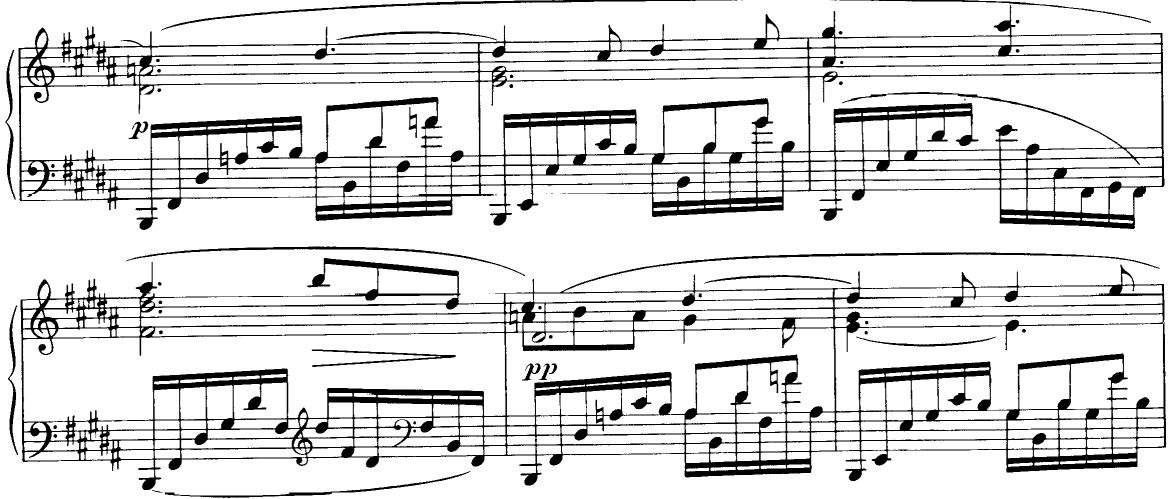
The left hand in the piece is rather wild and is constantly traveling up and down three octaves playing chords with extensions in an unusual pattern, usually at p and occasionally at pp or ppp.
My plan: Focus on the left hand, getting it count-able and up to speed, and learn to sing the melody and counter melodies while playing it. Then add the right hand. Challenge so far: learning the left hand has been going slow. It's not easy to get it into muscle memory. But I'm getting there! There are certain elements that are easier than they look, namely, the left hand's eighth notes on beats 4, 5, and 6. They're often played with the thumb, so making them stand out is natural.
I'll focus on finishing the left hand this week. We'll see if I can! Might be hard if I want to also do the Two Week Intensive I found out about yesterday. 😅
To give a flavor of the challenge of the piece, here's an excerpt.
-
I'm learning "Kind im Einschlummern" by Robert Schumann. I love it so much!
1. Easier than I expected:
- playing very soft dynamics, especially in the bass
2. Proving more difficult or stubborn:
- playing with fluency/even tone and playing longer lines
3. Spots that keep pulling my attention:
- measures 17 - 20 (a lot of tied notes)
- measures 21 - 24 (RH taking over briefly for LH)
4. One clear goal for this week:
- shaping m. 1 - 8
- slow practice m. 17 - 24; be clear where the melody is -
Traumerei-
What feels easy- The writing style. It is unique but makes sense and is very pianistic.
Stubborn- Focus, I'm working on scriabin op 11 with my teacher and have my own piano things for my job so I just haven't had all the time to work and sit with this piece. I have up until the first repeat and the ending. I need to find better practice habits to be efficient with my Piano workload.
Pulling my attention- Well the most obvious thing is the quarter note=100 in my henle urtext edition. This seems to be not the best tempo and after some research it is entirely possible Schumann did not mean 100bpm. Most great recordings of this piece are quite slow. I've been phrasing it weird and kind of trying new things with it. I am definitely playing it too fast but I am having fun with it. For example during the eighth note passages at the end of measures I am slightly rushing them just playing around with rubato to find how I would like to interpret it.
One clear goal this week- Whole piece under fingers.
-
- What feels easier than you expected?
- Nothing! Absolutely nothing
1) Faschingsschwank aus Wien: Fantasiebilder Op. 26, No. 2 - Romanze, in g minor by Robert Schumann
- What’s proving more difficult or stubborn?
- Counting. I am struggling with the rhythm of the triplet within the main motif. Seems straightforward but the tempo is slow and this becomes a challenge for me.
- Are there any spots that keep pulling your attention?
- In addition to nailing the triplet rhythm there is one spot that has a ritardando written in three bars in a row. It's very hard to feel confident that I'm returning to the original tempo each time and how.
- What’s one clear goal you want to focus on this week?
- I want to come to some conclusion on how I want to interpret this Romanze.
2) Bunte Blätter Op. 99, No. 10 - Präludium in b-flat minor by Robert Schumann
- What’s proving more difficult or stubborn?
- Working out the fingering
- Are there any spots that keep pulling your attention?
- In bars 1 & 3 some stretches of a 10th in the RH are proving to be a challenge.
- What’s one clear goal you want to focus on this week?
- Slow practice / learn the notes
3) Wandererfantasie Op. 15 - Adagio in c-sharp minor by Franz Schubert
- What’s proving more difficult or stubborn?
- Starting out too fast. This is essentially a theme and nine variations roughly. If you don't think about the ending variations and what is possible there this creates a problem because it is so easy to start too fast. Figuring that out and setting the metronome for that is the only way I can judge the correct beginning tempo.
- Are there any spots that keep pulling your attention?
- Oh yes! There are plenty of challenges in the first three pages but I have made good progress there. The last five pages will keep my attention for a long, long time. A few pages have two full lines for each bar. Not sure I've ever seen something like this before. It is really a stunning masterpiece of mathematics disguised as heavenly beauty.
- What’s one clear goal you want to focus on this week?
- Slow practice of the ending working out more fingering. Main focus also on the LH work
-
Hi - I'm new, and this is my first challenge and sharing a recording of any kind. I chose something pretty short and simple - Field's Nocturne No.5 in B flat major because I have limited time and am not a quick learner.
What feels easier than expected? I didn't expect to get my hands around it so easily in a week. It's been pretty easy to learn.
What's proving difficult? Randomly hitting wrong notes. There's no specific difficult passages - I just seem to always go to a few wrong notes, so I am trying to think harmonically and do some slow, focused practice.
One clear goal for this week? Do at least three "practice recordings", so I can listen and look for ways to improve, as well as feel less anxiety when I hit record!
-
Brahms Intermezzo Op118 no 2
A piece more difficult than it appears (stretching my technical skill, with its complex inner voicing and polyrhythms). I found Garrick Ohlsson‘s tutorial insightful for overall understanding, but far too premature, since it contains no hints on fingering or rhythm. So, I’m doing my own fingering and find it a bit difficult to decide in some places whether to allow something more comfortable or something that allows better legato. For example, I’m working through mm 34-37. Is it common for the left hand to take some notes?
I appreciate this challenge to force me to dedicate to a piece, to return to measure by measure basics, fingering and slow practice, which have neglected for 25 years since my training as a teen.
-
Hi everyone,
This video was recorded on a Roland F701 digital piano and apologies for the video quality, it’s a bit out of focus for some reason, but I promise the next one will be better. Here’s the link anyway:
https://youtube.com/shorts/epG2CqpsMko?feature=shareWhat feels easier than you expected?
Putting the hands together and gradually increasing the tempo felt more natural than I expected, especially in the main sections, and helped the overall waltz flow come together more easily.What’s proving more difficult or stubborn?
The chromatic passages are definitely something I need to work on, they still require more control and evenness. I’m also not fully memorized yet, which creates some mental insecurity since I’m still in the reading phase.Are there any spots that keep pulling your attention?
Yes, the chromatic lines keep drawing my attention, as well as finding the right balance and flexibility between the hands. I’m also still clarifying my understanding of rubato, particularly in the left hand. I’ve been listening to recordings like Idil Biret (Naxos) and Vladimir Ashkenazy, where the second beat feels slightly more stretched and the third a bit lighter, but I’m still learning how to internalize that naturally rather than imitate it mechanically. Pedaling is another area that’s not fully settled yet.What’s one clear goal you want to focus on this week?
My clear goal for this week is simply to finish reading the entire piece and feel comfortable navigating it from beginning to end.I’m really looking forward to watching everyone else’s videos and learning from your approaches. Please feel free to share any thoughts or suggestions on things you think could be improved. I’d really appreciate the feedback.
Mauricio C
-
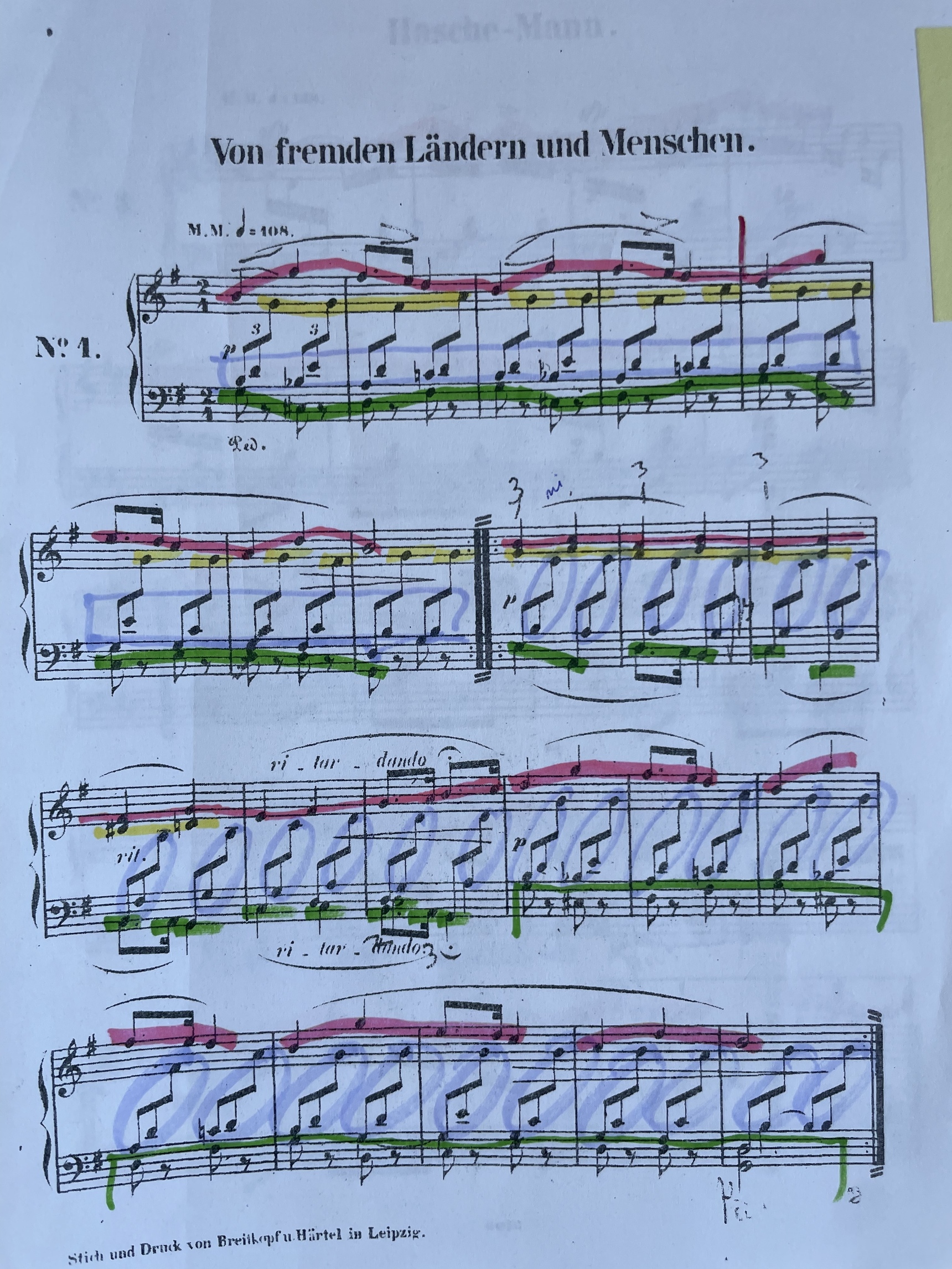
Schumann's Von fremden ländern und menschen.
Easier than expected: letting the top voice/melody distinct and be louder than the rest.
Difficulty/stubborn parts: Making sure the base line is consistently there and the middle voices stay quiet. I also hope to be able to play with a more singing quality. I think I'm doing that in my head when I'm playing, but feel that it's not as flowing and singing when I record and listen to myself.
Spots that pull my attention: Bars 13-14, part that transitions back into the melody of the beginning of the piece.
Clear goal for this week: Think carefully about how I want to play on repeats and not just do the same thing.
-
I'm learning the Eighteenth Variation from Rachmaninoff's Rhapsody on a Theme of Paganini, op 43 (in the piano solo transcription by Michael Voleridge).
Of course, it isn't an easy piece for me, but since I've fallen in love with it, it's gradually becoming more or less accesible. Some difficulties were resolved when I took the score and rearranged passages between the hands (something Jon Kimura Parker talks about in his Tonebase video, and which can be applied at certain moments in Voleridge's transcription).
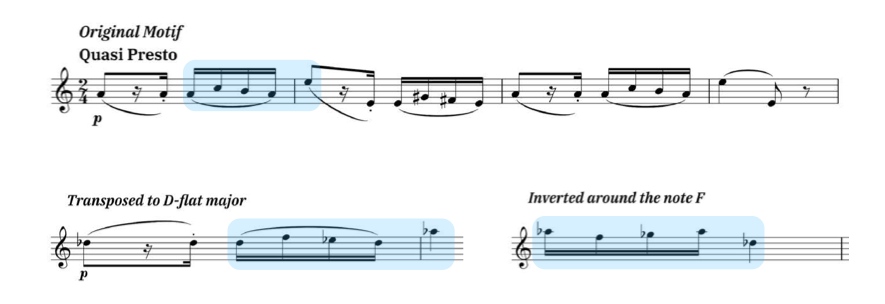
I'd like to share -though many of you may already know this-, the way Rachmaninoff found the very famous theme, one of the most popular in his output: the opening motif of Paganini's 24th Caprice is transposed to D flat major an inverted. Stephen Hough explanation:
-
My piece: Chopin's Barcarolle opus 60. I started learning this over the holidays.
What feels easier than you expected?
Surprisingly, learning the piece was easier going than I thought it would be. I avoided this piece for years because I was afraid of the double trills (not to mention the many consecutive thirds and sixths), but decided to try it over the holidays. I think working on other pieces with consecutive thirds, fourths, and sixths helped me find this more manageable than it otherwise would have been.
What’s proving more difficult or stubborn?
Focusing on very specific passages/bars and working through them slowly to clean them up. I keep wanting to play through the piece (badly) without working on the details, which is so bad.
Are there any spots that keep pulling your attention?
Several specific spots — I put yellow post-it tabs on each spot so they're now really obvious and I can't miss them.
What’s one clear goal you want to focus on this week?
Cleaning up the tagged spots only. Smoothening things out. Not playing the piece through.
-
Rachmaninoff Elegie - end of week 2 https://www.youtube.com/watch?v=f50v6i6O92c
I don't usually record myself as Sunday late morning is the pretty much the only quiet, interruption free time I have available, but I thought I need to practise holding my nerve running through the piece before the final submission. It's also good to be able to listen to the recording and find what I couldn't hear when playing so I thank the challenge for pushing me to do it :)
There're still a lot of rough edges, particularly on the final page - hopefully another week to secure it and the rest of the piece.