Is this piece too hard for me? Let's figure it out with Dominic

Tue Apr 7 at 11 AM - 12 PM PDT
Event by Team

We’ve all been there.

You sit down to practice and start wondering…
Did I choose something that’s actually right for me? Or am I just fighting the piece the whole time?

This live session is about answering that question honestly.

We’ll look at what “too hard” really means — not just technically, but musically and mentally. Sometimes a piece feels difficult because it’s pushing you in the right way. Other times, it’s just not the right fit (at least not yet).


I’ll talk through how to tell the difference, what to look for in your own playing, and how to adjust without losing momentum.


You can bring questions about:

  • A piece you’re currently working on
  • Something that’s been feeling frustrating or unclear
  • Or just your own experience of getting stuck

We’ll work through real examples and questions together.

If you’ve ever felt unsure whether to keep going or step back, this is the time to figure it out!

51 replies

null
    • Personal trainer
    • Judy_Kuan.1
    • 3 days ago
    • Reported - view

    Could this topic have been inspired in part by the Transcendental Etudes thread? 😅

      • Maria_F
      • 3 days ago
      • Reported - view

       I think it was probably inspired by questions asked during the most recent livestream. 

      • PViseskul
      • 2 days ago
      • Reported - view

       it could well be!!! (sure it is for me 😆 ) 

      • Personal trainer
      • Judy_Kuan.1
      • 2 days ago
      • Reported - view

       I had 3 separate people ask me (offline) about Mazeppa after seeing that thread lol

    • hot4euterpe
    • 3 days ago
    • Reported - view

    The picture for this event is perfect - lol!

    • Andrew.13
    • 3 days ago
    • Reported - view

    Hi Dominic,

    Little backstory before my question…

    I played piano from middle school and early highschool (5-6 years?). The most difficult pieces I could play back then would be the Schubert impromptus op. 90 no. 2 & 4. I was largely into romantic and contemporary pieces back then. 

    Long behold, I had a 15 year hiatus; leading to current me who was surprised by how much I remembered about reading music. 

    I started playing the Bach’s little preludes and then went onto the inventions; I found them challenging in their own right as far as fingering and hand independence. I took this piece to a piano teacher who asked what pieces I played back when I was younger. She concluded that the Bach inventions were too easy for me and to try Bach’s Harpsichord concerto no. 1. 

    I looked at the piece and gasped. I told her this is too difficult for me; that I haven’t played piano in a long time. She didn’t push it on me. 

    Weeks later, I decided to give the piece a try and with much effort was able to play it decently; still some wrong notes, slip-ups, and below ideal tempo. There are passages that are frustrating because I sometimes can play it perfectly and sometimes cannot. Do not know why…

    All in all, I was shocked at how much I underestimated myself. I do not believe I can play it at a performance level but I definitely have learned the notes. My current teacher even told me this is probably one of the most virtuosic baroque keyboard work; I was surprised. 

    So here comes the question: 

    1. Is English Suite no. 2 & 3 preludes and/or Chromatic Fantasy & Fugue too difficult for me? 

    2. How useful is the Henle difficulty scale? 

    3. Are some periods of music more difficult on a technical level vs. musical? 

    4. If one can play a piece perfectly at a slower tempo but with much practice cannot at ideal tempo, is the piece considered too difficult? 

    5. Is a piece too difficult if it takes with much repeated practice to play it? 

    Sorry for the long post but thank you! 

      • hot4euterpe
      • 3 days ago
      • Reported - view

       Hi Andrew. These are thoughtful questions! I'm sure Dominic will give great answers but I thought I might add to the conversation for you since it is a few weeks away.

      Many teachers follow a general progression when teaching the music of Bach after the initial early learner pieces. It goes roughly as follows:

      1. Two Part Inventions 
      2. Three Part Inventions
      3. French Suites
      4. Preludes and Fugues (WTC 1 and 2)
      5. English Suites
      6. Partitas
      7. Keyboard Concertos / Italian Concerto / Chromatic Fantasy and Fugue etc.

      This is just a general progression of complexity / difficulty. There is some overlap depending on the selections and not everyone completes something from each (I myself have never performed a French Suite but I have played about 10 different Preludes and Fugues over the years). 

      Students with comprehensive training in all periods that are capable of playing Schubert Impromptu's Op. 90 2 & 4 will typically have played at least 1 or 2 inventions in previous years and will be learning their first Prelude and Fugue around the same time.  Again, this is just a general guideline but I know if someone were to play one of those Impromptu's for me in a lesson that would be my expectation here in Canada.

      It is unusual to go from inventions to a keyboard concerto but I cannot speak to your teacher's intent. My intention with students is to select repertoire that expands their skills but is within their reach for a performance with high accuracy, appropriate style, control and expression within the study year. However, there are times that students will try a challenge piece they really like that is maybe not a fit for their current level but is still rewarding to 'get in the fingers' for the future. Since you mentioned you found the inventions challenging, I would suggest learning 1 or 2 to a high level of play and style, then perhaps try one of the English suite preludes you are interested in. The Chromatic Fantasy and Fugue is a much larger undertaking both in terms of complexity and technical demand. For many it is a 'capstone' piece after significant study of Bach and other advanced repertoire. However, your goals are your goals so this is just advice. If you enjoy being able to sketch through more advanced repertoire and not necessarily prepare it for polished performance, I am not here to tell you otherwise. I would say a key part of the question of "is this too hard for me?" is knowing what your goal is.  

      In regard to the Henle rankings, I would say they are most useful for those playing advanced repertoire. The 9 levels are skewed this way as levels 6-9 are all quite advanced in difficulty and include the major masterworks of piano which is what Henle mostly publishes. The entire range of beginner, intermediate and early advanced is compressed into levels 1-5, so those ratings are less helpful (at least, from the perspective of teacher who knows these levels of study in detail). Remember these too are just general guidelines and there are always going to be disputes. For instance, all the Op. 90 Impromptus are given a '6" but most would consider Op. 90 No. 2 and 4 to be a bit easier than No. 3 with No. 1 being the biggest undertaking. Still, they are quite useful for a quick assessment of the work a pianist has ahead of themselves for a given piece. 

      • Andrew.13
      • 3 days ago
      • Reported - view

       I’ve seen that Bach progression chart and was going off of that; hence my surprise in jump. 

      • Maria_F
      • 2 days ago
      • Reported - view

       I will try my best to answer some of your questions. 

       said:
      1. Is English Suite no. 2 & 3 preludes and/or Chromatic Fantasy & Fugue too difficult for me? 

      I agree with Dustin that you should refine one of the Inventions before you try the English Suite preludes.

       said:
      2. How useful is the Henle difficulty scale? 

      I think it depends. Above levels 5 or 6, they are helpful; under level 5, they are less helpful. The levels are also broad. The Hammerklavier sonata, Hungarian Rhapsody no. 6, and the Wanderer Fantasie are all level 9; I can play the Hungarian Rhapsody and am learning the Wanderer Fantasie, but Hammerklavier is significantly over my level. Chopin's Ballade no. 3 in A-flat Major, Chopin's Scherzo op. 20, and Ravel's Une Barque sur l'ocean are all level 8, and are not all the same difficulty, technically and musically.

      I think the main things to keep in mind are that pieces of the same level can be hard in different ways, a piece that is easy for one pianist may be very hard for another, and there are many pieces that are technically easy but hard to play well (such as Träumerei, which I have heard multiple pianists refer to as Trauma-erei because it is hard to play well and not bore the audience or oneself). 

       said:

      3. Are some periods of music more difficult on a technical level vs. musical?

      I think it depends, and I have contradictory opinions on which eras/periods are harder and how. 

       said:

      4. If one can play a piece perfectly at a slower tempo but with much practice cannot at ideal tempo, is the piece considered too difficult? 

      Maybe, depending on the piece. There are pieces that are not "above my level" but I cannot play them at full tempo due to my hand size. 

       said:

      5. Is a piece too difficult if it takes with much repeated practice to play it? 

      No. Almost all pieces that are not below one's level will require practice to play them; many pieces will take a lot of practice. 

      • Personal trainer
      • Judy_Kuan.1
      • 2 days ago
      • Reported - view

      I don't have much to add beyond what's already been well-replied by others, except have you checked out this site for difficulty ratings? I like how it gives a difficulty rating for each movement of sonatas (vs Henle rating the work as a whole). https://www.pianolibrary.org/difficulty/bach/

      • Maria_F
      • 2 days ago
      • Reported - view

       I think that Piano Library has some odd rankings, but I agree that it is a good source.

      I will also recommend Piano Syllabus as a good source of difficulty/grade levels. 

      • Andrew.13
      • 2 days ago
      • Reported - view

       where would you place ricercar a 3 in that tier list?

      • hot4euterpe
      • 3 hrs ago
      • Reported - view

       That is an interesting question because The Musical Offering rarely comes up for discussion in piano studios given it is a rather unique collection of contrapuntal works. However, the Ricercar a 3 is certainly the most accessible. Since it is fugal and quite lengthy, I would personally want a student to have played at least 1 WTC prelude and fugue so that they know the principles of fugues (subjects, countersubjects, episodes, articulation consistency etc) and have had a chance to demonstrate them in a less lengthy setting (most WTC fugues being 2-3 pages). Also, the Ricercar a 3 has less episodic sections which are usually good mental breaks from the counterpoint for students because they are sequences, so there is an element of added mental endurance.  

      I think if you feel comfortable with counterpoint and the basics of a fugue then it's reasonable to try it, especially if you are a big fan of Baroque music.

      Coincidentally, if you are really interested in the Musical Offering, I suggest a great book called "An Evening in the Palace of Reason". It is a very entertaining account of Bach's meeting with Frederick the Great that led to this remarkable "clap back" of a composition!

    • PViseskul
    • 3 days ago
    • Reported - view

    I'm still pondering about what you said on learning ~2 pages a week ... would that be just the notes, or what other aspects do you consider when assessing the quality of those 2 pages learnt in that week?

    For example, the Chopin Etude 10/4 I learnt last year - it took me about 4 weeks to be able to play from beginning to end at a very slow tempo. Then it took me many more months to crank up the tempo and fixed spots/techniques that fell apart at quicker tempi. In the end I worked on it continuously for about 8 months which is the longest I have stayed on any pieces ... and for 6 pages that's quite a lot of effort put into it (though my teacher said it's normal for students to spend a year working on an Etude ... as for me, it's well worth the time spent 🙂 ).

      • Kerstin
      • 2 days ago
      • Reported - view

       Hi Priya! I think it’s a well spent time. This Etude is heavy. But it’s a good to improve technic. Recently I asked my teacher which Liszt piece he would recomment for improving my technic and he suggested ,Wilde Jagd‘ etude. I am not sure whether I will ever be able to play it, but I use now small parts to warm up. So maybe in one year. 😂

      • Maria_F
      • 2 days ago
      • Reported - view

       I learned the first third of Wilde Jagd last year. I eventually decided it was too hard and gave up. I also learned the first 5 pages of Feux Follets. 

      • Kerstin
      • 2 days ago
      • Reported - view

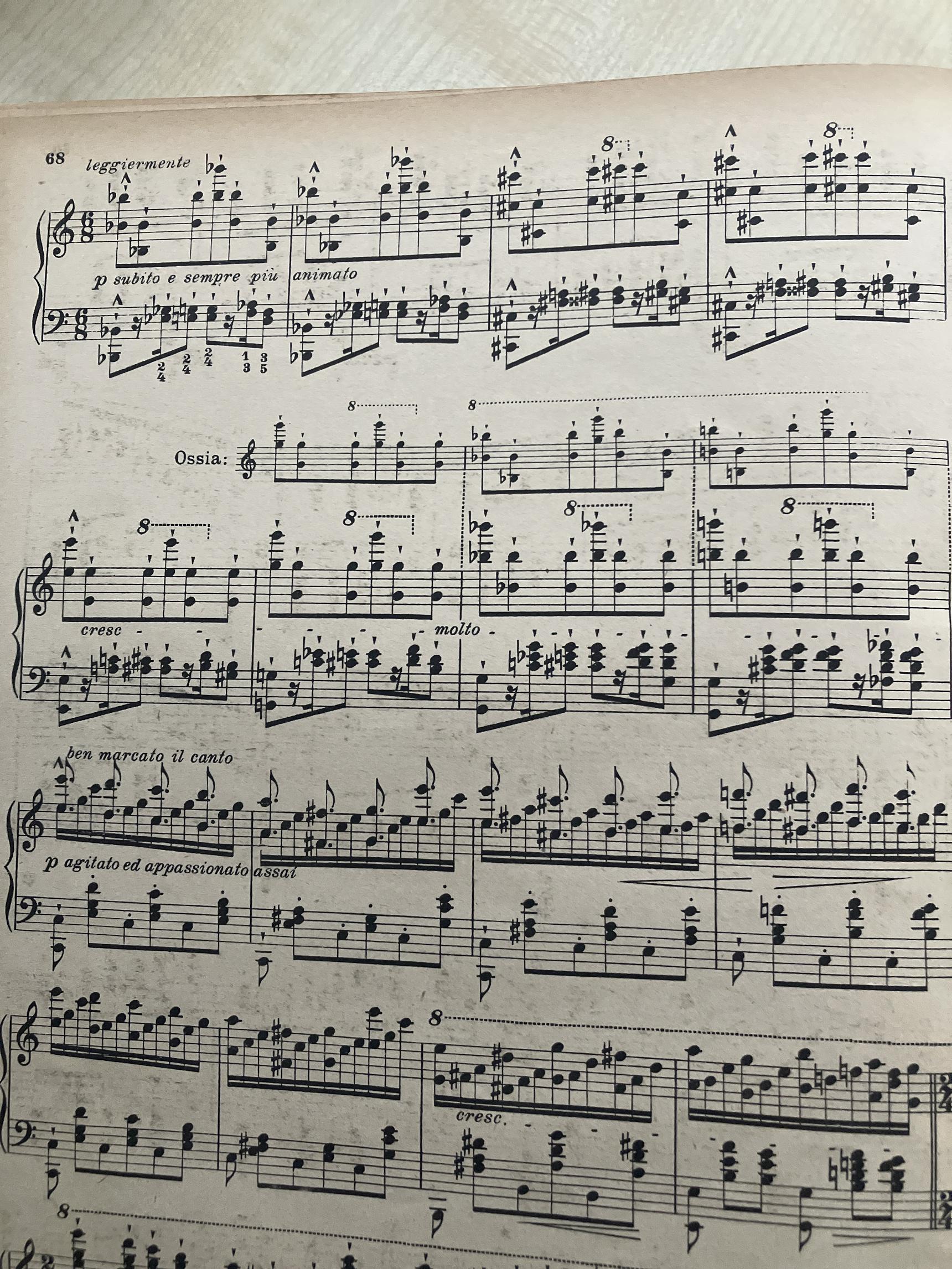
       I understand you. I looked it over and at first glance I though the octave jumps near the end is the hardest part. So I have started  with it. It’s an experiment. But I also think, you need to challenge yourself. Last year I have played Chopin sonata 3. It took me 10 month (~400 hours) to get it done (not memorized). And in the beginning it looked like, that the last movement it too heavy. But in this case I won. 💪 With Chopin piano concerto in e-minor I gave up on the first movement because of the last pages. Couldn’t make it in tempo. 🤷‍♀️ 

      • PViseskul
      • 2 days ago
      • Reported - view

       the time spent on the piece with proper guidance definitely helped for sure :)

      I suppose the piece is hard but still achievable (maybe not quite at the "ideal" tempo, though chasing the tempo at some point became a diminishing return).

      PS: just had a look at Wilde Jagd and immediately put it in my "impossible" bucket 🤣

      • Kerstin
      • Yesterday
      • Reported - view

       I understand you. I am also not sure if I want to go for it seriously. I take it right now as my execise to warm up 10min with one passage/bar.  For me the most ,impossible’ part is near the end. These octave jumps in tempo….🤯 

      • Unfrozen Barroom Piano Player
      • Peter_G
      • Yesterday
      • Reported - view

       just looking at this score makes my forearms hurt.  Re:  the octave leaps in the first few measures, it seems like some of the bottom notes on the lower RH octaves could perhaps be punched in with the left hand.

      • Kerstin
      • Yesterday
      • Reported - view

       That’s a good idea! I‘ll try it. 👍

    • Unfrozen Barroom Piano Player
    • Peter_G
    • 2 days ago
    • Reported - view

    Dominic has a great workshop addressing practice plans: https://app.tonebase.co/piano/live/player/fall-reset-practice-plan-2025

    He suggests there that if you find yourself spending X hours (I forget the number, but it's in the hundreds) trying to learn a piece, it may be worth considering whether it's too difficult for you. If you have hundreds of hours to spare, no problem, go for it, but for most of us, our practice time is all too scarce, and this level of attention on a single piece may be taking too many hours away from working on other pieces that could more constructively contribute to our improvement.

    I believe there is value in reaching for pieces above your (assumed) present capabilities.  You may surprise yourself, and you may actually improve your technique in the process.  But it can also give you an "excuse" to gloss over the difficult parts (something I'm often guilty of), e.g. "Well I know this piece is above my level, so I'm not going to worry about learning this correctly".

    So at the same time I also believe that there is great value in actually trying to perfect a piece that is already within your reach technically.  The effort involved in trying to play something, note-perfectly, with full expression, from memory, can give you great insights and experience with learning and developing your skills, not to mention enhanced respect for a piece that you had previously thought was "easy".

    P.S. I don't believe that playing something Note-Perfectly is necessary for performance, especially in our Tonebase concerts/challenges, but there is a great benefit to be derived from aspiring to that.
      • Kerstin
      • 2 days ago
      • Reported - view

       I understand what you mean. Normally I choose my pieces according to what I want to play. If it’s ,easy‘ or not. To play a Bach Invention perfectly is not easy. And I think it depends on what your goal is. My goal is to play a recital for my friends in July. And I am working on my program since September 2025 to play ~75min (5 pieces in 10 month). A lot of work, but that’s what I want. 
      So back to work. 💪🎹🌟

      • Unfrozen Barroom Piano Player
      • Peter_G
      • 2 days ago
      • Reported - view

       hey Kerstin have you selected your whole program yet, and are you willing to share with us what is on it? I would be happy to sit through a trial run of some of your pieces sometime if if you would find that helpful in your preparations,, and ifwe were able to coordinate it  

      Like Judy, I was very inspired by your Chopin Sonata, but unlike her, not inspired enough to dare to try it myself!

      • Kerstin
      • Yesterday
      • Reported - view

       Hi Peter! Yes, my program is fixed. 
      Beethoven sonata op. 7 , Bach WTK2 c-minor and D- major, Chopin op. 61 Polonaise-Fantasie, Cesar Franck op. 18 Prelude, fuge et variation. I am still in the middle of all pieces. I set the June for runs through all pieces and program. Recently I have played the 1. mvt of Beethoven for my friends. https://youtu.be/i1X67185Mko?is=Zuo7apG9ozRk9kZf Have a nice day. 🙋‍♀️

Content aside

Attendees

Stats

  • 51Replies
  • 228Views