Week 1: A New Hope

Starting on May 4th...

Welcome to the Unfinished Business Challenge — and the beginning of our four-week musical adventure!

Every great journey starts with a first step (and some hope!) This week is about choosing your piece: something you’ve always wanted to learn, something you started and left behind, or something unfinished that keeps calling you back.

This Week’s Mission

Choose one piece (or excerpt) to stay with throughout the challenge.

A few ideas:

  • A piece you’ve always meant to finish
  • Something abandoned years ago that deserves a second life
  • A new piece you’ve been waiting for the right moment to begin
  • A small excerpt from a larger dream piece

Big or small, all choices are welcome. What matters is that it feels like your unfinished business.

This Week, Share:

  • What piece did you choose?
  • Why this piece?
  • Is there a musical challenge or goal you hope to work through this month?

If you’d like, post a recording of where you’re starting from — even a rough first read. We’d love to hear it.

Over the next four weeks we’ll build momentum together!


341 replies

null
    • Der Wanderer
    • FRANZ_SCHUBERT
    • 13 days ago
    • Reported - view

    Having been inspired by the Live-stream today, I must say in regards to one of the points from Dominic that boredom has never been an issue for me (as a reason for leaving pieces).  The main issue is always that the Unfinished Business list is long and keeps growing and can distract.  The contributing factor in this is Tonebase as everyone here (yes I'm looking at you) keeps reminding me of pieces that I want to work on or need to revisit.  Let's just say, Sindre, is the latest example of this as you will see shortly (thank you very much!).

    I have a list of four pieces.  I am going to pick one for this next month.  The others will follow hopefully in the time left in 2026.  It is time to remove the cobwebs away and revive the past and take care of unfinished business!

    1) Beethoven:  32 Variationen in c minor

    2) Schumann: Fantasie Opus 17 in C major, 1st movement

    3) Rachmaninoff:  Moment Musical No. 1 in b-flat minor

    4) Chopin:  Scherzo No. 2 in b-flat minor (yes, this one is Sindre's fault.  Thanks for the reminder ;-))

    It will be a struggle session today.  I'll test out the waters today and see which way my mood will take me.  Hopefully, I'll know soon.

      • Akzent oder Diminuendo? • Hanon/Herz student
      • Maria_F
      • 10 days ago
      • Reported - view

      I believe the Wandererfantasie actually inspired Schumann's Fantasie. 

      • Der Wanderer
      • FRANZ_SCHUBERT
      • 10 days ago
      • Reported - view


      • What piece did you choose?
      • Why this piece?
      • Is there a musical challenge or goal you hope to work through this month?

      And so I picked the piece and I may as well address the other questions.  Why?  I have been fascinated with this piece (and Robert Schumann) as of late and for many years technically I wasn't ready or able.  Time is a thief and so if not now, when?

      At the top of the score is a short poem by Friedrich Schlegel:

      Durch alle Töne tönet / Im bunten Erdentraum / Ein leiser Ton gezogen / Für den der heimlich lauschet 

      Resounding through all the notes / In the earth's colourful dream / There sounds a faint long-drawn note / For the one who listens in secret.

      [Thanks to Maria and some other online translation help I came to this interpretation.]

      I also learned that initially Schumann intended to title this work:  Große Sonate von Florestan und Eusebius [Grand Sonata of Florestan and Eusebius].

      I'm sure most everyone here must already know about Florestan and Eusebius?  This is all par for the course for most of the big works of Schumann and so I intend to spend the rest of my life trying to find those faint long-drawn notes conveyed in secret amongst the contrasting themes between these two alter-egos of Schumann, himself.  I can also guarantee that there are plenty of secret messages conveyed to Clara Wieck, his future wife, through these two characters. 

      The middle contrasting section (Im Legendenton) from bars 129 and ending at 224 including the climax at bar 204 is very profound (to me). 

      I am going to enjoy the many details and trying to discover all the little buried treasure along the way.  If I only discover 20% of what's here I'll be quite happy. 

      The initial difficulties are many but I'll focus on just a couple here now.  First, I have to work on my trills.  Bars 22 to 27 give me grief because I want them to be pianissimo (and even) so this is one of the first challenges.

      Second challenge and maybe one of the greatest key moments in this movement is in bars 41 - 48.  Left hand articulation is quite hard (for me) and so I think most of the work will be here.  A similar moment comes again in bars 233 to 240.  Intuitively I know that these two short sections will get more attention alone than many pages of music before and after because these sections especially key and rather important and so I'll always be worried about messing them up (which of course with Murphy's Law will be the challenge not to).

      Overall, the majority of the challenge seems to be in the left hand and I'm ready to face this head on. 

      By the way, this Fantasie is dedicated to Franz Liszt!  Apparently, when Schumann presented this work to him, Liszt just sight read through perfectly and praised it quite highly.

      • Der Wanderer
      • FRANZ_SCHUBERT
      • 10 days ago
      • Reported - view

       Well, here is a bad sign.  I just spent a little more time with a post explaining why I chose the piece and few difficulties and Tonebase locked the post Pending Review.  So, for anyone interested check back in a week for yesterday's news :-(

      • Der Wanderer
      • FRANZ_SCHUBERT
      • 10 days ago
      • Reported - view

       It's obvious that all my passion for the piece overheated all the AI circuits !

       ;-)

      • Akzent oder Diminuendo? • Hanon/Herz student
      • Maria_F
      • 10 days ago
      • Reported - view

       The bot filter is highly annoying. For example, in addition to Der Staatstadt an der Donau, no one can mention Mrs. Hensel (I can't type her first name or initial).

      • Der Wanderer
      • FRANZ_SCHUBERT
      • 10 days ago
      • Reported - view

       Two Fantasies in C major ?

      No, my life is just One big Fantasy I guess - lately. ;-)

      Actually, something has gone wrong with my longstanding preference for playing only music in a minor key (I normally avoid music in major keys).  So isn't it strange that on my plate in addition to those most days I practice Chopin Prelude Op. 28 No. 1 in C major, Etude Op. 10, No. 1 in C major, & Op. 10, No. 7 in C major.  What have I become?

      • Pediatrician
      • a_weymann
      • 10 days ago
      • Reported - view

       I hear you, and I am quite in agreement - I, too, have always much preferred music in a minor key, ever since I was a child. However, the Schumann Fantasie is quite often suffused with minor key “flavor” and iridescent tonal ambiguity in the first and last movement (less so in the brilliantly affirmative second, of course).  Maybe that’s why you’re drawn to it in a particular way? 

      • Der Wanderer
      • FRANZ_SCHUBERT
      • 10 days ago
      • Reported - view

       Very well said Alexander (minor key “flavor” and iridescent tonal ambiguity).  Language is often tricky, for me, to explain what I really want to mean.  I guess I made a general statement which is true for me on so many levels.  If I would list all my favourite pieces I believe the majority would easily be mostly in a minor key.  My guess would be that two-thirds clearly minor in nature and one-third major keys.  This is the conservative minimum.

      The key though is that any of the major key works I would spend time with generally 'feel' like a minor key work and you might say they are closer to sitting on the fence, yet still leaning toward a more complex minor key world. 

      The pieces that are all sunshine and roses seem to me too light and insincere in order to avoid risk and reality.  It is not that I focus on tension, death, loss, turmoil, struggle, and the like, it is that I find comfort in the truth.  I also feel like I am sharing a bond and getting closer to this composer because they are sharing something meaningful and consequential in their life with me.

      Not great major key works remind me of when someone says "Hi, how are you?"  What follows is small talk and usually begins or ends with talking about the weather.  In most cases, no one cares how you actually are.  So regardless of the predominant key, I need a hint that this work I'm investing in is more than just small talk.  I need something that hooks me in for a long relationship that becomes deeper over time.

      The Schumann Fantasie Op. 17 in C major (1st movement) definitely has adventure, nobility, tension and struggle at it core.  We do know that at the time he wrote this piece there was much anxiety in his struggle with Clara Wieck's father who was opposing his bid for Clara.  So, while this is in C major this piece is about something real.  It is a clear autobiographical missive putting everything on the line for her.  You may not need to know this but when you do it helps to understand what any human might understand under those same circumstances.

      So a few great works in major keys will happily co-exist with the majority of the greatest works ever to exist due to them being exclusively in a minor key for me!  Ha Ha Ha.  Luckily, I have to go now but otherwise I may have started in on my thoughts about the meaning of each key and why a composer may have chosen d-minor as opposed to c-minor and so on.  :-)

      • Akzent oder Diminuendo? • Hanon/Herz student
      • Maria_F
      • 10 days ago
      • Reported - view

       This is not relevant to the challenge, but does "great works in major keys" include Chopin's Ballade no. 3 in A-flat Major? 

      • Akzent oder Diminuendo? • Hanon/Herz student
      • Maria_F
      • 10 days ago
      • Reported - view

       I listened to the whole Schumann Fantasie earlier and my favorite part of the first movement is definitely the Im Legendenton section. 

      • Astrida_Gobina
      • 10 days ago
      • Reported - view

       I think Schumann suffered a lot indeed. I just got a new book by Christine Eichel — Clara. Well, poor Clara didn’t have it easy, to say the least, after their much struggled for wedding. Robert was a troubled man. But it’s not a topic here. Just wanted to mention.

      • Noel_Nguyen
      • 10 days ago
      • Reported - view

        My favorite parts are those two brief passionate circles of fifths.

      • Der Wanderer
      • FRANZ_SCHUBERT
      • 10 days ago
      • Reported - view

       Quote: Robert was a troubled man.

      Who knows?  In many cases, 100 or 200 years later, stories about famous people carry on and I am mostly cautious and usually skeptical of the veracity of many since it takes only one corrupt or misinformed person with a pen to write some unfounded bit of gossip or hearsay and it then tends to live forever.  

      So I read or hear these stories on one hand and I also am spending a lot of my time going forward playing and studying his music.  In my opinion, this is not the legacy of a mad man but of a pure genius.

      Yes, I may be biased.  Did he walk on water?  No, as is also the case with every one that also breaths.  Perhaps he was simply misunderstood by many in the world?

      Again, who knows.  I simply base my opinion on the man solely on the record of his musical legacy.  And there are only a small group of people in history to belong to this club. 

      • Der Wanderer
      • FRANZ_SCHUBERT
      • 10 days ago
      • Reported - view

       RE:    My favorite parts are those two brief passionate circles of fifths.

      I don't get it?  😳🧐

      • Der Wanderer
      • FRANZ_SCHUBERT
      • 10 days ago
      • Reported - view

       RE: does "great works in major keys" include Chopin's Ballade no. 3 in A-flat Major? 

      Yes!

      But...

      For my money I'm learning these Ballades first:

      1) Op. 52 in f-minor

      2) Tie between Op 23 in g-minor and Op. 38 in F-major

      3) Then I will learn the A-flat major

      And so, in my opinion, when you have A-flat major vs F-major my choice defaults to the F-major first because it is just more evocative and deep.  Yet, both are still the best of the best.

      • hot4euterpe
      • 10 days ago
      • Reported - view

       Thanks for mentioning this book! I looked it up and. Would love to read this one ... but my limited ability to read German would make that a big undertaking (though maybe worthwhile for the effort!)

      I have read Nancy Reich's book about Clara though and yes, Clara was hardcore.

      • Akzent oder Diminuendo? • Hanon/Herz student
      • Maria_F
      • 10 days ago
      • Reported - view

       A-flat major is my favorite of them (and definitely in my top 5 Chopin pieces). 

      • Astrida_Gobina
      • 5 days ago
      • Reported - view

       I hope the book gets translated soon. It’s really worth being read more widely.

      • Akzent oder Diminuendo? • Hanon/Herz student
      • Maria_F
      • 5 days ago
      • Reported - view


       said:
      I just got a new book by Christine Eichel — Clara.

       I haven't read that book yet, but I will! 

    • Ken_Radford
    • 13 days ago
    • Reported - view

    Hi,

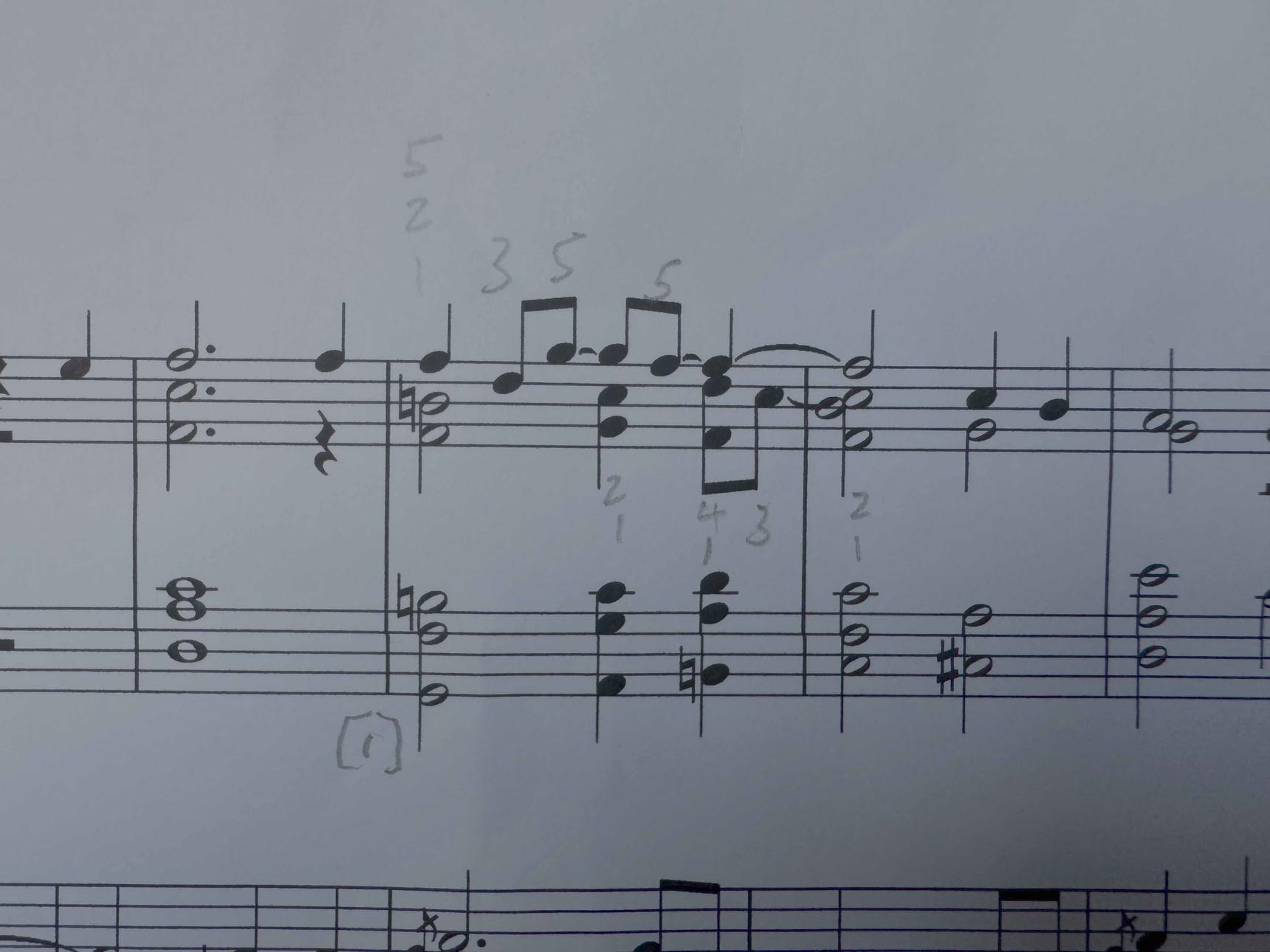
    I mentioned in today’s livestream that there are three left-hand root-7-3s (see attachment) in the Keith Jarrett piece Heartland (in F Major) that I have been struggling with for aeons. I have been stretching at and away from the piano and I am getting closer but it is taking soooo long. Any advice on technique/stretching/anything else that might help will be much appreciated. My teacher says that my hand is big enough and that I will be able to crack it if I carry on, but I need to make progress so I can move on..  

      • hot4euterpe
      • 12 days ago
      • Reported - view

       I myself cannot span a 10th, so those would be out of reach for me. I would consider the following:

      1. Try playing them modified as a rolled chords, as harmonic 7th with the 3rd added lightly after, or with the bass note slightly early (though I feel this last one would be distracting here).

      2. I would try omitting the 3rds in the LH. They are just doubling the same voicing in the RH and the RH is more engaging so it may sound convincing without these.

      3. Depending on how the pedal is being used, I would consider the possibility of letting RH finger 5's ring with pedal and then take the C and D of the LH in the RH.

      I've never played this but first glance tells me that I would likely just go with #2 or just add the LH 3rds in gently after. #3 seems like a lot of effort and disconnection from the melody just to add in a doubling of a secondary voice. Those are the possibilities I would explore though!

      • Ken_Radford
      • 12 days ago
      • Reported - view

       Thank you for your thoughts Dustin. I have tried options 1 and 2, but not yet option 3. I will give it a go tomorrow and let you know how I get on. I am still hoping to be able to hit the three LH chords as written with more stretching. Regards, Ken.

      • Ken_Radford
      • 10 days ago
      • Reported - view

       Hi Dustin. I have not had good results with option 3 so I have modified my stretching exercise to include root-octave-11th and this is helping (albeit a bit painful). 

      • cdales
      • 7 days ago
      • Reported - view

        “Painful” is generally not good. I’ve more than once crossed the line between painful and injured, and wouldn’t wish it on you or anyone else😢 I’m currently struggling with the demands of the big LH chords in my Debussy prelude, and will have to settle for compromise (usually playing the bass note first as neither rolling or omission is musically ok…)

      • Akzent oder Diminuendo? • Hanon/Herz student
      • Maria_F
      • 7 days ago
      • Reported - view

       I can reach 9 (only on white keys; 8 on black keys) and when I played La Cathedrale Engloutie, I definitely had to arpeggiate a number of 10ths. Thankfully, it made sense musically. Which Debussy prelude are you learning?

Content aside

  • 8 Likes
  • 2 hrs agoLast active
  • 341Replies
  • 828Views
  • 40 Following