How to play Chopin Étude Op. 10 No. 1 — Step by Step
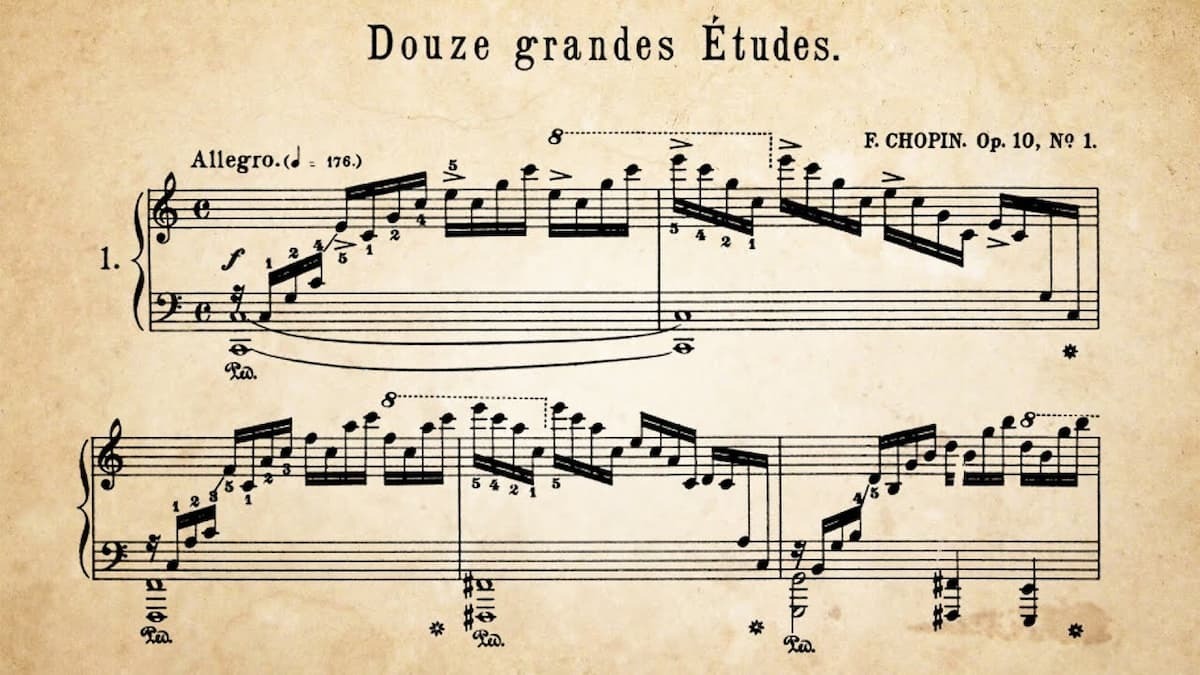
This session is for everyone interested in playing Chopin Etude op.10 no.1
Whether you’re playing it slowly and carefully, pushing toward tempo, or somewhere in between, Dominic will break down how to actually build the arpeggios so they feel secure and free.
We’ll look at:
• Hand shape and alignment
• How to move across the keyboard without tension
• Grouping and rhythm strategies for control
• How slow practice turns into reliable speed
• What usually goes wrong — and how to fix it
If you’ve ever felt stuck at a certain tempo, or like the passage works one day and not the next, this is for you.
Leave your questions below and join us live.
25 replies
-
Hi Dominic / Tonebase Team,
I play this wonderful etude very slowly no more than Mf as an excercise for playing with a relaxed hand using rotation and no stretching. The weakest link for me is bar 36. I ascend in bar 35 using fingers 1 2 3 5 rotating and moving towards the fallboard but have not found a way to descend in bar 36 smoothly at the same speed. I would be grateful for your suggestions.
Best Regards,
Barry
-
Dear Dominic,
Thanks very much indeed for all your very engaging and inspiring livestreams. Please could you advise what my goal, as a Level 4 pupil, should be for this piece?
Best wishes, Rashmi. -
Bar 30-31... Any great tips on landing those accurately and reliably?
-
I'm also completely stumped by Measure 31.
-
Dominic, how are you able to read my mind and always provide EXACTLY the topic I need? 😉
-
Dominic, thank you for focusing on this particular étude. I flog myself into submission on a daily basis with it (in a good way).
I have a million questions I would like to ask but will focus today mostly on what seems to be the goal of the study. I do not believe it is about speed but rather about playing legato while navigating wild open and closed hand positions.
If you recall, I've asked you previously about those handful of accents and playing legato was actually the deeper question related to this. I'll try to ask these questions again with the following points / questions:
1) Playing legato doesn't preclude one from accenting individual notes? Legato is specifically about how you join one note to the next? Is this correct?
2) Can you give some advice, if you haven't already, on transitioning from the 5th finger to the thumb (usually). I often hear, even in my own playing, a package of groups of four springing up, releasing and reloading on each beat (the thumb) rather than a smooth connection between the reload, if you know what I mean. Any advice on this including articulation and the volume of the notes transferring between these groups (same or loud to soft etc) in regards to legato.
3) Can you speak about the role of the left hand in context of legato and voicing given the focus seems to always pull to the RH. Should it play a more important role and how?
4) I believe I have confusion as to how to interpret time signatures and hopefully this question also points to how to play this étude better. I'm generally confused about the difference between common time (C) and cut time (C with a line through it). I know it's 4/4 vs 2/2 but mainly I'm wondering how you count this (the feeling of beats). Both have four quarters but does it make a difference if you count 1+2+3+4+ vs. 1+2+ (as half notes)? Should this étude feel like four beats per bar or rather two beats per bar?
A few less than a million questions but I'll stop here. Thank you for your help with this. I've had a last minute conflict with time so I'm still not sure if I'll be able to join you here live but will follow up with the recording if I can't make it.
Regards,
Doug
-
Sorry to add on here as Dominic might probably cover it but I just wanted to give a general PSA that often is not talked about until it is too late and that is about injury. In my case, this particular étude has led to more injury and problems than anything else I play (which is very little)
Many decades ago I had carpal tunnel syndrome and shoulder/back injuries (and still do) and this étude tends to make playing it a continual problem. If I'm not careful it flares up immediately if I overdue something and am not relaxed enough.
I remember before my injury by about the second page my arm felt like it was going to fall off combined with actual pain. Being young I kept pushing and pushing despite the pain.
I'm no expert but I think it is safe to say that you should never play onward if you experience pain in your hands, wrist or arms etc. For others it may be another piece but this étude seems to be the one that tends to reactivate my old injury.
-
I unfortunately missed the livestream, but I mostly need advice on how to get my fingers to the right keys at full speed (I can play it at 50-65% of the original tempo) without sounding disconnected and staccato.
-
Czerny's harmonic reduction of this etude:
-
I just watched the lesson now after a long workday and... Wow, @dominic_cheli , you have delivered a masterpiece of a lesson! I now realize why I have always struggled with this etude. I tend to approach fast passages in blocks of hand positions, and this etude requires a completely different approach. Now I don't think I will ever be comfortable playing this piece, but at least now I know why!
-
Playing the penultimate note at top staccato, and playing the very top note as beginning of a new group with a down motion is a total game changer for me. I can't believe how much easier it makes this etude, not to mention the effect it has on shaping the melodic lines where they occur in the 5th finger coming down. This, in combination with Marina Lomazov's practice strategies, is worth the price of membership. Thank you!