Mastering Tricky Passages and answering your questions!
Wed Apr 22 at 11 AM - 12 PM PDT
Event by Team

Welcome, everyone. 

If you’ve been sitting with questions about your playing, fingering, tricky passages, or musical roadblocks you haven’t quite cracked yet, this is a great moment to bring them out.


Whether it’s something small that’s been nagging you or a bigger challenge you’re ready to work through, every question is worth asking. Join us live today for real-time guidance and problem-solving!


Leave any and all questions below!

41 replies

null
    • Andrew.13
    • 3 wk ago
    • Reported - view

    Hi Dominic, 

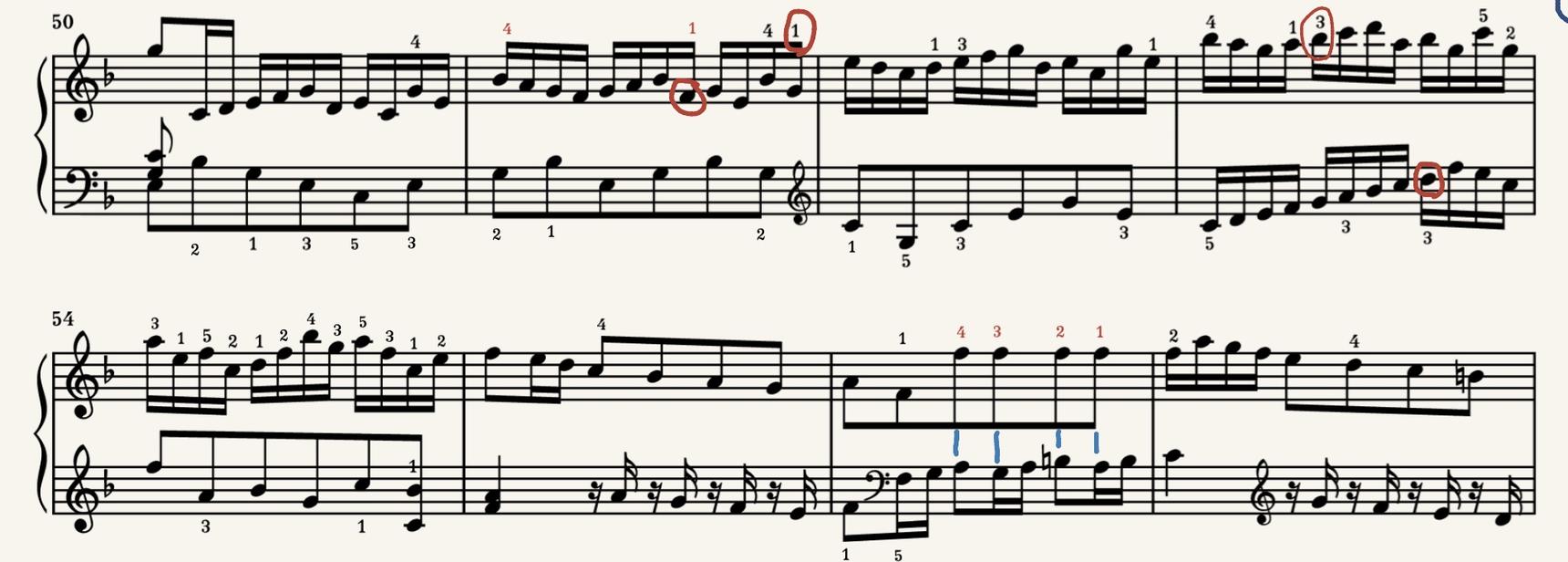
    I notice I struggle greatly with these types of 16th note runs Bach writes in his pieces. 
     

    Is it my fingering? Underdeveloped neuro-independent hand/finger playing?


    Also, after learning this piece I’m trying to decide on what next piece of Bach’s to learn. 

    Do you recommend:

    1. English Suite no. 3 prelude

    2. Italian Concerto

    3. Chromatic Fantasy (no fugue)


    Much appreciated! 

      • Noel_Nguyen
      • 3 wk ago
      • Reported - view

       Can you please tell us which pieces these passages are from? It seems the first is English Suite no.2? What about the second one? Thanks!

      • Andrew.13
      • 3 wk ago
      • Reported - view

       you are correct! Bottom is harpsichord concerto no 1 (3rd mov)

      • Noel_Nguyen
      • 3 wk ago
      • Reported - view

      Thanks!

    • Docstargazer
    • 3 wk ago
    • Reported - view

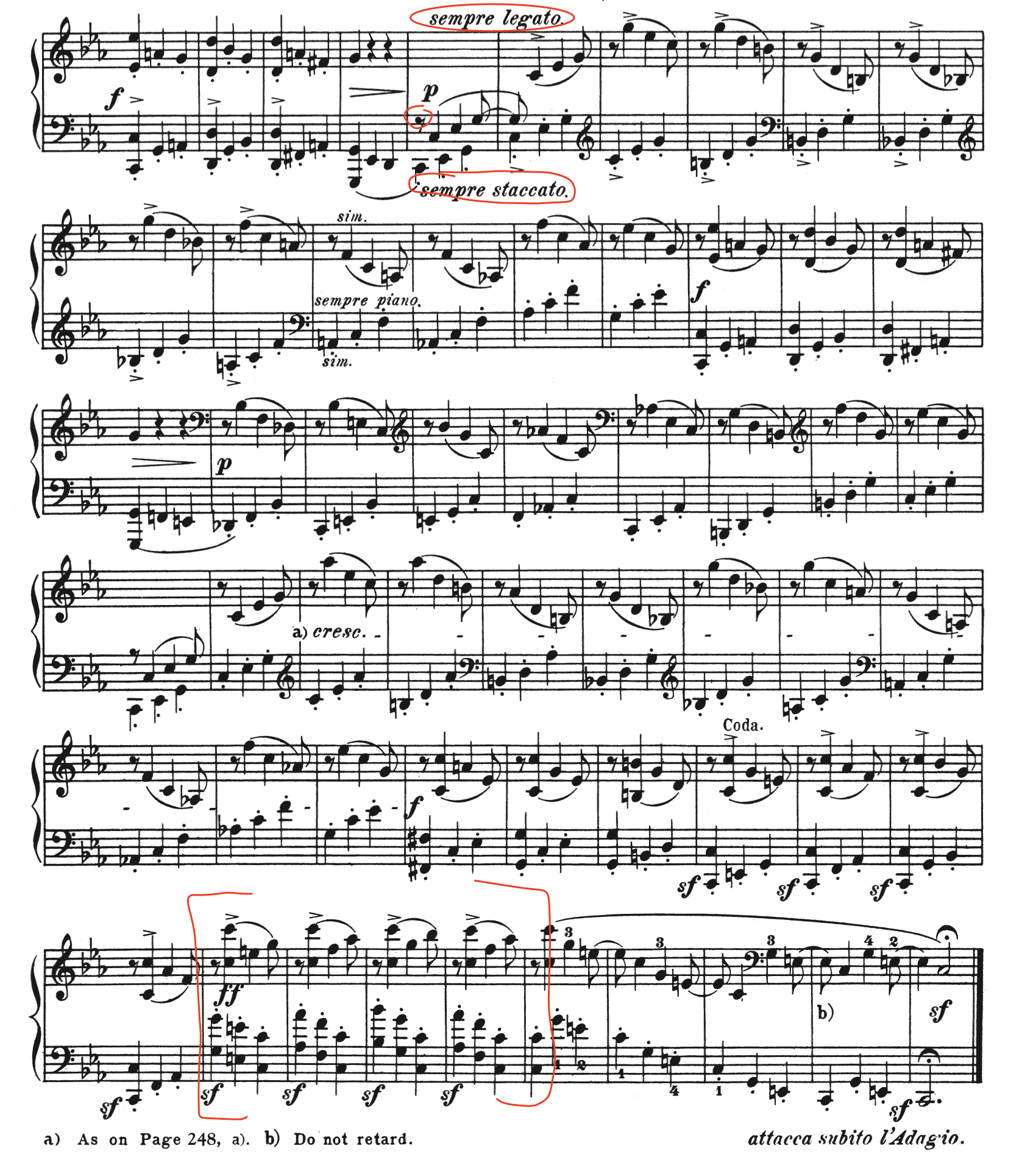
    Hi Dominic, Thanks for these very informative and helpful threads.  I've been working on the second movement from Beethoven's opus 27. no. 1.  I have struggled with maintaining the left hand staccato and right hand legato while the main theme returns and left and right hand are now staggered by a rest.  Any suggestions on how best to practice this.  I find when I play this part, my left hand gets clunky or my right starts to staccato inadvertently.

    Second question is how to deal with the rapid octaves in the last measures I've marked.  My hands are on the smaller size and the addition of age and a touch of arthritis has my span at 9 notes, I find the left hand octave jumps difficult and I develop significant tension; despite trying to immediately release and relax the hand after playing the octave.

    Any help greatly appreciated.

    Thanks again!
    • Herman.2
    • 2 wk ago
    • Reported - view

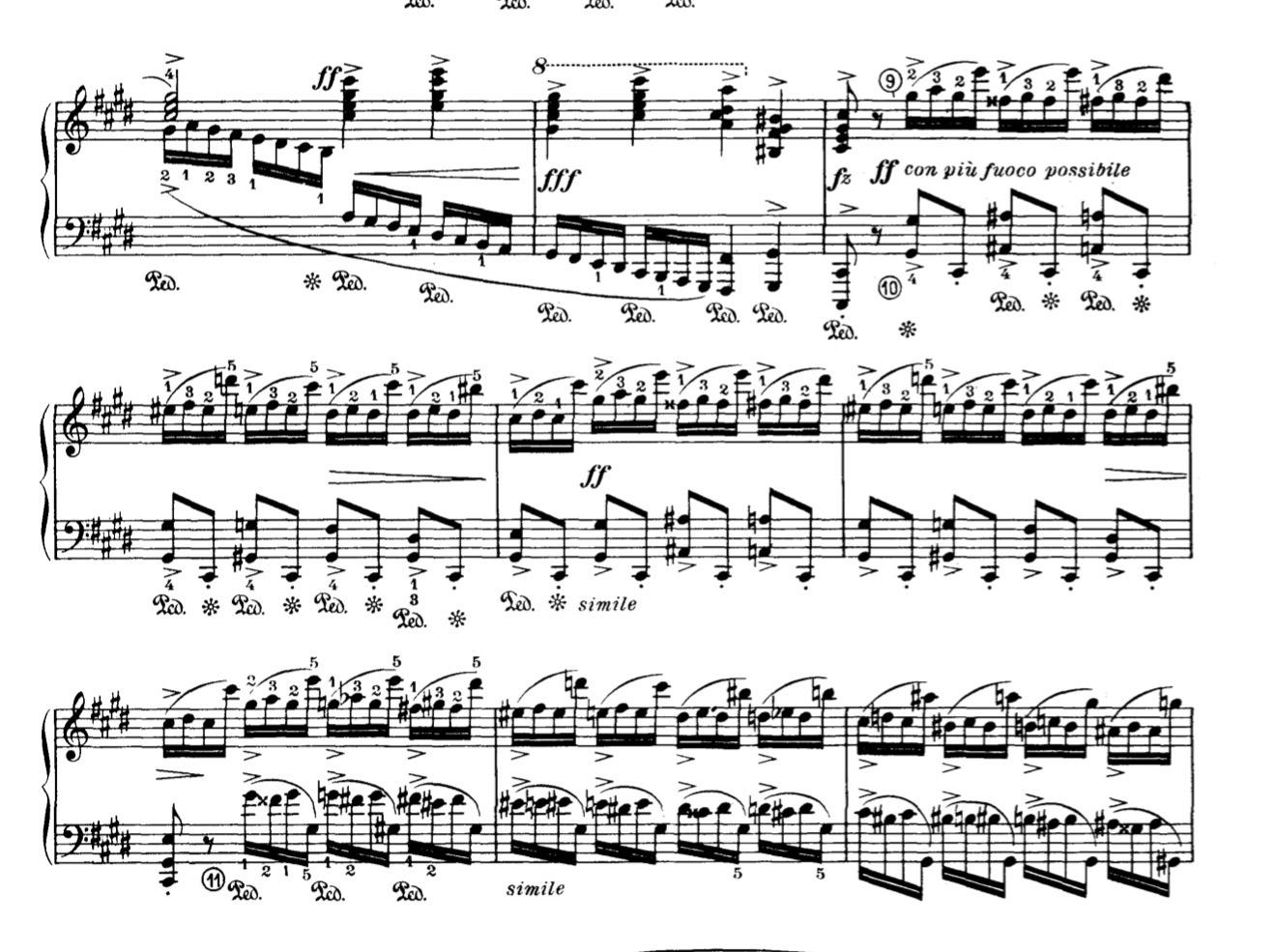
    Hi dominic. How should one practice the LH part in the last page of chopin op 10 no 4. What fingering to use for that jumps in the LH and any tips for pedaling? 

    • hot4euterpe
    • 13 days ago
    • Reported - view

    Hello Dominic,

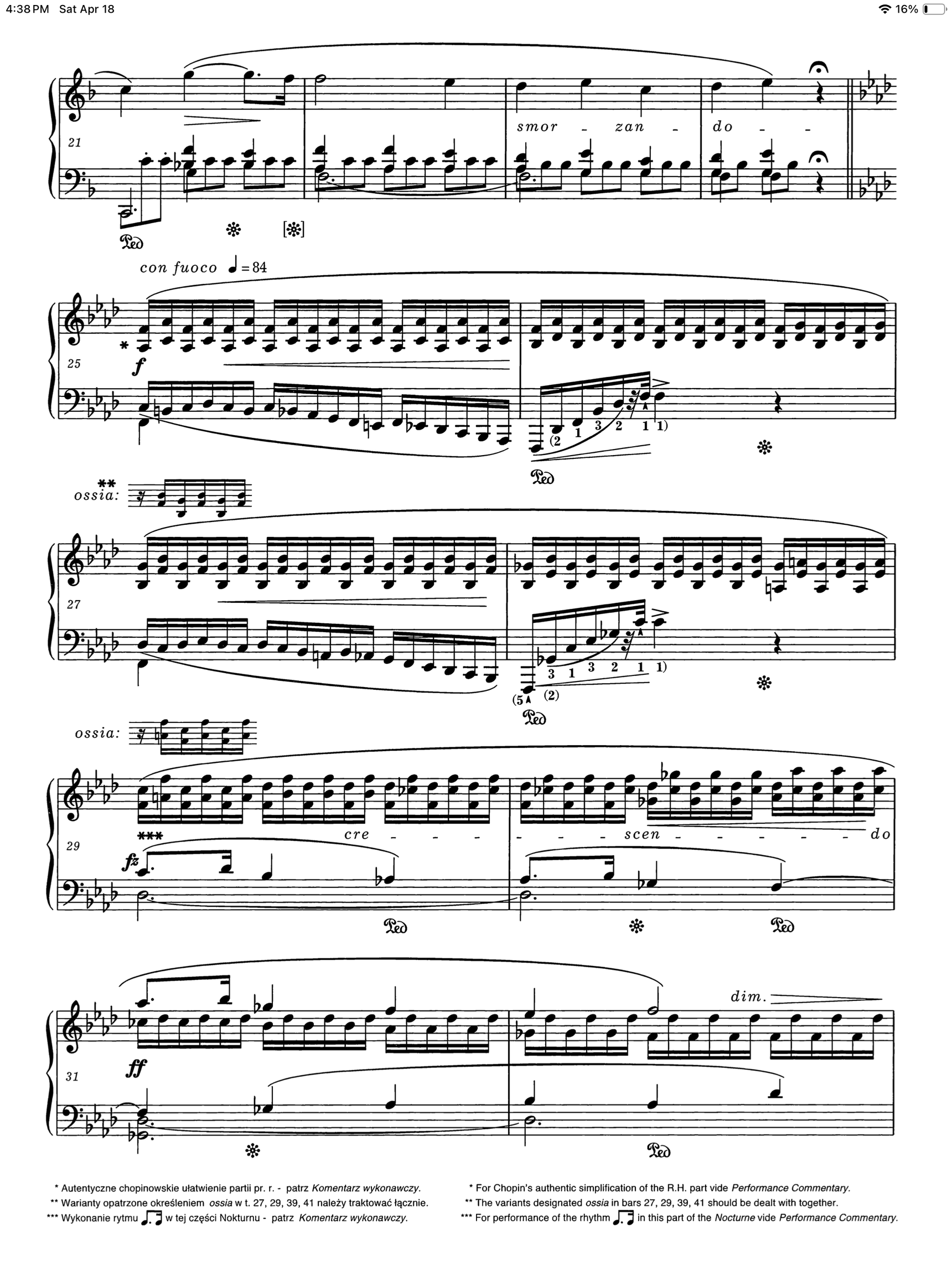
    I am interested in your thoughts on the RH tremolo figures that start at mm. 25 of Chopin's Op. 15, No. 1 Nocturne. I actually don't have any significant issue playing these and I can even do so fairly rapidly without fatigue. However, I am trying to elevate it to a point that it is as light and rapid as a regular open octave tremolo. (I'm closer to a Pollini in speed whereas I'd love it to be more like a Maria Pires!). What would your advice be for taking it that extra step.

    Thanks for any suggestions =)

    • vbashyam
    • 13 days ago
    • Reported - view

    Hi Dominic, 

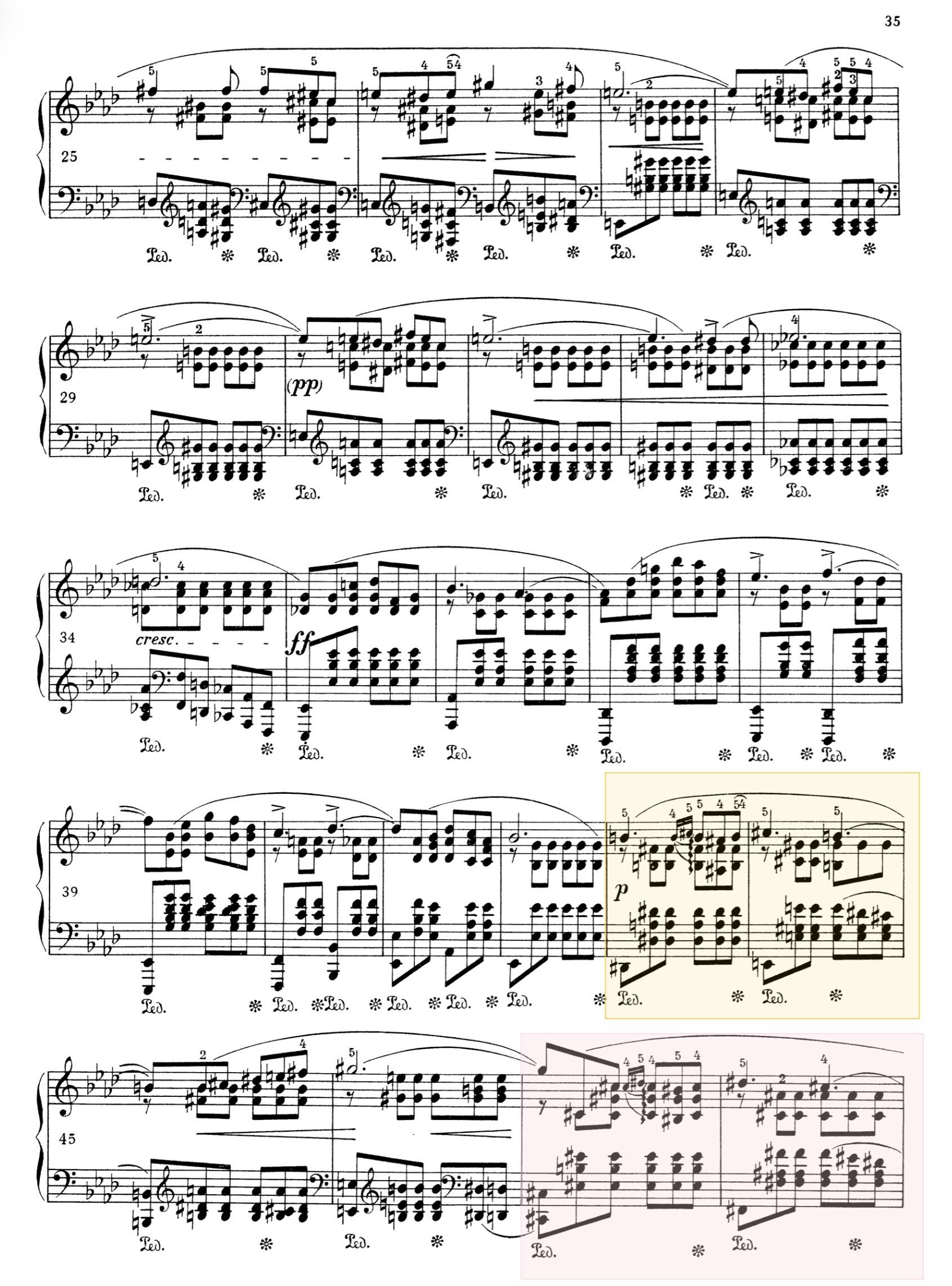
    In Chopin’s Prelude #17, I find measures 43, 44, 47, and 48 a bit awkward. I have tried some rearranging that helps- ie taking the b natural in m43 with the left hand. I would love to hear any thoughts you have on making these measures smoother (hand positions, fingering, etc). Thanks!

      • Unfrozen Barroom Piano Player
      • Peter_G
      • 11 days ago
      • Reported - view

       Yikes! good luck with this one Vidhya!  P.S. how do you get your scan to appear right in the text of your message rather than as an attached PDF??

      • vbashyam
      • 11 days ago
      • Reported - view

       Hi Peter, just take a screenshot of the score and click on the picture button on the bottom left to share it.

      • Unfrozen Barroom Piano Player
      • Peter_G
      • 11 days ago
      • Reported - view

       Vidhiya, your contribution to my ongoing tech education is much appreciated! I'll hope I get to hear you play this Prelude at one of our future events.

      • Der Wanderer
      • FRANZ_SCHUBERT
      • 11 days ago
      • Reported - view

       Vidhya, a very good question and one that I share with you.  These two instances in bars 43 and 47 are a handful.  And when I look at the suggested fingering of bar 43 I'm perplexed.  ( I personally don't want a break in the top line)

      The way I do it (which is likely the wrong way...) is, just before the 4th beat, I start the roll on the low b-natural (in RH).  So b-natural, f-sharp, b-natural, then c-sharp and fingers 1, 2, 4, 5, 4.  I start slower and then try to play the upper b-natural to c-sharp and back like a mordant (quick and joined). The final b-natural, right on beat 4 is accented to follow the line / melody before and after it.

      But I will be listening as well for Dominic's suggestion(s).

      • vbashyam
      • 10 days ago
      • Reported - view

       Thanks. I also tried that same fingering. Very awkward to do that and play beat 5 and 6 smoothly- maybe because of my hand size. My next option was to just take the b natural throughout and the low a sharp (beat 5) in the LH and basically ignore rolling. 

      • Unfrozen Barroom Piano Player
      • Peter_G
      • 10 days ago
      • Reported - view

       and  I've never tried to play this piece or even looked at it, so naturally I feel totally qualified to comment. My question for you is what do you make of the tiny little ties from the first note of the grace note in these measures to the perfect fifth below in the rolled chords? Unburdened by any actual knowledge of the piece or its melody, I would read this to mean that the first note of the ornament comes as the top note of the rolled chord, on the beat, e.g. in m. 44,  roll b-f#-b so that the top b hits the beat, and then the c# and b follow as though the  b (from the ornament)-c#-b (from the main note) on top were a little triplet commencing on the beat.  In my head it sounds like a very natural little decoration of the line without interrupting it. What do you think of that?

      • vbashyam
      • 10 days ago
      • Reported - view

       Very interesting!

      • Der Wanderer
      • FRANZ_SCHUBERT
      • 10 days ago
      • Reported - view

       and @Vidhya Bashyam  Well this little exercise has clarified my own interpretation (ie. this is how I will interpret / play this - doesn't mean it is correct)

      I'll talk only about bar 43.  Same applies to bar 47.

      The notes in the rolled chord are b-natural, f-sharp, b-natural, c-sharp, b-natural.  I play this with RH fingering 1, 2, 4, 5, 4.

      The b-natural in RH from beat 1 is the melody.  It is ideal if you can hold the first b-natural as long as possible.  I feel that the final b-natural on my roll described just above has to be dead on beat 4 because beat 4, 5, 6 should, in my opinion, be exactly on beat as it is elsewhere before and after this bar.  Otherwise, the rhythm turns a little too jazzy (or you have to play everything in that rhythm)?

      Peter, those tiny little ties are possibly just an editorial addition (I don't think Chopin wrote those) but what they imply is that, as you roll, you hold the first b-natural, you hold the f-sharp and do a little turn / mordant / trill (not sure the proper term?) of the b-natural, c-sharp, b-natural.  So it is quite difficult to hold your thumb and index finger and end with a nice fourth-fifth-fourth finger turn / trill.  I believe now it makes sense that the full roll is played evenly (like all sixteenths or thirty-seconds etc.)

      Note that the b-natural, f-sharp, b-natural, c-sharp should be play sotto voce (quietly) so that all the focus ends on that final b-natural and on the beat 4.  There can be a little crescendo in the roll leading to the fourth beat but nothing should be louder than the fourth beat.

      Sorry for my long tedious explanations.  It is simply an outward expression of how much I love this music.  After playing 'something' for years I owe Vidhya a big thank you because this question helped me solidify in my mind what I need to do to make this problematic (hard) issue better.

      • Der Wanderer
      • FRANZ_SCHUBERT
      • 10 days ago
      • Reported - view

        Sorry Vidhya, I should apologize. Your question helped me but this was your question so I hope Dominic can solve this for you.  There is the issue of hand size etc. so I too am interested in what Dominic recommends for you in this situation :-)

      Thanks for letting me have some personal gain from your question.

      • Unfrozen Barroom Piano Player
      • Peter_G
      • 10 days ago
      • Reported - view

      Hey Doug, no need to apologize for sharing your thoughts. I for one always learn a lot from hearing about how multiple players approach or solve the same problem -- and about the logical and interpretive choices that motivate and inform their solutions. Gives us all more to think about, and a fuller context, in preparation for hearing what Dominic has to say.

    • Noel_Nguyen
    • 13 days ago
    • Reported - view

    And now for something completely different, a passage that is more challenging musically than technically (although massively difficult technically too😆). I am working on the last part of Chasse-Neige for the Liszt challenge, and frankly I have never been able to fully understand the musical meaning of the last bars of that masterpiece, and yet I absolutely love it. I do feel that this is supposed to be the end of a long and epic journey. And I know that the easy thing for Liszt to do as a composer would have been to write a massively loud climax of an ending. But he knew better. The ending he went for is more effective, perhaps because it is more mysterious. But what to make of that final crescendo?! He could have gone the way of his Sonata (another epic journey !) and ended it softly. But here we do have a short crescendo, after 4 bars of diminuendo. And I do like that there is a crescendo there, don't get me wrong, because I feel that a journey such as those twelve etudes just cannot end on a soft chord! The problem is, how to render that crescendo in the most musically convincing way? One thing that makes it especially challenging (musically) is that it ends with a sforzando on that last chord, and yet the crescendo is supposed to have been in the mp range, because that is the last dynamic marking that Liszt wrote. But doesn't the sforzando make that last chord sound mezzo-forte, or even forte? I have even heard someone play it fortissimo(!), but definitely didn't like it. I know that a few pianists choose the play the passage as a big crescendo but with the una corda. Would you consider playing it that way?

    Sorry for the long question! In short, I am simply curious how you would play it,  . Many thanks for your help, and I will totally understand if you don't have time to answer this difficult question!

      • Der Wanderer
      • FRANZ_SCHUBERT
      • 10 days ago
      • Reported - view

       Noel, I hope you don't mind if I add my perspective (only my opinion)?  This piece is probably the single piece that has lived rent free in my head for longer than any other piece maybe?  This only means that I like it, a lot, and think about it nearly every day - nothing more.

      Regarding the ending, you ask good questions and only Liszt might be able to solve this dilemma.  I would encourage you to look at the two versions that preceded this final one.  Originally, it does end pianissimo.  The second version fades as a diminuendo and a final sforzando.  The last version adds the crescendo in the penultimate bar.  So even Liszt obviously was questioning the result he wanted but over time obviously thought the crescendo / sforzando ending was the right thing to do.

      I think the ending crescendo / sforzando is simply a waking up from the trance we've been in.  It is the rude awakening like the snap of the fingers that a hypnotist uses to bring us out of our dreams / unconsciousness.

      To me, this makes sense based on my overall interpretation of this piece.  I don't view Chasse-Neige as a representation of a big snow storm.  And the same is probably true of a piece like Orage which is probably not exactly representing only a thunderstorm either (although it certainly does).  Two things can happen here at once and still reflect one meaning.  I don't think Liszt thought swirling snow or a thunderstorm was the meaning of these pieces.

      I believe Chasse-Neige is profoundly psychological in nature.  He is using the images of swirling snow to portray angst of some sort.  A foreboding, unspeakable, maybe unsolvable problem is at hand and about to rise up.  And as a human, we don't need to know exactly what but it is understood on a level beyond words.  It comes as a swell (rising up and then falling).  For example, the beginning and maybe the first half start softly and slowly rise.  The ending tends to go the other way and dies away.... except for the final two bars.  ;-)

      On a final note, I can confirm to you that my work on this piece is right on schedule.  Yay, 2046 !

      • Noel_Nguyen
      • 10 days ago
      • Reported - view

       Thank you Doug for sharing your thoughts! And I absolutely agree that, even without knowing the previous versions, one can't help but sense some... gulp... ambivalence from the Master! That longish diminuendo is essential , yet when I listen to most versions, the performers tend to start it too early! So that's how my version will be different from most (that and the abominable lack of mastery😅). Until we hear the benchmark Doug version in 2046 (sadly I'll probably be too impaired cognitively by then to appreciate it🤣).

      • Akzent oder Diminuendo? • Hanon/Herz student
      • Maria_F
      • 10 days ago
      • Reported - view

        It is easily my favorite Liszt etude, along with Mazeppa. 

      • Noel_Nguyen
      • 10 days ago
      • Reported - view

       How is your part coming along?

      • Akzent oder Diminuendo? • Hanon/Herz student
      • Maria_F
      • 10 days ago
      • Reported - view

       I can play the whole section (with uninvited and absent notes). I am currently busy with Hanon and Vienna Conservatory-style scale drills at unreasonably slow tempi, but I am still making progress and my teacher supports my Liszt participation (and wants me to learn the entire thing and perform it in a festival in the fall).

      • Noel_Nguyen
      • 10 days ago
      • Reported - view

       That sounds very promising!

Content aside

Attendees

Stats

  • 41Replies
  • 286Views