Piano Manufacturers and Brands: A discussion!

Hello Everyone! 

Here is a place for us to chat about our favorite pianos, questions, and general conversation!


What instruments have you loved playing lately? Which brands surprised you (in a good or bad way)? Have your preferences changed over time as your ears and technique developed?


Feel free to share:
• Your favorite grands or uprights you’ve played  
• Differences you notice between brands in touch or color  
• Hidden gems or underrated makers  
• Questions you have if you’re shopping or comparing instruments  

No right answers here — just experiences and impressions. Curious to hear what everyone is playing and why it speaks to you.

154 replies

null
    • Maria_F
    • 11 days ago
    • Reported - view

    Does anyone have any observations on piano key width and depth across brands?

      • Owner of the world's tiniest piano store
      • clavierhaus_Vienna
      • 7 days ago
      • Reported - view

       It's what I have thought all along: We are talking about tolerances in manufacturing during the pre-CNC era. 0.5-1mm in tolerance is nothing to write home about in terms of manually producing a precision keyboard assembly, especially across the range of 7-8 octaves. The 0.5mm-1mm in the bass section will be evened out by the same metric in the opposite direction and thus give you a feeling of consistency.

      CNC was only invented in the early 1950s and it took a couple of decades to find its way into piano manufacturing. Most likely Yamaha and Kawai were at the vanguard of introducing this into their manufacturing process some time in the early 90s.

      The notion that some Steinways from 100 or more years ago had a noticeably different - and consistently so! - keyboard scaling from those models manufactured 20 years before or after that simply doesn't hold water to me and is explained by bias at best - and it is noticeable that during the whole discussion about this subject in the forum no hard measurement results were introduced to prove a point in one or the other direction.

      I can provide measurements with calipers on 5 different pianos by tonight: The notorious 1887 NY D, my 1886 NY/Hamburg bastard B, a 1900 Bechstein model IV, a 1967 Bösendorfer 225 and a 1970s Hamburg B - and right now and here I am willing to bet a substantial sum on a result that will show very little diverging values that can only be explained by manufacturing tolerances of the pre-CNC era.

      Is anyone game and can or will come up with a measurement regimen with robust results?

      • Owner of the world's tiniest piano store
      • clavierhaus_Vienna
      • 6 days ago
      • Reported - view

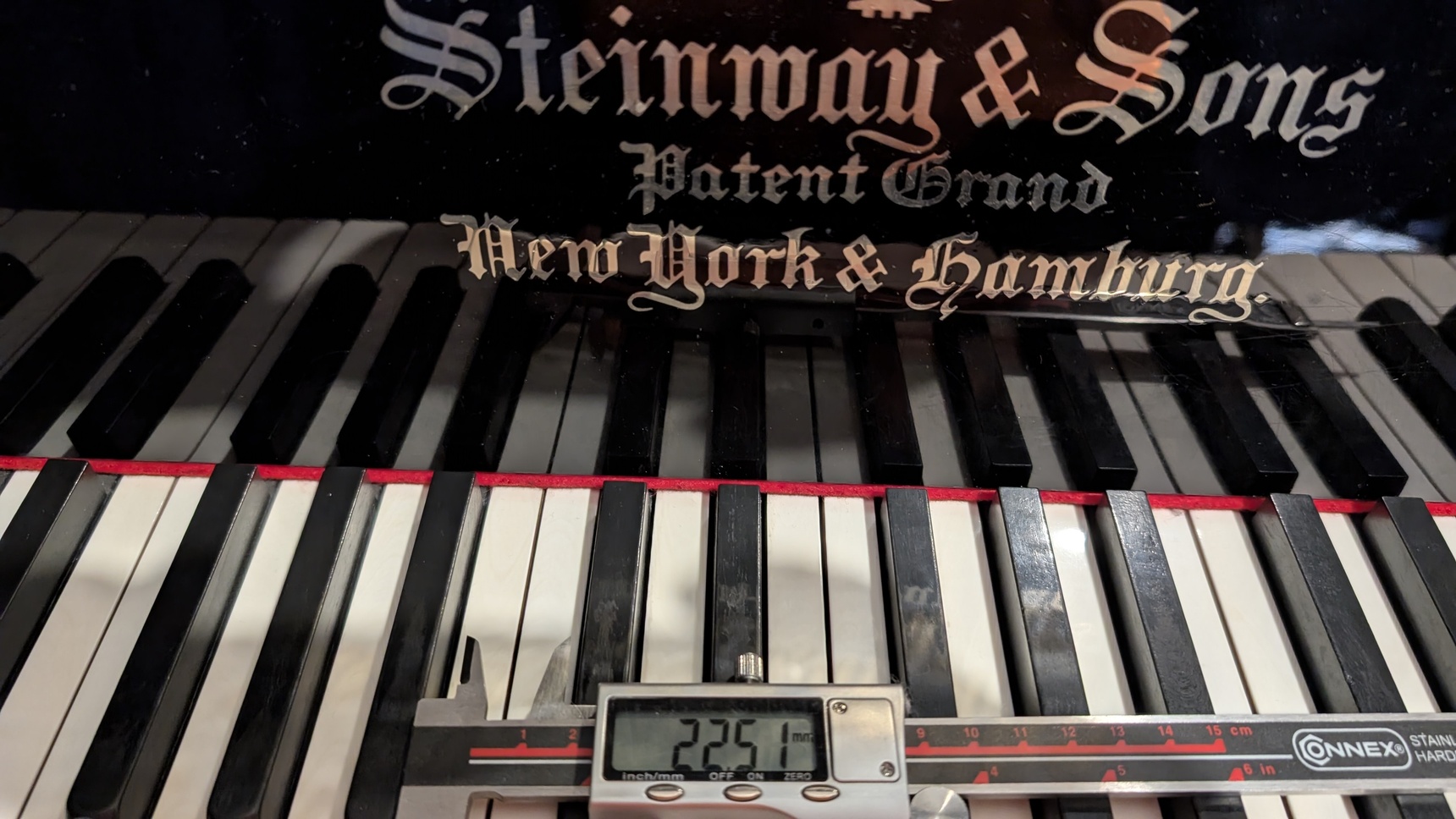
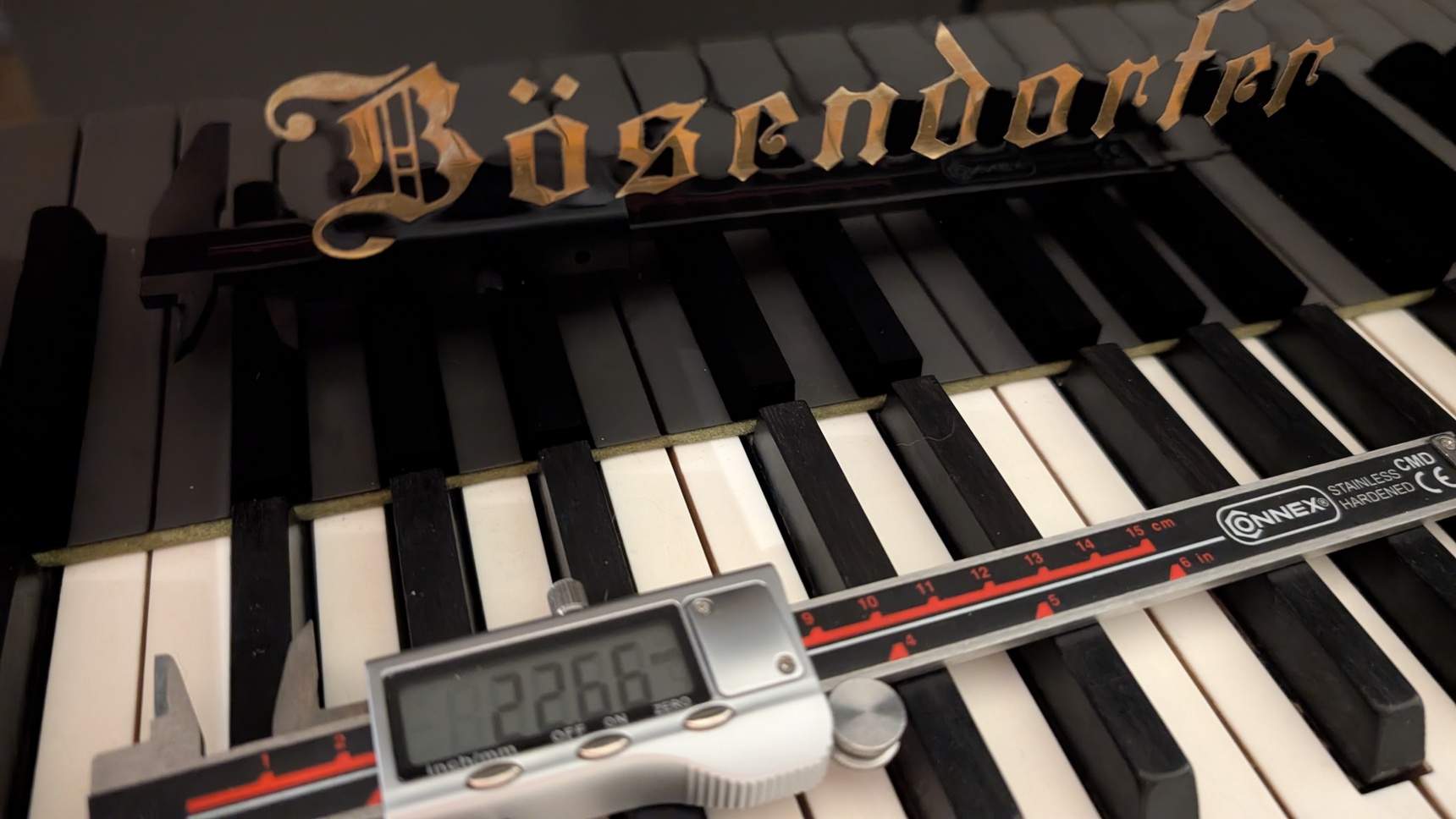
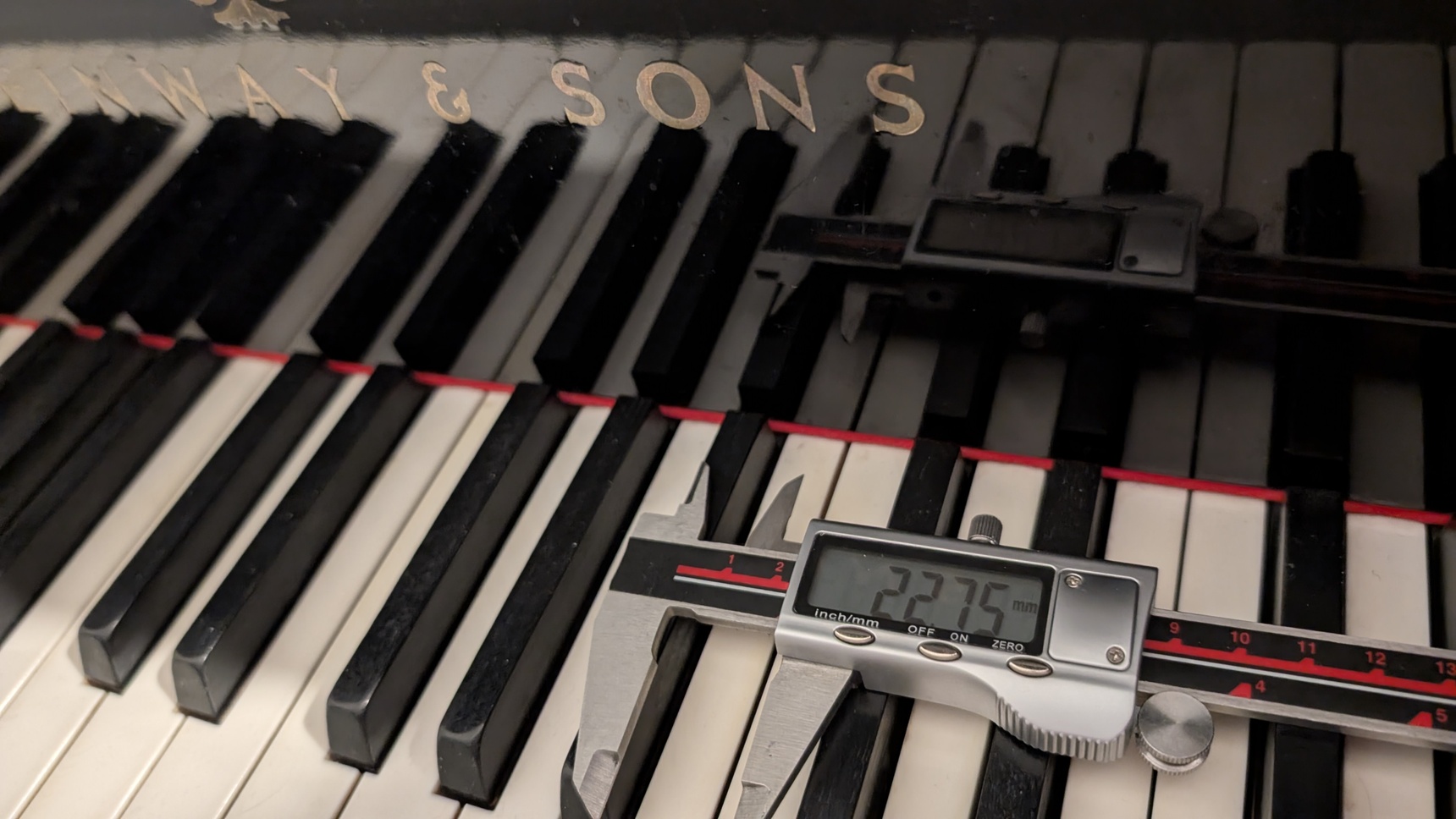
      I present you measurement of key width across three different pianos:

      • 1967 Bösendorfer, 225cm
      • 1970 Steinway B 211cm
      • 1887 Steinway D 269cm:
      • Owner of the world's tiniest piano store
      • clavierhaus_Vienna
      • 6 days ago
      • Reported - view

      I sampled a couple of keys of each piano and the variance is basically what you can see across three different model from different eras.

      So, we are talking about a maximum variance of 1.5 Micrometer across the whole range - which is significantly less than assumed earlier on. It also means that even in pre-CNC times the production precision was already on an extremely high level, in an obviously standardized width of the white keys.

      I will tonight sample the 1900 Bechstein 220cm as well as my 1886 Steinway B. I am pretty confident that both will end up in the same ballpark. 

      • Maria_F
      • 6 days ago
      • Reported - view

       Thank you for the information. By the way, I am not a piano tech and was asking a question, not making a statement. 

      • Maria_F
      • 6 days ago
      • Reported - view

       Thank you for the information. As I said earlier, I am not a piano tech and do not have an easy way to measure pianos' keys; if I did, I definitely would. I did not take photos when I was at the piano shop that had a 1900s Steinway upright with a noticeably different key width next to a 2018 Steinway D.  

       said:
      it is noticeable that during the whole discussion about this subject in the forum no hard measurement results were introduced to prove a point in one or the other direction.

      I don't have measurements or calipers. I was not making an argument, I was asking a question that I should have phrased differently; what I meant was closer to "do different pianos actually have different key widths and if so, does anyone have observations?" I also was not specifically referring to pre- or post-CNC pianos. 

      • Peter_William
      • 6 days ago
      • Reported - view

       recently I was reading a book and came across Hoffman. Absolute genius !. Rachmaninoff thought Hoffman was the best of that time which included himself and Conus - per the book ( I am not qualified to speak lol! ) . Every bit of video available of Hoffman playing is fantastic. Watch his version of Chopin :-) .. The speed and clarity at speed is from a different planet. Also learn't - that he was huge inventor with close to 70 patents!..

      • Noel_Nguyen
      • 6 days ago
      • Reported - view

      And imagine if the narrower keyboard was a key factor!... I know it's unlikely but still.

      • Maria_F
      • 6 days ago
      • Reported - view

       I read that Anton Rubinstein hated child prodigies but called Hofmann "the greatest musical genius the world has ever known.”

      • Peter_William
      • 6 days ago
      • Reported - view

        we may have read the same book. :-)

      • Maria_F
      • 6 days ago
      • Reported - view

       which one did you read?

      • Peter_William
      • 6 days ago
      • Reported - view

       "Basic Principles in Pianoforte playing" may be that one. Hard to pinpoint exactly since I read about 300 pages of 2 other books in the past 2 days on a different subject.. 

      • Andrew_Smith
      • 6 days ago
      • Reported - view

       Hi Peter. What does CNC refer to? Thanks. I did a little research --info which you probably already know-- after seeing Maria's reference to "stretto" pianos, and those are modern custom-built narrower-width keys/mechanisms that are then retrofitted into a piano. The 1930s Steinway I played DOES have noticeably narrower keys; I can stretch an 11th on it but only a 10th on most others.  I'm wondering if this 1930s I played was rebuilt and if the keys/mechanism is not the original? (Its owner doesn't know). And as I also stated, our 1980s 6 foot 3 Baldwin has narrower keys than Steinway, but not by as much. The Baldwin was not retrofitted but is the original. When the width differences are larger, it can affect my playing (but not disastrously). 

      • Maria_F
      • 6 days ago
      • Reported - view

       I believe CNC stands for Computer Numerical Control. 

      • Noel_Nguyen
      • 6 days ago
      • Reported - view

       I hate child prodigies too. When I see one, I can't wait until they reach adult age, to make me feel better about myself.

      • Maria_F
      • 6 days ago
      • Reported - view

       I sometimes get down on myself when I see pianists who are like 12 and playing pieces I am playing now. I started piano lessons late so of course I wasn't playing Chopin Ballades when I was 12!

      • Owner of the world's tiniest piano store
      • clavierhaus_Vienna
      • 6 days ago
      • Reported - view

       As Maria said, CNC stands for Computer Numerical Control and in essence is CAD/CAM i.e. Computer Aided Design and Computer Aided Manufacturing. It boils down to having machines do a faster and more precise job in manufacturing than humans.

      I am surprised you still maintain that "The 1930s Steinway I played DOES have noticeably narrower keys". I had imagined that my measurements would have shown a distinct pattern, but obviously they did not so I won't bother you with more images of my Bechstein and 1886 B measurements - which were exactly as I expected them.

      I'll leave it at that; I just wonder why no one has bothered to use calipers (not that this tool is an exotic one - it isn't) to give one's claim some substance that we can actually discuss. 

      I am used to be the voice crying in the wilderness (Anyone remember Joyce Hatto?), in so far I look forward to being proven wrong and learn something new. Until then I can only say that I don't trust statements of something being "noticeably" something without measurements to prove the claim.

      • Maria_F
      • 6 days ago
      • Reported - view


      But are all 1930s Steinways identical? As I said, I don't have calipers or easy access to pianos to measure. I don't have an opinion - if you have measured and found no evidence of width variation, I believe you. If I have a way to measure or take a photo of noticeable key width variation, I will post the measurements or photo here. 

       said:

      I am used to be the voice crying in the wilderness (Anyone remember Joyce Hatto?)

      I was reading about Joyce Hatto the other day.

      • Andrew_Smith
      • 6 days ago
      • Reported - view

       Next time I am there I will measure the 1930s piano key width. I think it's incredibly presumptuous of you to imply that I'm making some erroneous claim about what my own hands have felt and eyes have seen. It wasn't some vague sensation; it was a clear difference. And your measurements were not on the piano I've played. I'm not talking about your Bechstein. I was trying to add useful information that some pianos are retro-fitted with custom stretto/narrower keys and that that might be the case on that 1930s piano I played. 

      • Owner of the world's tiniest piano store
      • clavierhaus_Vienna
      • 3 days ago
      • Reported - view
      • Maria_F
      • 3 days ago
      • Reported - view

       I read that article. I was wondering if the Peter Lemken mentioned was you.

    • Stefano_Montani
    • 11 days ago
    • Reported - view

    I just bought a Petrof P118 upright piano, and it's my favorite. I had a Petrof before, thirty years old. I went to various piano shops to try out different ones, but only this one made me fall in love with its sound. The others seemed flat to me. But this must be a deformation due to habit and a certain inability to hear. This transition made me rediscover what it means to have a musical instrument under my fingers. There are certainly better pianos, because they are richer in possibilities. But in the end, what matters most is what you ask of your piano, more than what the piano can give. This is something I learned very late because, incredible as it is, none of my teachers was ever able to teach me what it meant to play a piano: searching for the sound, learning to find the sound you need, exploring what's possible. And I've never been musical enough to intuit it on my own. The instrument can be more or less rich in possibilities, but if you don't know how to ask the right questions, of it and of yourself, it's utterly useless. I owe my old piano more than a few apologies.

      • Karen_Sam
      • 11 days ago
      • Reported - view

       Exactly. My mentor’s criterion is whether he can make music on the instrument. That’s all he asks.

    • Noel_Nguyen
    • 11 days ago
    • Reported - view

    I absolutely love my Baldwin SD-10, built in the late 1970s and well maintained for all of its life so far. I love its powerful and vibrant yet warm sound. And yet I know its limitations. As I said during the concert chat today, I find its sound to be rather unidimensional although that word might be too harsh. I mean it is the perfect piano for Rachmaninoff and non-classical music, but I wouldn't want to record Chopin and especially not Ravel/Debussy on it for instance. This is not about dynamic range (I can play ppppp fairly easily on it), but rather about the sound character.  And yet it is unbeatable in what it does best.

    Truth be told, I don't know what my dream piano is. Probably the one that comes closest would be the Fazioli F308. But every single piano is different anyway!
      • Noel_Nguyen
      • 11 days ago
      • Reported - view

       This being said, the idea of chasing the perfect piano may be a rabbit hole. I'd much rather spend my efforts optimizing what I have. 

      It's a fun topic in any case. I especially like when I'm impressed with brands that are not always discussed in the "greatest piano" talks, such as Grotrian-Steinweg, Steingreaber, Schimmel, Sauter, Blüthner, and the golden age American brands such as prime Baldwin and Knabe.

      • Maria_F
      • 11 days ago
      • Reported - view

       Have you ever played a Seiler?

Content aside

  • 5 Likes
  • 3 days agoLast active
  • 154Replies
  • 291Views
  • 19 Following