Week 1: Vertical Voicing
Week 1: Vertical Voicing
Choose one piece of Bach, with suggested repertoire below. Use the daily practice activities to begin practicing exclusively the chords in your chosen piece. Listen along with a good recording. Track your progress daily and upload a videos of your work and feel free to ask questions about voicing, technique, or texture.
Week 1 Suggested Repertoire
Well-Tempered Clavier Book 1
- Prelude in E-flat minor
- Prelude in B-flat minor
Well-Tempered Clavier Book 2
- Prelude in F minor
- Prelude in A-Flat Major
English Suites
- English Suite 1 – Sarabande
- English Suite 2 – Sarabande
- English Suite 3 – Prelude
Partitas
- Partita 1
- Partita 4
- Partita 5
- Minuet 2
- Overture
- Sarabande
French Overture
- Passepied I
- Passepied II
- Sarabande
—
Practice Habits
Five basic voicing habits for this week to be mastered first:
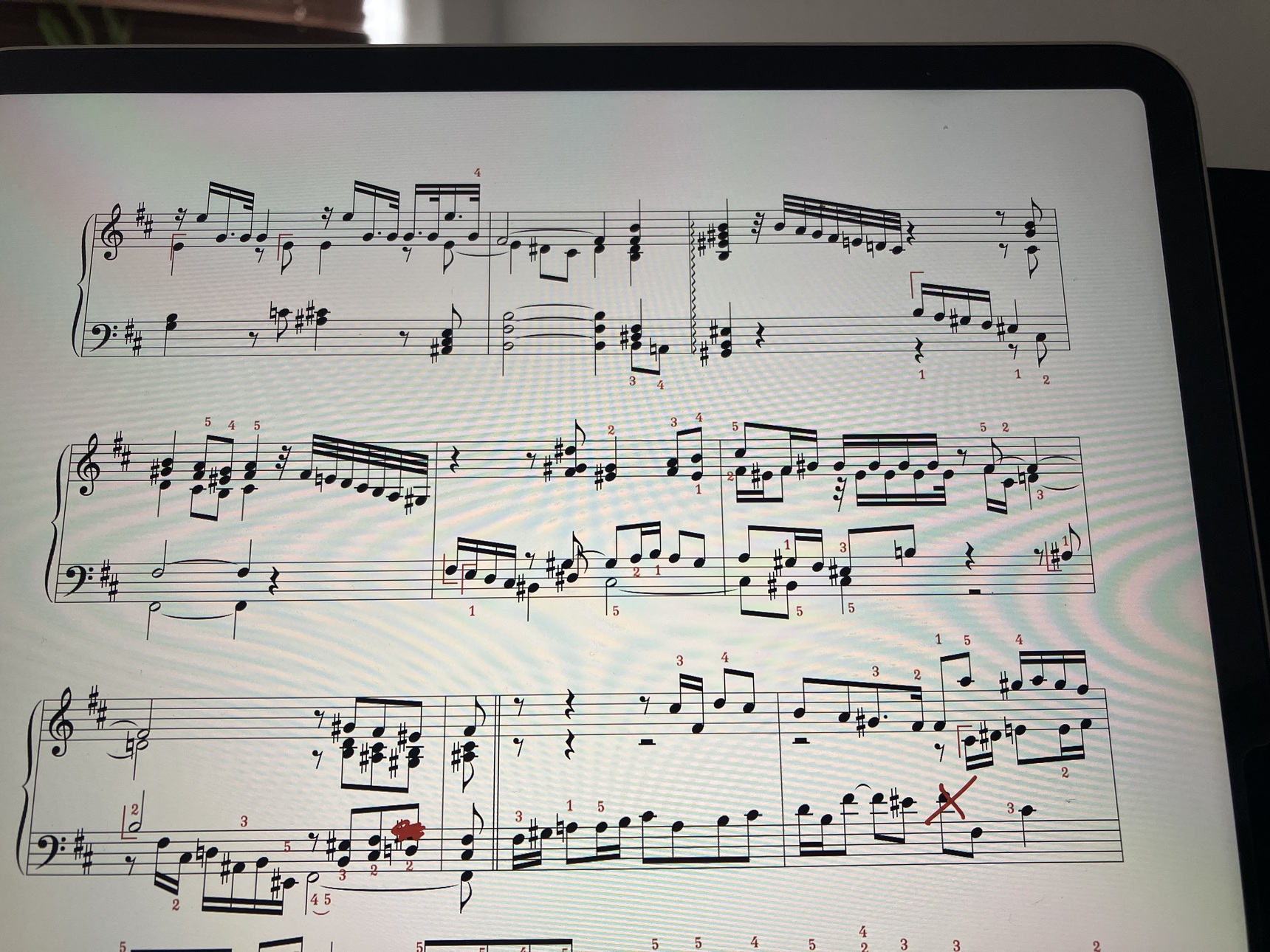
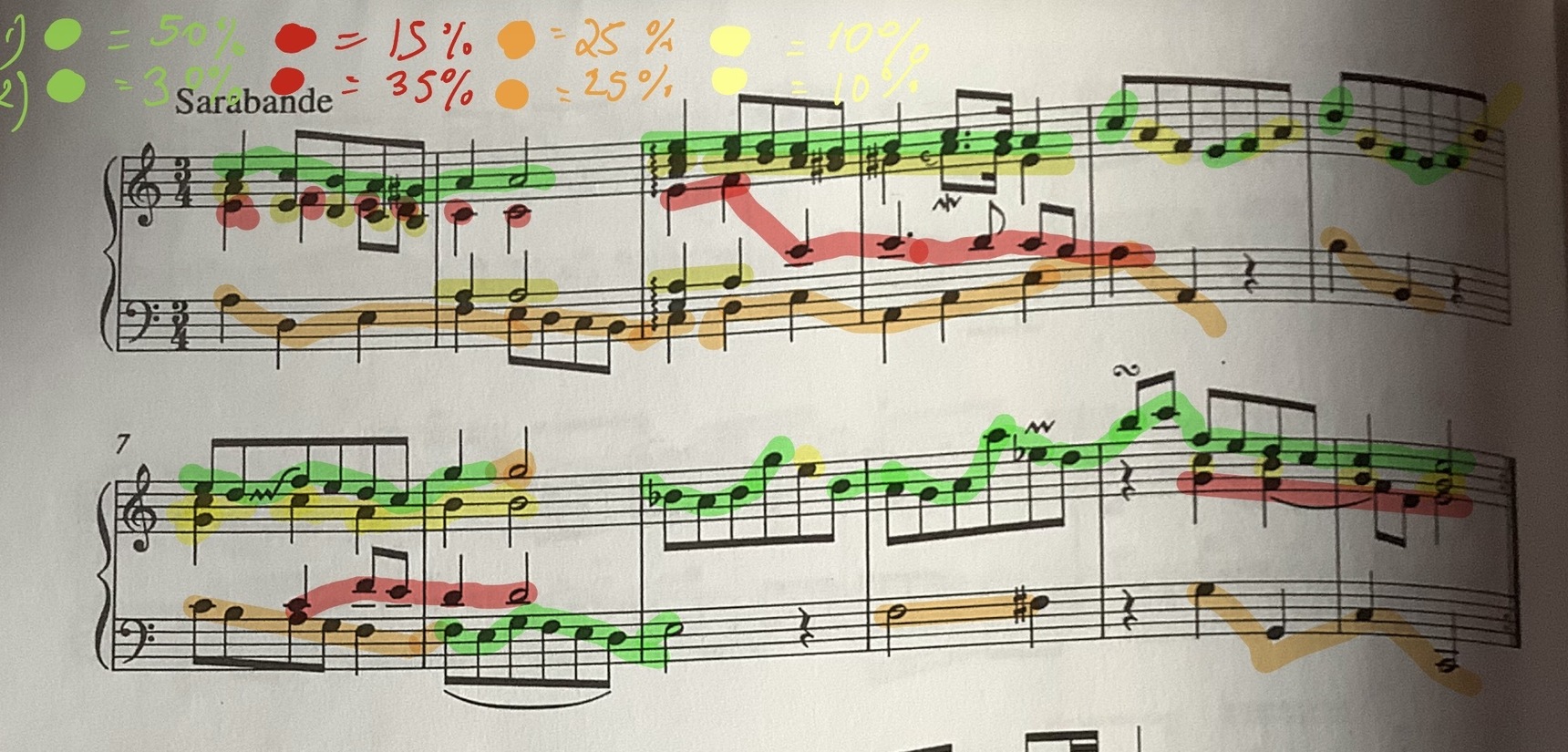
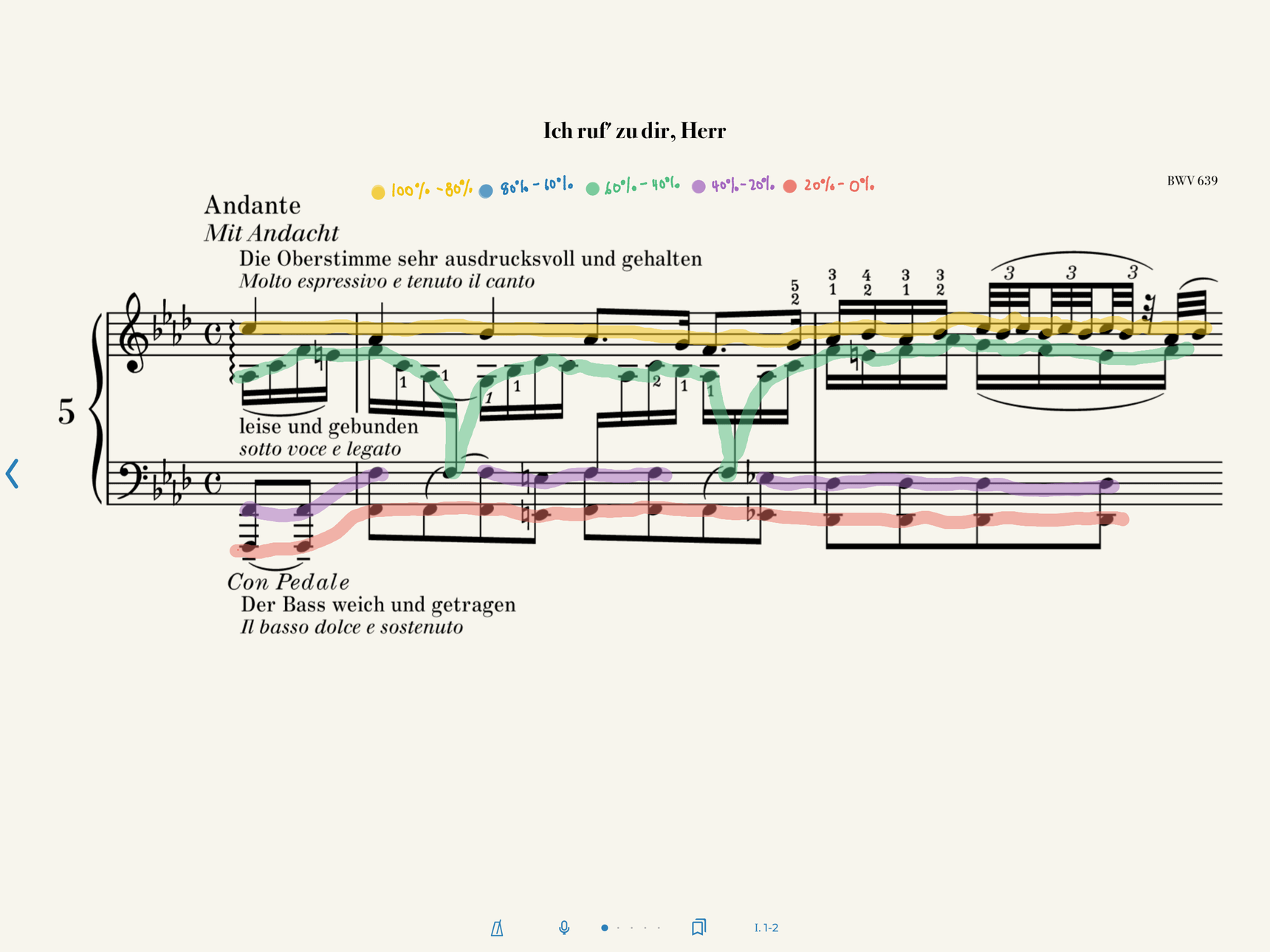
- Numbers game: identify number of voices per chord. Assign a percentage of sound per note/voice (10% + 20% + 10% + 60%).
- Transpose the chord up or down an octave. Check clarity is consistent in any octave.
- Arpeggiate downward and upward. Alternate between playing higher % notes and lower % notes (intervals).
- Observe obliques and listen carefully when one voice moves. Practice in two hands (eg. RH plays Tenor, LH plays Bass) in exaggerated percentages.
- Sink/slide into chord loosely (no tension), see what your hand naturally does. Adjust angle of arm toward the finger playing highest % note.
Five intermediate voicing habits after the above five are mastered:
- Play long tones as if they repeat (half note = 4 eighths cresc/dim).
- Textural thinking (eg, wool, velvet, cotton, cashmere, linen). Use your imagination to envision sophisticated effects for each sound in a chord.
- Hold highest % note(s), repeat the lower/lowest % note(s) and vice-versa.
- Key depth and reaction thinking (sinking slowing into keys with full arm weight, glancing the key at the halfway point, bouncing off the point of sound, etc).
- Playing an entire passage/chord progression with all chords voiced clearly.
Ultimate Goal
Your sound should convey the character of the piece / passage conveyed as soon as the chord sounds. There is absolute clarity of the leading voice which develops harmonic tension and phrasing.
63 replies
-
I will take up the easiest of these as an exercise using David Chang’s approach. Meanwhile, my coach, Brendan McGrath, and I are using the shorter parts of the Cello Suites, starting with the Sarabande, Minuets, and Gigue of BWV 1007. They are very instructive and useful for practicing good phrasing and articulation and it is also straightforward to see and hear the harmonic language. Eventually too- really good as one-handed exercises.
-
I'm choosing the Sinfonia (first part) of Partita 2 in c minor. Lots of vertical cords.
-
https://youtube.com/shorts/O4sXoJpG-Xs?si=7Dve43BL7CCXWhM- Practiced a little bit in the morning. I have not many chords and I fill the left hand in. Left hand has the theme ( most importent) then upper voice and middle voice piano. Sounds a little more elegant now. 🌟
-
I'm currently working on the 1st fugue, in C major, my first fugue! I would like to keep working on that please.....
-
Hi Jarred,
Thanks for the wonderful lesson.
I have chosen the WTC Book II Prelude in F minor, simply because it is within my reach in a short period of time. Also I have not really learned a proper piece in any WTC, so it's a good start. https://youtu.be/Kve-ELA2XQo
In the video, I am showing how I practiced :-
a) Playing the individual note of the chord according to my written %. Not as easy when it comes to really playing it versus mentally think that's how it should sound. :)
b) Arpeggiate upwards and downwards. I do notice there is a slight difference in my how my fingers weighing on the individual note upwards or downwards.
c) For oblique passages, is it correct to say that this happens on the LH melody from measure 20-28 ? I have played that section for you to review if I am doing it correctly.For the percentages, I have tried on the first 4 measures and the LH of m. 20-28.
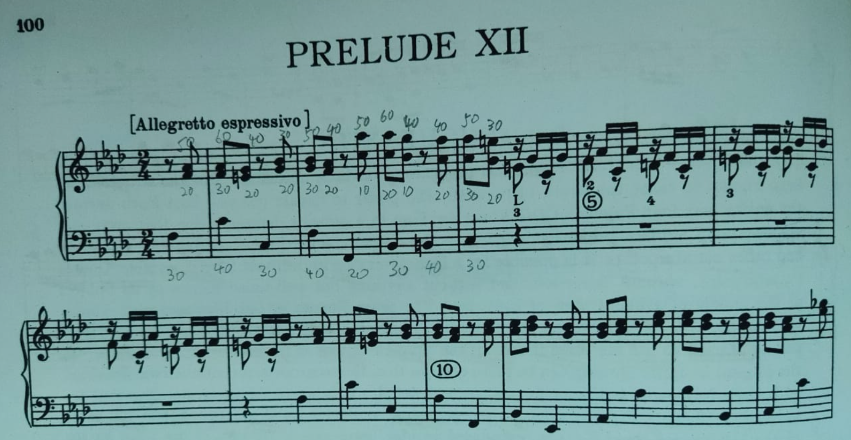
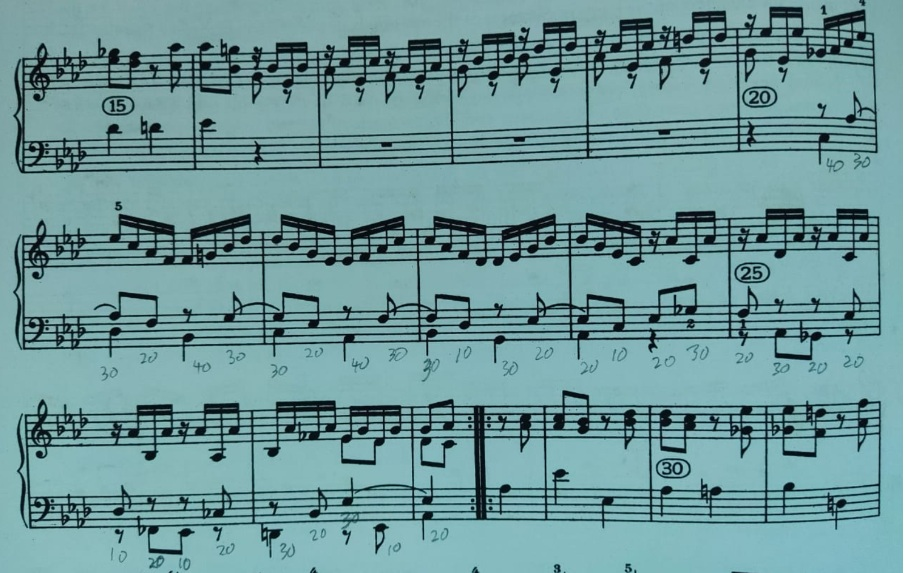
Your advice and guidance is much appreciated. Thank you so much !!
-
Obsessed with voicing now 😂. It has changed something only because if being aware of it. Practiced a little but Bach. https://youtube.com/shorts/CbWnMS103Rg?si=2DKlZhew7foel8vT
-
Hi, I’m not 100 % sure I’m getting my percentages right. Or maybe I’m making my life too difficult here. Would like to choose option 1 first and option 2 for the repeat (which is a struggle). Does it make any sense not to give the most weight to the top line ever?
-
I have chosen to choose chords from three pieces: the Sarabande from the English Suite in A minor; the E flat minor Prelude, No: 8 from the WTC 1; and the B flat minor Prelude, No: 22 from the WTC 1.
Bringing out the top-line is relatively straightforward, as is reducing the bass voice. The tenor and alto lines are harder as the volume appears to be a consequence of what has been given to the other two.
I have been arpeggiating the notes separately so that I can apply different strengths to the respective voices, and then inverting them to apply the same strengths to the given voices.
-
Hi! I’m working on the Prelude in B flat minor, Well Tempered Clavier, Bk I. Thank you for this intensive! This is a new approach for voicing for me. I’m already listening to things differently, and picking out different voicing. Thank you. Video to come soon.
-
Do not know if I am doing this right… Or if this not the best piece or the best bars to show?