The digital piano thread
Do you own one? Is it in addition to owning an acoustic piano?
I own a Kawai ES920, which is my main practice instrument. I do own an acoustic piano as well, as many of you know, but it's a monster concert grand, so I cannot practice late in the evening for obvious reasons.
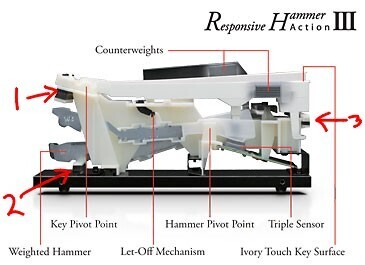
I find that my digital piano fulfills its role perfectly. Of course I will never find the sound of a digital to be as enjoyable as that of an acoustic instrument, but I still prefer my digital piano to an upright acoustic one, because I find its action to be closer to that of a grand piano, which it was designed to mimic.
What's your digital piano story? What led you to choosing the one you currently own? Let's discuss!
80 replies
-
Hi Noel, I recently replaced my acoustic upright for a digital (Roland LX6) because I was having ear issues (bouts of tinnitus due to Eustachian Tube Dysfunction). I felt that to continue playing with comfort, & to not do further damage, it was important to have volume control! The other bonus is being able to practice with headphones, so I don't disturb my son who's revising for A levels! I also quite like the subtle difference between piano sounds too, & will select different depending on the style & period of the piece I'm playing.
-
I have a Roland V-Piano in my basement studio and I use it for practicing phrases that I struggle with so as not to torture my wife. The action is a bit heavier than my Steinway Model B in my main piano room, and I think this helps from a finger strengthening perspective.
-
Noel,
I also replaced my upright acoustic piano with the Roland LX-9. The flexibility and musical experience are more than enough to offset any difference in the acoustic experience.
-
Noel,
I have an Estonia L210 that I love, but also I want to practice at times that don’t always match with my family’s schedule. Like you, I own a Kawai ES920. I used to have a Yamaha CLP something, but never loved the sound. The ES920 has a pretty terrific tone with lots of ability for modification- resonance, hammer, etc. however, the rebound-bounce of the keys drives me a bit crazy. I’m not sure why they bounce so much and others have noticed but Kawai didn’t address it before the first nutrient was released? Does yours bounce too?
-
In addition to my Steinway B, I've had a Yamaha P-125 for about 20 years that I use mostly for travel (sometimes for 2-piano pieces). It now resides with my son a couple of states away and I recently got a Yamaha P-225 to replace it at home / for travel.
I've loved the Yamaha (not as much as my Steinway :). The keyboard is very responsive and realistic. It has graded resistance so it is similar to most grands (unless you have the Stanwood system and had the key weights adjusted to something different than manufacturer's standard). It has a few bells and whistles (voices, etc.) but I wanted something that didn't have a lot of that -- I'm only playing classical piano rep.
-
Hi Noel
I have a medium grand Schimmel which I love. I bought a Roland FP 90X to record accompaniment music for my Baritone. I no longer play the Baritone and concentrate on the piano. I really like the Roland, it feels similar to the acoustic and has a nice sound, but due to my very small hands and injuries to my right hand was having a lot of trouble and often couldn't play. So I bought an Athena (had been waiting for a while to replace the keyboard of the Schimmel with a small handed one but it was taking a long time). The Athena doesn't feel or sound anything like the Roland so I connected them and added some good speakers, which has made a big difference, but still not totally to my liking. So am getting my son to add it to a computer connection instead (don't know what you call it) but he said it would really improve the sound as well as giving me all of the Athena's extras which I don't get now.
Interesting what you did with the felts. Might ask him if he can do that as well.
-
I have a digital piano as well as silent grand piano. Even I use silent system still have a lot of noise to hit the strings. Also I use digital piano to listen other instruments sounds to think of Orchestration and harpsichord. It's a very useful function for me. However, both are occupied big space!
-
In 2019, I bought a Yamaha Clavinova CLP-685 upright for ca. $6K. I love the touch and response (both keys and pedals). I am no professional and I can't play scales very quickly, but that's me, not the piano. For many years I had an upright Steinway. The Clavinova is far superior: never needs tuning, the touch stays even (actually seems subtly lighter at the higher portion of the keyboard), same graded pedal response, huge dynamic range. Plus, there are many voices to choose from. Since my home is a converted chapel, playing the organ voice at volume is glorious!
-
I have a Casio Bechstein GP510 hybrid piano and love it. It's the closest I've found that can replicate a true piano action. It's really designed more for the serious piano lover: you can make it sound like a Bechstein, Steinway or Boesendorfer. I live in a climate that gets very cold and dry in the winter and very hot and humid in the summer. I was spending lots of money tuning my previous acoustic piano plus cracks in the sound board. It always seemed out of tune. I'm way happier with my hybrid, which requires no maintenance and is always in tune. It's the only piano I have.
-
I spent several years practicing on a Yamaha P515 when I returned to the piano. It was great for the time, but I now have a Yamaha AvantGrand N2 hybrid piano (which has noticeably better touch and is still neighbor-friendly) and an Estonia L168 baby grand (which has better touch and sound). There's nothing the P515 really does better than either (other than travel) so it's currently gathering dust at this point.
I will say I wouldn't get rid of the N2 even if I someday find myself living the dream in a single family home with two(!) acoustic grand pianos — being able to learn new rep and do slow practice on something that's as close as I can get to an acoustic grand action and doesn't go out of tune or bother anyone around me is game-changing. As it is, I do 90% of my practice on the N2 and polish the details on the L168 so my apartment neighbors don't come pounding on my door.
-
Does anyone else have trouble executing trills and ornamentation on their digital keyboard? Also rapid repeated notes?
-
My primary digital keyboard is the Kurzweil PC4. It weighs only 28 pounds, but it’s got a weighted action, 88 keys, excellent piano sounds, 1000+ other great instrumental sounds, sophisticated sound editing (which I don’t use much), 16 Zones for mapping different sounds along the keyboard (which I use extensively on gigs), and many programmable knobs, buttons and sliders (essential for quickly accessing zones, sounds and setups), among other features.
Like Ken, I sometimes use it to give my long-suffering wife a break, especially while memorizing a piece or learning its notes. But otherwise, I don’t practice my piano repertoire on it, because even the best weighted actions on these keyboards can never substitute for a real piano for me.
My real piano is a 1916 Mason & Hamlin Model BB (6’11”), which I cannot keep my hands off of except when the house must be quiet. I use my Kurzweil for recording (non-classical music), for gigs with my band, and for solo piano gigs in larger rooms with an amplifier.
I also have a Casio Privia PX-330, circa 2009, which weighs only 26 pounds and also has 88 keys, a decent weighted action, decent piano sounds and about 250 other sounds (not as good as the Kurzweil but usable on jobs). It also has 2 built in speakers, which are loud enough to use without a separate amplifier for rehersals and sometimes gigs or parties in smaller rooms. I also have a Kurzweil PC-88mx, circa 1994, the great-grandfather of my present Kurzweil. It has 88 keys, 4 Zones, the best piano sound for its time, and again many programable knobs and sliders. lt was my go-to keyboard for 3 decades, and it still works, but it weighs nearly 60 pounds and was getting too heavy to take on gigs.
Prior to my Kurzweil I owned several other synthesizers, dating back to my first MicroMoog (a poor man’s MiniMoog) back in 1978, including an Oberheim Matrix 6, an Arp String Ensemble, and an Ensoniq ESQ-1. They did not have weighted actions and were very electronic sounding, and except for the ESQ, did not sound anything like a piano on gigs. They could never serve as a piano substitute, because of their unweighted synthesizer actions, but I used them for playing in bands and recording.
I also have several rackmount MIDI modules, which are basically sound boxes that you can play with a MIDI keyboard, including a Yamaha TX 81Z (a poor man's DX7 - are you detecting a pattern?), a Kurzweil 1000PX Plus, and an Alesis QSR, which I still use on gigs with my PC4.