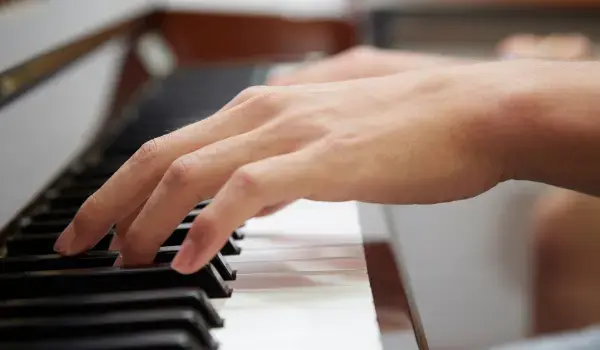
Week 2: First Steps

Week 2: First Steps

You’ve chosen your piece. Now the real work begins.

This week is all about getting into the music without worrying about perfection yet. First impressions matter. The way a piece feels under your hands, the sounds you’re drawn to, the passages that already feel natural (or completely confusing) are all part of the process.

This is the stage where pieces often feel the most fragile. Things are slow, uneven, and uncertain. That’s normal.

For this week, we’d love for you to share:

  • Early practice clips
  • First impressions of the piece
  • Passages you’re struggling with
  • Musical moments you already love
  • Questions or discoveries from practice

A few ideas to focus on this week:

  • Finding a comfortable tempo
  • Experimenting with sound and tone
  • Discovering patterns in the music
  • Identifying one or two “problem spots”
  • Practicing smaller sections instead of full run-throughs

Looking forward to hearing everyone’s first steps into the music.

73 replies

null
    • Noel_Nguyen
    • 4 days ago
    • Reported - view

    What I find especially treacherous about muscle memory is that it tends to dominate in practice, only to maliciously abandon you in performance. I call it the great betrayal. Don't fall for it!

      • Noel_Nguyen
      • 4 days ago
      • Reported - view

        Another easy way to throw off the muscle memory: rolling the chords! Try it, and experience a good simulation of being on stage, with that muscle memory gone AWOL, and the panic that is supposed to be exciting!

      • Unfrozen Barroom Piano Player
      • Peter_G
      • 3 days ago
      • Reported - view

       ,   Such a wise and helpful discussion, I'm following with great interest even though (for a change) I'm not saying much (until now!).

       I'm just back from a week of travel resulting in about 10 days away from the piano.  I had been working on memory spots before this trip, and I tried to make the most of 2 long train rides by studying the score visually and trying to connect it to my memorization and performance -- a very difficult thing for me. 

      Back at the piano now, Mark, I'm noticing that I too almost always go BACK to the previous memory spot, and Dustin brilliantly elucidates why that is not a good idea.  I'm finding it takes a real mental adjustment for me to move AHEAD instead. I have to make myself more alert to think of what's coming,  instead of merely focusing on getting through what's in front of me. 

      So now I'm trying to force myself to jump forward to the next memory spot at random moments.. And I find that one needs to pick different random moments each time, so as to avoid 'learning' a particular stopping point.

      (All of this applies to the B Major Prelude & Fugue WTC2 which I had roughly memorized before leaving and hope to play in Saturday's Community Concert -- my Rach Preludes for this event have picked up some rust but are still generally intact, so I'm going to try to resume "finishing" the Bb Minor ' as part of this workshop.  I hope to post my Week 1 version soon, hopefully some time before Week 3.  ).

      So anyway, thank you gentlemen for sharing your thoughts and expertise here. It's very enlightening.

      • Akzent oder Diminuendo? • Hanon/Herz student
      • Maria_F
      • 3 days ago
      • Reported - view

         My teacher recommends both playing very, very slowly and rolling chords.

    • Ken_Radford
    • 4 days ago
    • Reported - view

    I am intrigued with the concept of ‘musical significance”. Every time my piano coaxes tones from me, are they or are they not musically significant? I may have missed the point...

      • hot4euterpe
      • 4 days ago
      • Reported - view

       Significant to the structure / form of that particular piece of music. 

      Edit: Now that I am re-reading in less haste, I am not certain if you were joking and asking or just joking =)

      • Ken_Radford
      • 3 days ago
      • Reported - view

       For some notes to be considered musically significant would imply that other notes are not significant, and if these can be identified maybe I can just not play them :)

    • hot4euterpe
    • 3 days ago
    • Reported - view

    My week 2 update so far:

    With "Mouvement" this week I have been going over mm. 67-88 which precedes last week's section and collectively makes up the B section. I have also been going over the coda material (mm. 156 to end). It has been progressing well, I just need to find some time to record these which is my goal for this week.

    • Mark_Cooper
    • 2 days ago
    • Reported - view

    Week 2 progress 

    first half page of the allegro IV from Handel’s keyboard suite in F

    Right and left hand separately, then hands together ( memorised)

    I found this a useful exercise 

    this is a fugue 

    you should be able to hear the main subject repeated in the various voices as well as the countersubject 


    Handel’s keyboard suite in F

    First half page 


    https://youtu.be/qJKXN72snq4?si=SKqVJmp_kbNeRUwM

      • hot4euterpe
      • 2 days ago
      • Reported - view

       Bravo Mark! Very nice attention to clarity of articulation and convincing imitation. Very cool to see your individual hand work and how it remains intact when you combine it all. This attention to the parts and their combinations is top tier fugue practice. Sounds great!

      • Mark_Cooper
      • 2 days ago
      • Reported - view

       thank you Dustin!!

      I put in a bit of work into this .

      I’m trying to apply this separate hands approach to my other exam pieces. What I’ve learned so far is that just because one can play two hands by memory doesn’t necessarily mean you can play separate hands by memory. That requires additional work. My teacher advises me to at least memorise the left hand of at least part of the pieces. 

      • Mom, fitness instructor, lover of music
      • Michelle_Russell
      • 2 days ago
      • Reported - view

       Super cool! I love the clarity.

      • Ken_Radford
      • 2 days ago
      • Reported - view

       Well done Mark. You make it look easy (and I know it is not).

      • Mark_Cooper
      • Yesterday
      • Reported - view

       thank you Ken!

      I thought this might interest you 

      Keith Jarrett playing this piece , it’s pretty good I think 


      https://youtu.be/Lbo-yITNMo8?si=VNFReytNCTZyts39

      • Ken_Radford
      • Yesterday
      • Reported - view

       Thanks for sharing Mark. I have marvelled over Keith’s playing for the last 4 decades, and without his inspirational playing I may have given up my quest for piano competency. Have you heard his interpretation of J.S. Bach: The Well-Tempered Clavier?

      • Mark_Cooper
      • Yesterday
      • Reported - view

       Hi Ken, I didn’t even know he had done a recording of the WTC, but I did hear a CD of him playing the preludes and fugues of Shostakovich 

      • Ken_Radford
      • Yesterday
      • Reported - view

       He is one talented musician. To be able to play classical pieces and to be able to improvise in front of large audiences is nothing short of amazing.

      • Mark_Cooper
      • 17 hrs ago
      • Reported - view

       Rick Beato did a recent interview with him on you tube . Unfortunately he is very disabled from a stroke . I honestly found it difficult to watch , quite upsetting. 

      • Ken_Radford
      • 13 hrs ago
      • Reported - view

       Yes, I watched the Rick Beato interview and it made me feel very sad. Mr. Jarrett has surely suffered for his art.

      • vbashyam
      • 7 min ago
      • Reported - view

       Well done! I love the hands separate memorization!

    • Mom, fitness instructor, lover of music
    • Michelle_Russell
    • 2 days ago
    • Reported - view

    First of my week 2 updates: short practice sections, each measure on repeat (4x) then move to next measure. The goal is to move seamlessly from one measure to the next, which doesn't always work in practice but shows me where I need to work the seam between measures a little more. I do like to close my eyes for the majority of the repeats (after I've played through once), and where I don't play as confidently with eyes closed marks another spot to come back to tomorrow.

    https://youtu.be/Rym6qYxCekk

    • Sachi
    • 2 days ago
    • Reported - view

    This is week 2 practice:  Chopin prelude op.28/13 in F# major bar 24-28.

    This prelude has six #s, and accidentals shift within a bar some places. I need to remember those. 
    From bar 21, Chopin’s pedaling indicates left hand sounds like violin playing pizzicato (new word learned: Googled the terminology, i.e. plucking). 
    My recording sounds horrible when pedal is not used at all, so I need to use some pedal. 

    https://youtu.be/bgshkiFX6EE?is=TkQ9luudohnBpVvm

      • hot4euterpe
      • Yesterday
      • Reported - view

       Hi Sachi! Thank you for sharing your work on these tricky measures. You have a nice balance of layers developing. I feel that your melody sings clearly and spins out naturally over chords. 

      No need to be apologetic about using pedal btw. When Chopin does not indicate pedal, it does not actually mean 'no pedal'. The pedal marks he does give are just particularly important such as where a change should take place to avoid obscuring the harmony; to prevent a pianist from perhaps making too many pedal changes; to sustain important bass tones that you have to release to continue playing with the LH; or to help express an important rhetorical moment. This prelude in particular definitely needs pedal throughout. If you only use it where he has pedal markings, your sonority will constantly change! He even marks this section 'sostenuto' which indicates a sustained sound throughout. So your instincts are correct! With the dense texture you may also find half pedal to be desirable. 

      • Sachi
      • Yesterday
      • Reported - view

       Hi Dustin. Thank you so much for listening and generously offering me your feedback. I don’t have a teacher at the moment, so your advice feels like rain in the desert🌵

      I will use pedals according to Chopin’s pedal marks, and by listening carefully. 

      • vbashyam
      • 2 min ago
      • Reported - view

       Sounds great! I am working on this one too. So much more difficult than it sounds but so worth the effort to learn this one.

    • hot4euterpe
    • 2 days ago
    • Reported - view

    Week 2 Recordings for:

    - mm. 67-88, Start of B section (technically I start from mm. 63 because it made for a nicer lead in). 

    - mm. 156-end, Coda

    I just made them both into a single video with a transition for easier viewing =) I also added PDFs below to show the sections if anyone wants to see the music.  

    https://www.youtube.com/watch?v=9UP5-h1q0Rk


    Mouvement mm. 63-88 Mouvement mm. 156 - end

Content aside

  • 4 Likes
  • 2 min agoLast active
  • 73Replies
  • 255Views
  • 16 Following