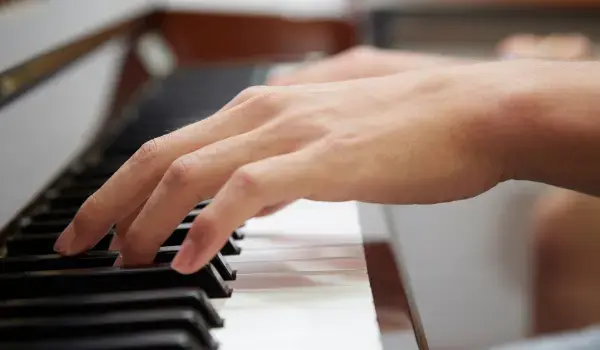
Week 2: First Steps

Week 2: First Steps

You’ve chosen your piece. Now the real work begins.

This week is all about getting into the music without worrying about perfection yet. First impressions matter. The way a piece feels under your hands, the sounds you’re drawn to, the passages that already feel natural (or completely confusing) are all part of the process.

This is the stage where pieces often feel the most fragile. Things are slow, uneven, and uncertain. That’s normal.

For this week, we’d love for you to share:

  • Early practice clips
  • First impressions of the piece
  • Passages you’re struggling with
  • Musical moments you already love
  • Questions or discoveries from practice

A few ideas to focus on this week:

  • Finding a comfortable tempo
  • Experimenting with sound and tone
  • Discovering patterns in the music
  • Identifying one or two “problem spots”
  • Practicing smaller sections instead of full run-throughs

Looking forward to hearing everyone’s first steps into the music.

30 replies

null
    • Pediatrician
    • a_weymann
    • Yesterday
    • Reported - view

    In Week 2, I plan to practice the “negative”, or opposite, as it were, of what I worked on in Week 1: I will study the entire movement and learn to play it in a moderate tempo, focusing on good sound, voicing, and use of pedal. But in those six sections in which the main theme is presented and recurs, accompanied by eighth note triplets in the left hand, I will ONLY play the right hand. If I have time, I will still separately practice those left hand segments to which I had devoted Week 1, trying to get them to a faster tempo. 

    • Pediatrician
    • a_weymann
    • Yesterday
    • Reported - view

    Oh, and my hope-themed motto for this week shall be: “Learn from yesterday, live for today, hope for tomorrow” (attributed to Albert Einstein). 

    • Mom, fitness instructor, lover of music
    • Michelle_Russell
    • Yesterday
    • Reported - view

    For this week, I'm going to spend more time on the left hand especially where there are small leaps (practice in isolation, as well as with eyes closed slowly to feel topography of keyboard from one note to the next and quickly to train trust/confidence). Additionally, I'll play smaller sections on repeat at faster than goal tempo. By the end of the week, I hope to have the middle section in a more confident position as this was the section that gave me the most challenge when I was learning the piece last year.

      • Pediatrician
      • a_weymann
      • Yesterday
      • Reported - view

       practicing with eyes closed is a great idea! A couple of years ago, I had the wonderful opportunity to play for Ursula Oppens in a tonebase masterclass. The piece I played for her had some nasty leaps, and Prof. Oppens said: “You must practice them with your eyes closed!” And then she told the story of how as a college student, she was practicing in a big auditorium and the electricity and the lights went out. She happened to be working on the Schumann C major Fantasie which in the coda of the second movement contains one of the most notorious and dreaded leap passages in the entire literature. So she was forced to practice that piece in the dark, feeling her way around the keyboard - and, as you can imagine, she ultimately found it very helpful. 

    • Ken_Radford
    • Yesterday
    • Reported - view

    I spent week one on the difficult LH stretches in bar 95 of Heartland. This week I thought I’d give my hand a rest and play from the beginning of the piece. Here are bars 1 - 33 (of a total of 140).

      • hot4euterpe
      • Yesterday
      • Reported - view

       Very nice Ken! Some very sensitive LH playing and great tapered resolutions!

      • Ken_Radford
      • Yesterday
      • Reported - view

       Thanks for your encouraging words Dustin, they are much appreciated.

      • Pianist, composer and piano teacher
      • Sindre_Skarelven
      • 19 hrs ago
      • Reported - view

       Sounds beautiful, Ken! Great start! 

      • Ken_Radford
      • 19 hrs ago
      • Reported - view

       Thanks for your kind words Sindre. I will be recording the next few tens of bars today.

    • Noel_Nguyen
    • Yesterday
    • Reported - view

    Piece: Rachmaninoff Sonata no.2 - III. Allegro molto


    You know what they say, no pain no gain. But at the same time you don't want too much pain or you'll just quit! So just enough pain, and if possible the kind of pain that has pleasure in it, which I rarely achieve 😅. I know it sounds downright masochistic. I am suddenly reminded of a video by Josh Wright in which he said he would challenge himself to play a piece after putting his hands in snow!

    Well there will be no such extreme self-flagellation here, but I _will_ challenge myself during practice, because the more I suffer during training (in the right way😂), the less I will during performance! I think it was Muhammad Ali who said something like that.

    But enough idle talk. This week I will challenge myself to not rely on muscle memory, because I know with 109% certainty that it will betray me in performance. To achieve this, I have to stop myself at any random point, let the muscle memory fade, and then find my way back through my other memory modalities, i.e., visual , auditory, tactile, and most of all analytic, which involves remembering the musical theory of the passage. I wasn't kidding when I said there will be pain!

      • Mark_Cooper
      • Yesterday
      • Reported - view

       I absolutely agree that relying on muscle memory is potentially disastrous !

      I have recently started using a method I call anchoring points . I thoroughly memorize selected bars , potentially these could be completely random. If the inevitable memory lapse occurs, I just rewind to the ‘anchor ‘ and press on , rather than starting the piece from the beginning. If you have enough of these anchors , you may only need to rewind a few bars to get restarted 

      In addition , I find that as I’m playing , and I know that my anchor is approaching, I feel a lot more relaxed …

      • Pediatrician
      • a_weymann
      • 17 hrs ago
      • Reported - view

       that’s an excellent strategy and certainly reduces performance anxiety! 

      • hot4euterpe
      • 17 hrs ago
      • Reported - view

       Your checkpoint, or anchor point, strategy is excellent and a fundamental tactic of secure performances, particularly for longer works. You will find that most discussions of this suggest that you use musically logical points where a phrase begins or a texture changes etc. rather than random points (though I suspect your random points are probably musically significant in some way!). 

      Most important though - in a performance - is to move forward to your next checkpoint / anchor point rather than backward. Advancing keeps the music flowing forward and your audience may not even notice the lapse! Going backward is a much more obvious correction and you run the risk of the exact same lapse taking place again (especially because you are now aware of it), resulting in repeated crashes and restarts. I've seen this occur in many performances from young students in lessons to experienced students at festivals, and even at university masterclasses. It is so common an occurrence that this could almost be a T-shirt, along with "It was so much better when I played it at home!". 

      • vbashyam
      • 17 hrs ago
      • Reported - view

       Great discussion and advice from you,  and  ! Exactly what I needed to hear. I have been thinking about this as I have been working on memorizing and being able to play securely from memory without relying on muscle memory. I especially like your advice on moving forward to the next anchor point. Will keep it in mind! 

      • Akzent oder Diminuendo? • Hanon/Herz student
      • Maria_F
      • 1 hr ago
      • Reported - view


       said:
      "It was so much better when I played it at home!". 

      I make many more mistakes during lessons when I am actively trying to avoid them than when I am practicing.

      I basically don't have any performance anxiety so I am pretty sure it is just an issue of me thinking about potential/past mistakes and being distracted by trying not to make them. 

    • vbashyam
    • 20 hrs ago
    • Reported - view

    I had to look up the Star Wars reference for “First Steps”(it’s been a while): “After Luke feels the Force for the first time while training on the Millennium Falcon, Obi-Wan tells him, "You've taken your first step into a larger world," signaling his transition from a farm boy to a Jedi initiate.” 😊

      • Pianist, composer and piano teacher
      • Sindre_Skarelven
      • 20 hrs ago
      • Reported - view

       Yes! And the line is also echoed in Rey’s vision in The Force Awakens with «These are your first steps» . The final scene in this episode is called Jedi Steps where she is actually climbing a steep stairscase on an island finding Luke at the top. 

      • Pediatrician
      • a_weymann
      • 17 hrs ago
      • Reported - view

      😂yes! And then he turned around, and I thought: “gosh, Mark Hamill really hasn’t aged well, has he?”

      • Akzent oder Diminuendo? • Hanon/Herz student
      • Maria_F
      • 1 hr ago
      • Reported - view

       I didn't realize "first steps" was a Star Wars reference. I don't understand any of the references.

    • Ken_Radford
    • 18 hrs ago
    • Reported - view

    Here are the next few bars of Keith Jarrett’s Heartland.

    • Noel_Nguyen
    • 16 hrs ago
    • Reported - view
     said:
    though I suspect your random points are probably musically significant in some way!

     You suspicion is correct, at least for me!

    • Noel_Nguyen
    • 15 hrs ago
    • Reported - view

    What I find especially treacherous about muscle memory is that it tends to dominate in practice, only to maliciously abandon you in performance. I call it the great betrayal. Don't fall for it!

      • hot4euterpe
      • 15 hrs ago
      • Reported - view

       Absolutely. In practice, we are in our own safe space playing on the piano we know without any observer. We do not have adrenaline hitting us and are not overly self-aware. We also tend to focus on the attempts that go well and mentally erase the many tries that perhaps did not.

      Then comes time to make a recording or perform in public and suddenly adrenaline hits, heart rate increases, fine motor skills feel blunted and we are self-conscious of everything we are doing which we perhaps realize, we don't actually know in places because it has become muscle memory without cognitive awareness of any landmarks / guiding elements (The Great Betrayal!).  

      Muscle memory is an important component of getting into a flow state but it requires deliberate awareness of the movements we are making and the fingering we are using every time so that it will be executed the same way with reliability. When paired with the other elements you mentioned (like analysis, the 'shape' and 'feel' of certain figurations and, of course, the listening to the sound we are producing) muscle memory can flourish as part of the team of executions in a successful performance!

      I say all this just to expand on your excellent points! Learning to play a piece and learning to perform that piece are definitely two different challenges. Once my students can play through a piece, I often tell them that they are now ready to being learning to perform it =)

      • Mark_Cooper
      • 10 hrs ago
      • Reported - view

       thanks Dustin , point taken about moving forward rather than back to anchor points 

      one additional useful tip from my current teacher , when practicing from memory, play the passages ultra  slow , this will substantially reduce the muscle memory element , and you will be reliant on actually knowing the notes to be played ( this can be further reinforced by playing with eyes closed)

      • Noel_Nguyen
      • 9 hrs ago
      • Reported - view

        Another easy way to throw off the muscle memory: rolling the chords! Try it, and experience a good simulation of being on stage, with that muscle memory gone AWOL, and the panic that is supposed to be exciting!

Content aside

  • 3 Likes
  • 1 hr agoLast active
  • 30Replies
  • 118Views
  • 14 Following