Week 2: Clarity and Articulation!

Welcome to Week 2 of the Mozart Challenge.

Now that the notes are starting to settle, this week we shift our focus to something essential in Mozart’s style: clarity of articulation and shape of phrase.

Mozart’s music often looks simple on the page, but its beauty comes from how clearly each musical idea speaks. Every slur, staccato, and gesture contributes to the character of the phrase.

Your goal this week is to make the music speak more clearly.

Your Focus for the Week

Continue working on the same Mozart piece you chose in Week 1.

Spend time exploring:

• Where each phrase begins and ends
• How the articulation shapes the character
• Where the music feels like it’s asking a question or giving an answer

Try to imagine the music as spoken language. Mozart often writes phrases that feel conversational.

Practice Prompts

Try one or two of these ideas in your practice:

• Practice your piece slowly with exaggerated articulation
• Shape each phrase as if it were a sung melody
• Lighten repeated notes so the texture stays transparent
• Experiment with slightly different lengths of staccato or slur

Share Your Progress

If you’d like, post an update this week:

• A short video
• A practice discovery
• A musical question
• Or simply a note about what you’re noticing in Mozart’s style!

14 replies

null
    • Maria_F
    • 6 days ago
    • Reported - view

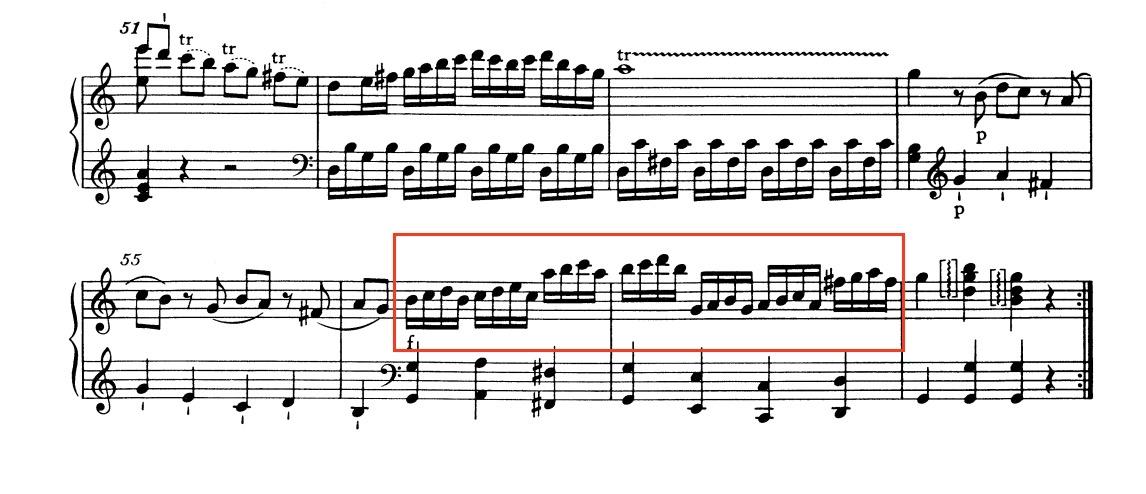
    Does anyone have fingering suggestions for the fast right-hand sixteenth notes in measures 56-57 of Sonata No. 7 K. 309?
      • hot4euterpe
      • 5 days ago
      • Reported - view


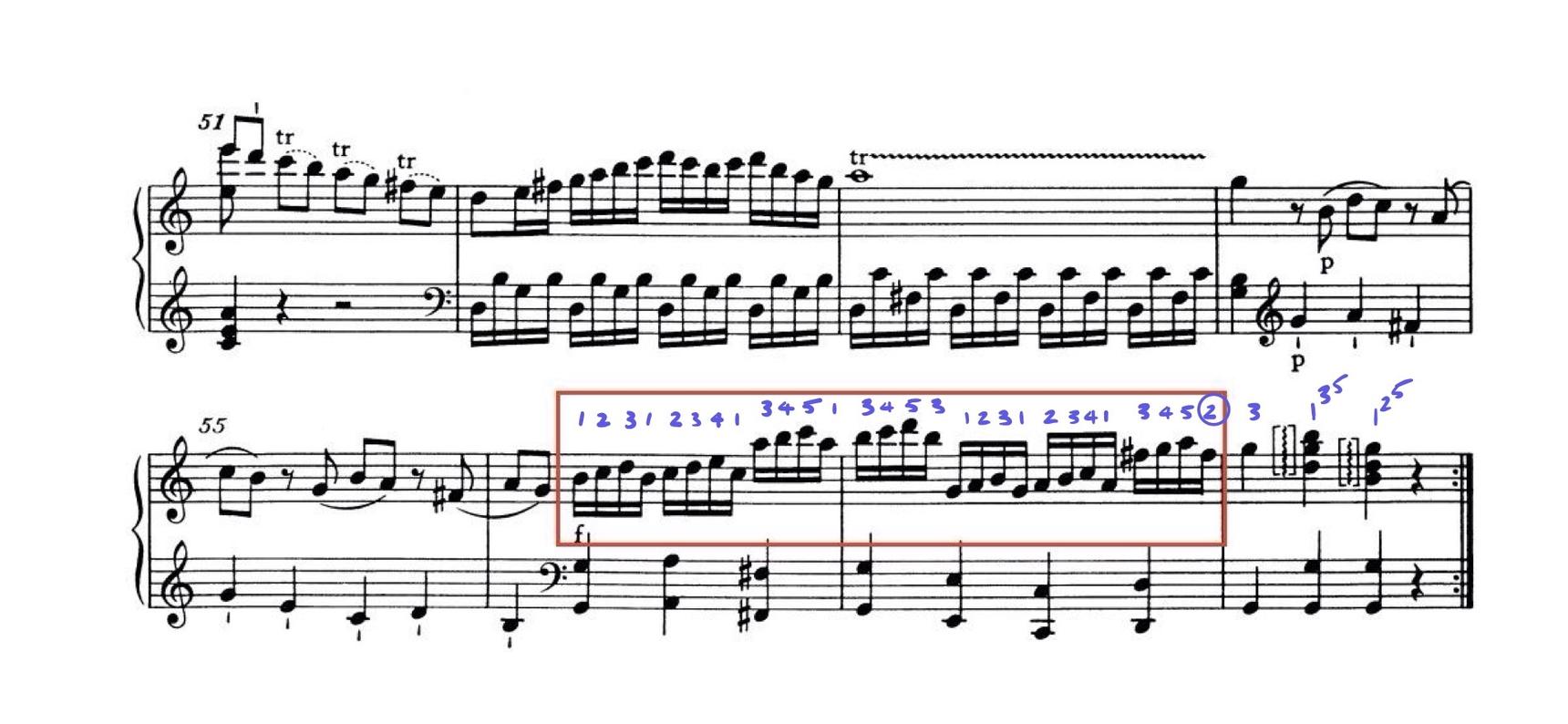
      I would do the following. It is similar to what I saw you post in the other thread but using 3 for the first note after the leap to the higher register will be slightly faster than a 2 since the 3 will always arrive sooner than 2 moving right in the right hand. It also keeps the hand / wrist nicely balanced. I would be sure to conclude the 16ths with 2 so that you can enter the G with 3 which then stays in place for the rolled chord.  

      Multiple fingerings I saw in the other thread are suitable though. This is just to optimize the lateral movement of the wrist in the register shifts, especially if going for a very quick tempo.

    • Maria_F
    • 2 days ago
    • Reported - view

    I have the first movement mostly memorized, but I am still trying to figure out the best fingerings, as there are quite a few awkward passages. I am not quite at the point where I can work on articulation yet, but I am making progress!

    • Claire.3
    • 2 days ago
    • Reported - view

    I'm doing the Sonata in C K279 and I have lots of questions! firstly my edition, it's edited by Bartok and I'm not sure how much to abide by his markings. Would anyone have an urtext copy they'd be willing to share the 1st 2 pages of?  I really need help with the fingering on the 5th line, I can't sort out those ornaments, especially going to the semiquavers in the 2nd bar. Then the grace notes in the 4th line of the 2nd page, I've got used to them as acciaccaturas and love the playfulness of it, but most performances seem to have them as appoggiaturas. sorry the photo isn't very clear....

      • Maria_F
      • 2 days ago
      • Reported - view

       In my experience, Bartok's editing choices are sometimes strange. 

       said:
      I can't sort out those ornaments, especially going to the semiquavers in the 2nd bar.

      Those are mordents. I am not sure what your specific question is, but if you can specify, I can (hopefully) answer! 

       said:
      Then the grace notes in the 4th line of the 2nd page, I've got used to them as acciaccaturas and love the playfulness of it, but most performances seem to have them as appoggiaturas.

       They are notated as appoggiaturas in the Bärenreiter Urtext, which I attached.

      • Claire.3
      • 2 days ago
      • Reported - view

       thank you so much! The problem with the mordants  is the fingering, especially going from the previous bar to the semiquaver bar. 

      • hot4euterpe
      • Yesterday
      • Reported - view

       Hello. The Bärenreiter and Henle editions are of course wonderful, but if you have many questions about playing Mozart you may value a good student edition like those published by Alfred. The Mozart sonatas books include a lot of historical information as well as performance advice. The pieces themselves often have numerous footnotes detailing how the different ornaments are commonly realized. I have attached a pdf. of the first two pages of K.279 for you to see what I mean. Hopefully it is helpful to you =)

      • Claire.3
      • Yesterday
      • Reported - view

       Thank you for that! It's a nice clear copy.  it's more the execution of the ornaments that I have trouble with, especially in bar 14, going from the quaver B to semiquaver C with trills. 

      • Maria_F
      • Yesterday
      • Reported - view

       I have personally found Alfred inaccurate when compared to the urtext. 

      • hot4euterpe
      • Yesterday
      • Reported - view

       The two editions have very different purposes but you raise an important point. For those that do not know, urtext editions try to present the score in a way that the publisher feels is the closest to the composers intentions based on various surviving manuscripts / early editions. They tend to be viewed as the standard for serious performers because they are excellent for musicians that have a strong knowledge of style and performance practices since those musicians can make their own decisions about realizing ornaments, articulation, phrasing etc. Points of contention are often detailed in extensive set endnotes or appendices. This type of edition includes Henle, Bärenreiter, Wiener, and Ekier.

      Alfred "Masterwork Editions" do not claim to be urtext. The editor(s) often discuss common points of contention in their footnotes. They also point out what is commonly done by 'big-name" performing pianists as much as they discuss what is musicologically appropriate (these two things don't always align). They are particularly useful to learners who are still developing a sense of style and / or not sure how to realize the ornaments. 

      Some Alfred editions are definitely better than others (as is the case with all publishers). The two volumes of Mozart sonatas are quite recent and very well done. They also include some interesting fingering solutions to consider. The four volumes of Beethoven sonatas are also well done and the two volumes of the Well Tempered Clavier were particularly popular for a period of time as the editorial suggestions for articular are given a lighter grey colouring and many notes on performance practices are included at front of each book.

      Many teachers have multiple publications of the same repertoire for the above reasons. For example, I have at least five different editions of Beethoven sonatas in my studio at the moment. Another pedagogical edition I like to use for teaching are Schirmer Performance Editions which are considerably better for students compared to the older classic yellow ones because they are much cleaner in presentation and clearer about their editorial suggestions.

      • Maria_F
      • Yesterday
      • Reported - view

       I primarily use Henle, Edition Peters, Bärenreiter, Breitkopf and Härtel, and Wiener Urtext editions. 

      • hot4euterpe
      • Yesterday
      • Reported - view

       That makes sense since the posts I have seen from you indicate that you are knowledgable pianist with a wide range of repertoire and style practice experience. 

      • Maria_F
      • Yesterday
      • Reported - view

       I am actually an advanced student, but I read a lot about theory and musicology, and play a wide range of repertoire. 

    • Ellen_Weaver
    • Yesterday
    • Reported - view

    Here’s a short video of the opening bars of the 3rd movement of the A Major concerto. I was aiming for active fingertips and getting the phrasing to sound Mozartian. I welcome any feedback. I posted this under Week 1, but I think people have moved on now to Week 3. It’s a bit confusing to have several different threads on this topic.
    https://youtu.be/hs9sBoUUt58?si=UmFTcEpLO0Szu_QP

Content aside

  • 4 Likes
  • YesterdayLast active
  • 14Replies
  • 94Views
  • 8 Following