Week 4: Share It
- Dominic_Cheli
- updated 3 mths ago
- 260replies
We made it.
Four weeks ago, this challenge began with A New Hope. You chose a piece, took the first steps, kept the momentum going, and stayed with it through the ups and downs.
Now it’s time for the final step:
Share it.
This week is all about recording and posting your piece. It does not need to be perfect. In fact, that was never the goal.
Maybe your piece isn’t exactly where you imagined it would be. Maybe there are still rough edges. Maybe there are passages you still wish you had another week with.
That’s okay.
The point of Unfinished Business was never perfection. It was showing up, sticking with it, and bringing something across the finish line.
So this week, post your recording! Whether it’s:
- your full piece
- an excerpt
- one section you’re proud of
- or your best take so far
Share it.
And then… get ready.
On June 6th, we’ll celebrate together during our Unfinished Business Watch Party, where we’ll enjoy and celebrate recordings from the community and look back on the journey we took together.
You’ve already done the hard part.
Now let us hear it.
You have until June 5th to share a recording with us, to be included on the concert!
260 replies
-
- Noel_Nguyen
- 3 mths ago
- Reported - view
My dear friends,
I am in sheer panic mode right now. My recording is done and the audio is good, but the video quality is unacceptable! Very shaky picture because of the mighty vibrations from the concert grand. I've been working on fixing it with a dozen softwares. I am not giving up, still aiming for a last minute submission!
-
- hot4euterpe
- 3 mths ago
- Reported - view
said:
Perhaps Dustin Anderson can comment.So many things have been touched on in this discussion I am not sure what to comment on precisely!
I will say that there are some useful approaches mentioned, some that are perhaps rather simplified and some that are, in my opinion, misguided. I think the role of a teacher is definitely a bit mischaracterized when described as someone that will let you circumvent practice paths. A good teacher shows effective paths and provides a level of oversight and accountability for a student. The student must do deliberate practice if they want to progress in their skill and presentation, regardless of the quality of the teacher. A teacher cannot bestow powers, just guide!
I can say that even an hour a day to practice is enough to make considerable advances if the practice is focused and one is consistently coming back to the piano each day. 30-60 minutes of deliberate practice wins against 3-4 hours of wandering practice 100% of the time in terms of long term efficacy.
It is good to have a list of pieces you want to someday play though a list of 10 pieces to learn in a year is extremely ambitious if you want to play those pieces well, even if you have a great teacher and many hours in the day available for practice. I would have to know what the pieces are to comment more but, again in general, students typically learn about 5-7 pieces (each of similar difficulty) to a performance level in a year. There is much more to this than just learning notes and working with a metronome. Many teachers would say that once you have notes and rhythms sorted, you are now ready to begin learning the music; pitches, rhythms and fingerings are just the price of admission!
In any case, these are just general comments. At the heart of it all is that we have to be excited about both the piano and the learning process itself in order to move forward reliably. If there are any specific questions though I am certainly happy to give whatever level of response anyone would like =) My intention is just to encourage and advise when asked, not tell anyone what they should or should not do. I myself had a very unusual educational path.
-
- Larry_K
- 3 mths ago
- Reported - view
What approaches did you think were misguided?
I have never considered a teacher as a shortcut but as someone who guides me and holds me accountable, as you said.
I know that the daily work is up to me.
A teacher is someone who can listen to my playing and hear and see my failings, and can offer suggestions and demonstrations of how to improve my playing.
I am not a teacher. I do not have the kind of experience that is needed to analyze my own playing.
I am lost without weekly oversight from a teacher. So, now, I am very much lost.
-
- hot4euterpe
- 3 mths ago
- Reported - view
I would caution against the idea of using a metronome while first learning a piece. It is an important tool that should be used to solve specific tempo and rhythmic issues but it doesn't necessarily help read through the music for the first time and can actually distract a person from considering good fingering and technique that will take time to get up to tempo.
I would also caution against learning a piece by watching a video at 1/2 or 3/4 speed etc.. It is a great idea to listen to performances and even watch performers and observe how they tackle specific moments etc. but watching someone play as a way to learn a piece yourself is a bit like watching martial arts so you can get ready for a fight.
Also, it is very important to practice in sections but not blindly by lines. Begin by organizing the piece into rhetorically logical sections by observing phrases, cadences, textures and form etc. This also helps one begin to memorize early. Ideally we don't learn a piece and then memorize it; we memorize through the process of learning it.
-
- Larry_K
- 3 mths ago
- Reported - view
Those are all excellent suggestions. I agree with all of them.
I don’t use a metronome when first learning a piece. I work on seeing how to finger the measures. Time takes a backseat.
When I feel I have worked out the fingering, I will see at what tempo I can navigate some of the measures.
The harder measures become obstacles in maintaining a steady tempo and require more work.
I don’t learn from YouTube. I rarely look at it and I don’t pay for it. Video can consume vast amounts of time.
I can’t accurately grasp hand positions by looking at a video. I discover the hand positions myself by studying the music. It’s a puzzle, but I like puzzles.
On another forum, I read about a man who could not read music, and so, he laboriously memorized the hand movements of the few pieces he wanted to play.
I can read music, although my reading of treble clef is stronger than my reading of bass clef because of twenty years of lessons on violin and classical guitar.
I use Blackwing Matte pencils and German erasers. My marks are dark enough to be easily seen and I can confidently erase. I don’t scribble.
I have started using little PostIt arrows to refer to the last section I worked on. I can move them around.
Yes, I do work in sections, looking for phrases and repeats, analyzing the form.
I don’t always play from the beginning. I purposely choose sections later in the piece.
When I was studying the classical guitar, I watched a master class with David Russell.
He memorized in the following way. First, he memorized the last measure, then the one before, then the one before that, on and on to the beginning. In this way, the last measures were played the most.Clever, no? What do you think of that? I will admit that I have a difficult time memorizing a complete piece.
Can I memorize at my age (61) when I have not done this my entire life? Is it worth the time? Should I play more pieces and not struggle to memorize?
Oh, chords. I work on forming my hand in the air and play a lot of left hand alone to be able to confidently play the chords at tempo.
-
- Peter_William
- 3 mths ago
- Reported - view
I don't understand what you have written above clearly and am sure that it is a higher level perspective ( I know you are a teacher) which I am not understanding
For my learning purposes
1. I hear a piece ( eg. Bach C Minor prelude) if I like it. I immediately look for the score and check out 2 world famous artists who have played it. Then try to follow the score. Then I bring out the metronome and match the rhythm. At tempo I am not able to locate the beats correctly usually. Most often I have to listen at 1/2 speed to track every note first ..then after a few listens go to about 0.8 speed. By then I can actually follow what it should sound like.
2. Once I am able to track it at 0.7 or 0.8 of tempo ( this ensures elimination of distortion to at least hear the notes ) only then do I try the first bar or second bar. The first and second bar usually takes me at least 20 mins to get to a point where ok it is getting close. Then proceed to the line.
Using this method I was able to read through the whole piece at slow tempo in about 8 rounds . Since i) I noticed every bar had the same 1e&a,2e&a,3e&a pattern with a little trick of the left hand alternating with the rh on the 3rd beat.
Bumping up the tempo to K Lifschitz's fantastic performance tempo ( of 118 bpm to the quarter ?) is definitely out of reach..
But one sort of gets the essence of the method to continue practising and progressing slowly on a daily basis. It is absolutely not anywhere near performance ready to play with another soul around - for sure.
But I believe this method has saved me years of learning time.
Yes I know about a much higher level of seeing the whole piece as musical structure as chord transitions on the left hand and understanding harmony.
In fact I have used this same method to learn a far more dauting piece - just the first page .. Beethoven Sonata 7 in D major ( 2nd movement) where chord transitions occur from bar 1.. The page was so dense with notes that a few years ago I would just look wistfully at the page and turn it as quickly as possible without even a thought.
Please let me know if this is unknowingly detrimental to making progress from level 2 to level 3..? Thank you for any advice or comments, it will be very carefully pondered over and help me introduce corrections.
Best regards
-
- hot4euterpe
- 3 mths ago
- Reported - view
I am happy to advise but perhaps you can be more specific about what you did not understand. I do not see what I wrote as "higher level perspective" (as you said). In fact, I deliberately kept it free of specialized terminology. If you maybe quote a part that you find confusing and why, I can better clarify!
Since you asked if your process is detrimental to making progress, I will say that I do feel there are far more efficient and effective practice paths and that some of yours are strong examples of "shortcutting" the learning process in a way that may give you some immediate gratification but will not help you learn effectively and holistically. Your impression is that it has saved you years of learning but I am certain (from my own observation and experience of working with students as well as those of many other pedagogues) that it is actually a learning barrier.
In order to better help you, could you give me more details about your music reading ability. You have indirectly indicated that your reading skills may be limited when it comes to rhythm. Why do you feel you need to observe someone playing it to learn it? I ask because, part of the learning process is exploring and inferring based on the score and careful listening. As @Larry K said, it is like a puzzle and working your way through that puzzle is where important skills are cultivated.
-
- Akzent oder Diminuendo?
- Maria_F
- 3 mths ago
- Reported - view
-
- Larry_K
- 3 mths ago
- Reported - view
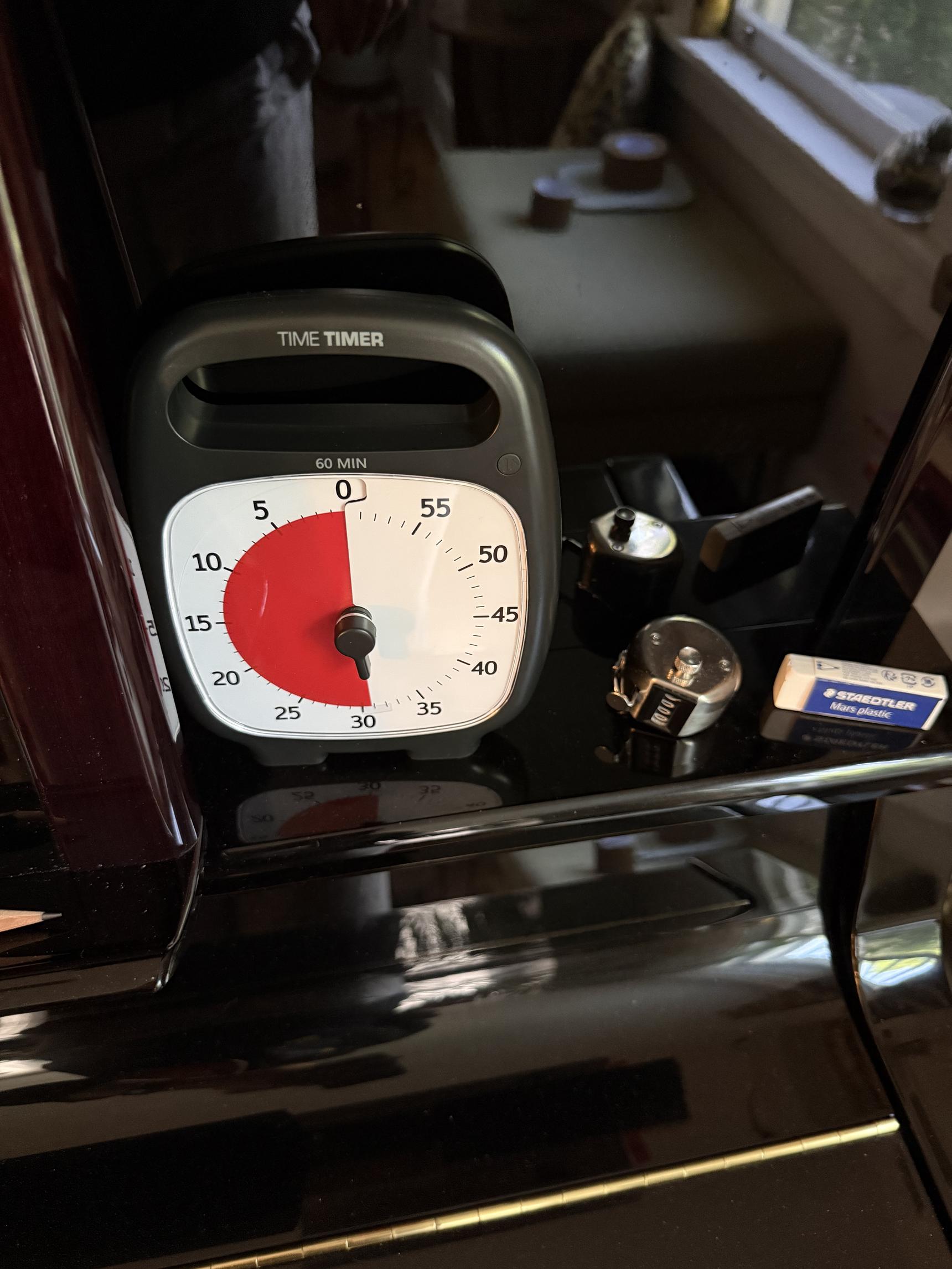
I actually use two brands of German eraser,
Faber-Castell, dust free,
[Pack of 4] Faber-Castell LARGE... https://www.amazon.com/dp/B06Y2CWLB5?ref=ppx_pop_mob_ap_share
and Staedtler plastic vinyl erasers,
STAEDTLER Mars Plastic Vinyl... https://www.amazon.com/dp/B00006IFAN?ref=ppx_pop_mob_ap_share
The Blackwings have erasers but I like these erasers better. The Matte Blackwings have a soft graphite that makes darker lines than other models,
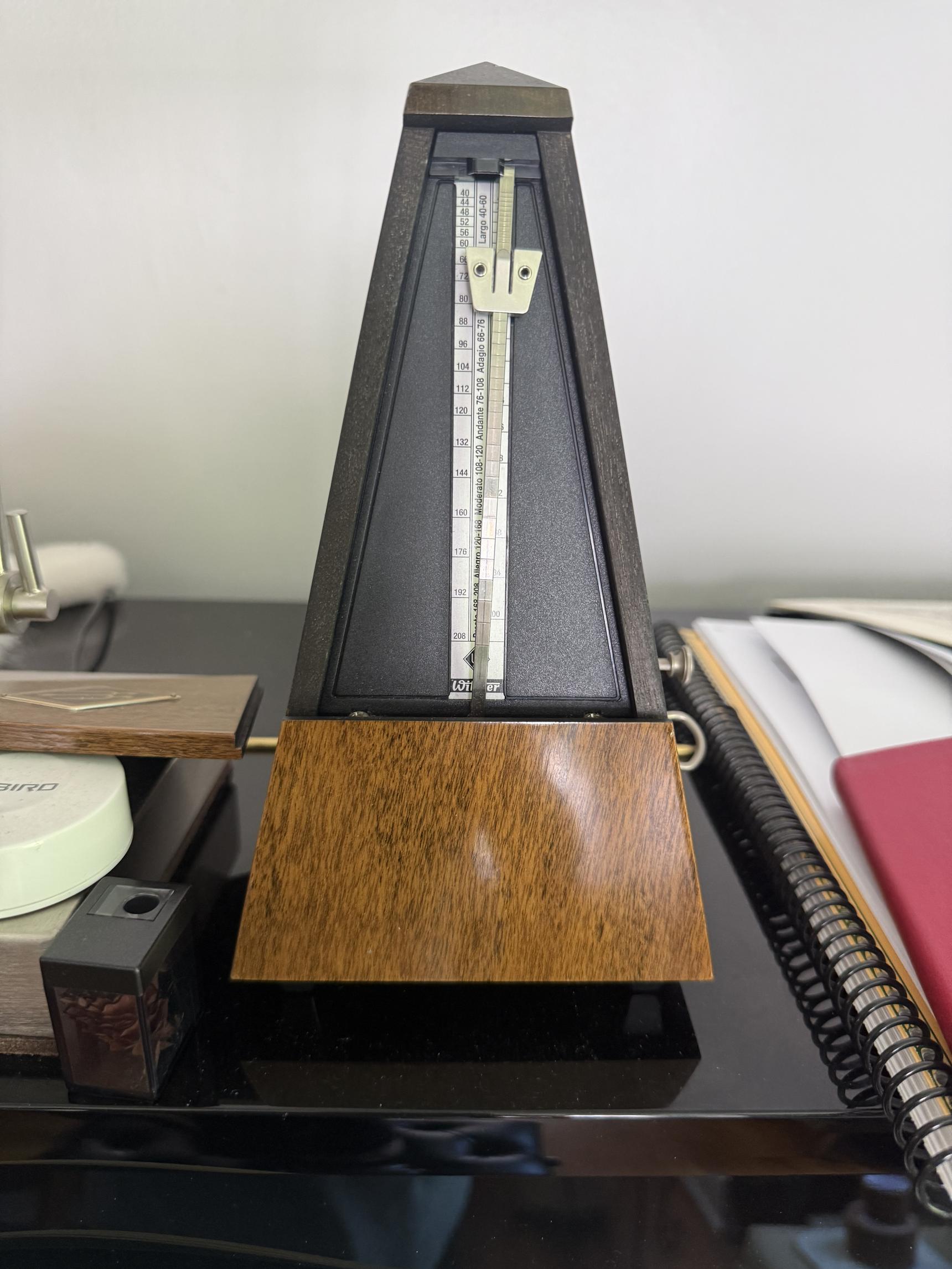
I try to limit distractions from my phone by using a mechanical metronome and a big timer. I use a Japanese clicker device to count 30 minute practice sessions. It is my take on the Pomodoro study method for piano practice, lol.
-
- Akzent oder Diminuendo?
- Maria_F
- 3 mths ago
- Reported - view
I also use a mechanical metronome. I don't use any main brand of pencils, but I have the Henle composer pencil set and erasable pens, among other things. I like the erasable pens because they are heat-sensitive, so they can be completely erased from a page with a hair dryer.
-
- Larry_K
- 3 mths ago
- Reported - view
Oh, interesting! If only I owned a hair dryer, haha.
-
- hot4euterpe
- 3 mths ago
- Reported - view
Practicing in logical sections doesn't really require a knowledge of harmony, sequences, modulation etc (though those can help!). You can just use your ear, observe phrase marks, observe how rests may delineate sections or where the figuration noticeably changes. These are all things you can do without any theory knowledge that will allow you to organize your practice more effectively than just practicing a line / system at a time =)
I do have to admit a certain confusion in your responses. You seem to simultaneously be fine with using strategies that will not develop long-term musicianship skills (you said you have reconciled this long ago) but then also say there are no shortcuts in piano playing!
I am a little unsure how to advise since I'm not sure what your goal is. If you are happy with your strategies and you are getting all the satisfaction you are looking for out of your playing then that is great and you should do what brings you musical happiness! If you are looking for a change though, there are many things we can do without a knowledge of theory.
-
- hot4euterpe
- 3 mths ago
- Reported - view
You have a number of effective strategies!
Memorizing sections out of order is definitely useful in many pieces and securing the end first can be particularly good when there is a coda.
One of the biggest barriers to memorization is that people believe themselves unable to memorize which then looms over every memory effort. I cannot say if it is worth your time but when I have a student that struggles with confidence in their ability to memorize, I will help them select a single page piece that is several levels below their study level and have them work on that with the intention of memorizing it as quickly as possible (with strategies of course!). Memorization stamina is something that can be trained and strengthened just like physical stamina and it is best to build on small successes.
-
- Larry_K
- 3 mths ago
- Reported - view
Thanks, I’m glad that you find some of my approaches to be effective.
I don’t believe that I cannot memorize, for I often play passages without reading the notes, but it is the memorization of a long difficult piece that I find so challenging.
Without the oversight of a teacher, as I find myself at the moment, I am going back to simpler pieces that I played years ago, ones I worked on with my teacher.
This way, I am working on pieces that I played fairly well. It is demoralizing to always struggle with music that is outside my grasp, which I seem to be doing lately.
I’ll try to memorize a single page of an easier piece, as you suggest.
I went back to studying the piano because I wanted to play the keyboard works of Bach.
Now, I see the immense difficulties inherent in playing all those independent voices and want pieces with chords, lol.
Chords announce themselves as right or wrong. You form the shape, you play the chord, you can hear if it is right, and then you can devote your attention to the melody in the right hand.
So, I think I will stop torturing myself with Bach and play “easier” pieces with chords.
I think I can play the opening chords of Chopin’s Op 17 No 4 Mazurka from memory. That section moves me deeply. My teacher gave me that piece to work on. I raised my eyebrows and said, really?
After working hard on it, I couldn’t get it all of it to come together coherently and so I set it aside. Maybe I should pick it up again, I don’t know.
What are your suggestions for someone who finds themselves without a teacher and not for lacking of trying to have lessons?
We have a tentative plan to move to Philadelphia in a year so I don’t want to start with another teacher and then drop them. Yet, I want to keep making progress on the piano and find that difficult without a teacher’s guidance.
Andre Watts said that a good teacher is worth their weight in gold. I believe that deeply. I don’t want to be without a teacher.
-
- Larry_K
- 3 mths ago
- Reported - view
What do you think of this teacher’s involvement in this young girl’s lessons?
https://www.facebook.com/share/r/1HGXThuC4s/?mibextid=wwXIfr
I think she is 5.
The teacher acts as a human metronome. Without the teacher, the girl takes over as the metronome and calls out the rhythm.
I do this myself sometimes, calling out the rhythm.
The girl certainly seems to have made a lot of progress even if she strikes me as a bit heavy handed at the keyboard. That can be changed.
She has decades of lessons ahead of her, if she wants them.
-
- Akzent oder Diminuendo?
- Maria_F
- 3 mths ago
- Reported - view
I don't like her teacher's approach, or the fact that she yells "One-y and a two-y" regardless of time signature. She seems not actually to know how to count. By the way, she is 9, not 5, and has been "6" for 3 years. 6 years ago, her mom posted about her third birthday.
-
- Larry_K
- 3 mths ago
- Reported - view
I hear the teacher counting both “1 and 2 and,” and “1 y and a 2 y.” I don’t hear a “trip-a-let.” I don’t have the music.
Sorry I got her age mixed up. So, you’ve been following her?
The results seem pretty good, I have to say. I can’t play Bach with that facility no matter what rhythm the teacher yells in my ear.The girl also counts out loud to herself when she plays. Does she count wrong?
-
- Akzent oder Diminuendo?
- Maria_F
- 3 mths ago
- Reported - view
She doesn't always count "wrong," but she counts the same way in 3/4, 4/4, 2/4, 6/8, etc. My current teacher and my previous teacher have both been seeing her for years. My teacher's phone will randomly start playing her videos during my lessons sometimes, even when it is on the opposite side of the room.
-
- Larry_K
- 3 mths ago
- Reported - view
It is certainly a triumph of social media marketing, I have to say.
Now you see why I use a crude timing device to keep track of my practice time.
I should put my phone in the freezer when I practice. Just once should do it. Ah, but I like all you wonderful people on here.
Surely, somebody can fix her counting.
-
- hot4euterpe
- 3 mths ago
- Reported - view
Well, this is a very manicured window into the lessons. Besides the fact that there are many different teacher personalities, any teacher's intensity will change throughout the lesson!
These clips seems to show a pretty standard performance preparation. The student clearly knows the notes well already. The piece is running 16th notes, so I am guessing all the counting is because there have been moments that the student doesn't maintain their drive and the teacher is helping them internalize it. The teacher is in a coaching role in these clips as the student is clearly capable of playing the music and the teacher is helping them elevate it for performance readiness (like a conductor). There is nothing that seems particularly unusual here to me but I am just inferring from a few seconds of footage clipped together.
No intention of being contradictory but I am not hearing anything wrong with her counting in this particular video. This invention is in 3/4. The counting approach of "1 - e - and - a" is used for counting 16th notes (metric counting). You can switch to just counting eight notes by dropping the "e" and "a". Teachers go in and out of counting different levels of pulse all the time depending on what they are helping draw attention to.
I suppose one could say that the montage does suggest that the counting is the specific thing that is improving the students playing from one clip to the next. That is definitely not the case! This teacher seems very committed to refining this young student's playing to a high level and there is much work off camera that has happened as well. I have every reason to assume from the clips that she is a very focused and thoughtful instructor!
-
- Larry_K
- 3 mths ago
- Reported - view
I agree, I love her intensity and how engaged she is with the young girl.
I want some of this intensity in my lessons. I have not seen it. Perhaps it is because we approach piano study in a more cerebral way. I’m thinking I need more of this kind of instruction.
I will interview some teachers with this in mind.
Am I just too boring as an adult student since there is no hope of my attending a conservatory or playing publicly? You don’t have to answer this question. :)
When I was studying violin in my 20s, my Russian violin teacher said to me, if I had had you when you were 5, I might have been able to do something with you. It was both an encouraging and a discouraging message.
-
- Akzent oder Diminuendo?
- Maria_F
- 3 mths ago
- Reported - view
That was one of the better videos of her that I have seen. I didn't notice an issue with her counting in that video, but I have seen others where she tries to count "one-y and a two-y and a" in 6/8 or 3/4 and gets mixed up/out of time. From what I understand, almost always counts loudly when practicing, regardless of the piece, and also when listening to music and occasionally during recitals.
said:
I want some of this intensity in my lessons.
My new teacher is serious and academic, but she is definitely involved (counting to keep me in time, singing, etc.) but thankfully not enough to be annoying or distracting (I would be distracted by a teacher like Kym Corridan). I love my new teacher and I definitely learn much more with her than with my previous teacher.
-
- Peter_William
- 3 mths ago
- Reported - view
in 6/8 there is a slight accent on beat 4 . 1 is emphasized like always..for each quarter note beat .. but the 16th would still be counted as
"1e&a" or "1y&a" whilst the 8th would be counted as "1 & " and the quarter as usual " 1 2 3 4 5 6 " .. am I thinking about this wrong ?
So I don't see what that teacher is doing wrong in the video..
-
- Akzent oder Diminuendo?
- Maria_F
- 3 mths ago
- Reported - view
I wasn't talking about that particular video. I didn't notice a problem with that video either.
said:
"1e&a" or "1y&a" whilst the 8th would be counted as "1 & " and the quarter as usual " 1 2 3 4 5 6 " .. am I thinking about this wrong ?What you described would be 6/4, not 6/8. 6/8 is not usually counted in quarter notes; it is usually counted in dotted quarters, eighths, or sixteenths. The eighth note count is "ONE-two-three, FOUR-five-six" or "ONE-and-a, TWO-and-a" and the sixteenth count would be "1-and-2-and-3-and, 4-and-5-and-6-and." "ONE-ee-and-a-two-ee-and-a-three-ee-and-a" would be thirty-second notes.
What I meant is that sometimes she will count "One-ee-and-a" on beats 1, 2, 3, and 4, and then "Two-ee" on beats 5 and 6 of that measure, and "and-a" on beats 1 and 2 of the next measure. It technically works, but it seems like she is not connecting the numbers to the beats.
-
- Peter_William
- 3 mths ago
- Reported - view
sorry I misspoke. My apologies! you are exactly right. Thanks. In 6/8 an 8th is counted as 1 beat.. not what I wrote above as you rightly pointed out.
I meant to say "ONE-two-three, FOUR-five-six" like you wrote above and you have explained the dotted counting as well very clearly. ( I see this in the Beethoven Sonata 7 - 2nd mvmt - where the counting is exactly as you wrote above)
Your third para explains your point as well. Thanks
BTW Ben Laude explains all this in his lectures rather superbly. But from what you have written above you are well past all those stages.. :-)
-
- Peter_William
- 3 mths ago
- Reported - view
May I ask a couple of basic questions for myself.
what in your expert opinion would be a good path for me to progress ?
- My goal is to play just the one concerto K414 reasonably over the next 3-4 years. I had already been learning the notes/timing /etc for the past 2 and 1/2 years - until last month (unfinished challenge enthusiasm . lol) - when I started playing other pieces .. But I think I want to go back to just one piece -after being on this forum for a week or so.
is it reasonable to expect to improve in about 3 more years of playing?
Here are my problems. You told me in a previous post that you had played this concerto in a recital !!
1. I have defintely hit a speed wall on the 1st movement. Cannot seem to hold it together at over 108bpm on the first movement.
To simplify I thought let's check the scale speed and unfortunately as the tempo went up in steps of 12 ..around 120 the scale itself is garbled and there was a bit of hand fatigue -so I promptly stopped it - my technique is definitely incorrect.
2. Any ways of improving scale speed for clarity ? I have hear dotted rythym's practise will help - not sure but want to be careful not to get injured.
I have a plan in place to watch on TB over 30 lessons and have gotten to about 12 of them so far.. ranging from absolute basics to a little bit higher.
Thanks in advance for any advice. Apologies to you in particular if I misspoke on topics that I have no expertise on -piano playing.