Schubert!
Whether you are currently playing Schubert, listening to Schubert, or just discovering Schubert's vast catalog, this is the thread for sharing any thoughts, observations, questions, favorite recordings, or anything else.
I also hope to discuss:
- Theory
- Specific pieces
- Technique and interpretation
- Liszt transcriptions
- Anything else!
Performances are welcome as well!
To start, which of his Sonatas is your favorite?
Do you prefer the Impromptus or Moments Musicaux? Which set of Impromptus do you prefer?
87 replies
-
Hello
For some unknown reason my previous post has been « pending review » for 5 days even after mail to support. I was not allowed new answers anywhere and even « likes ».
I will try to catch up because there are so interesting new posts.
Kind regards
Thierry
-
Kudos! for starting this thread. What a profound discussion! So many insights into Schubert.
-
Case Study #1267: More reasons why Schubert is mandatory and necessary to me.
The G-major Sonata, D 894 is a long work. Even more so if you are committed to playing it at a slower tempo which it deserves.
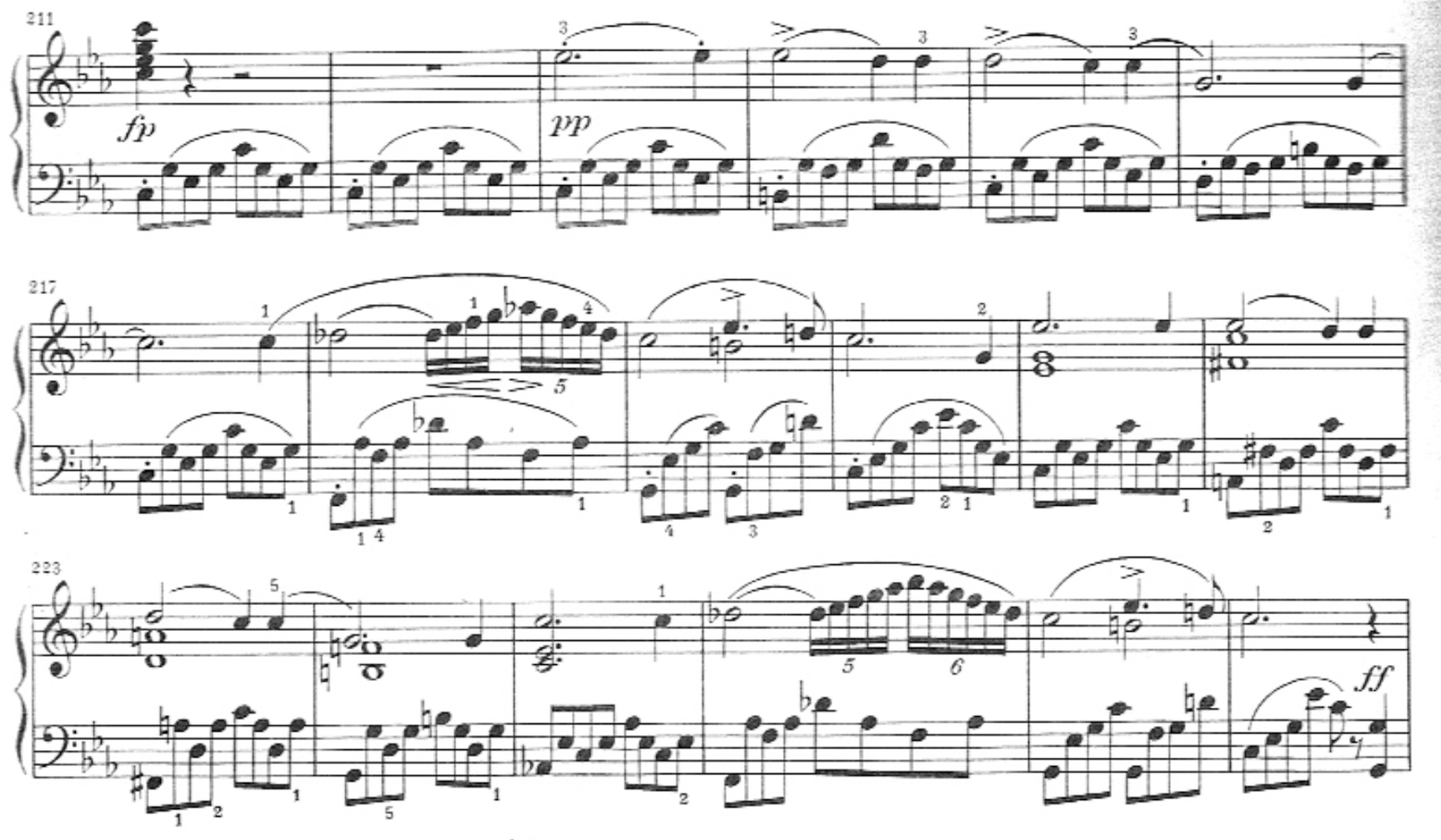
Of course there are many highlights but here is one reason that causes me to spend 40 years in the wilderness possibly wondering around looking for the promised land. After a lot of ground covered (meandering for 45 minutes maybe?) you come to this (see attachment).
Blink and you might miss it. A few short bars but within them is what I come to Schubert for. A complete representation of the actual definition of what bittersweet means (arousing pleasure tinged with sadness or pain).
This is only one reason out of thousands of why I need Schubert. These are priceless gifts to those who find them.
I ask then, what kind of goblin or monster could you be if you can play this and not be truly moved beyond words? (<-- another example of how music has the ability to make me overly passionate and probably a very unreasonable, insufferable soul ;-). (I'm joking, of course!)
The last thing I would like to say is that like no other composer (in my mind) when Schubert tells you its Pianissimo or even Pianississimo take note. These are usually his most special moments and he is imploring you to come closer (to him). He is going to whisper a secret to you in your ear. It is so special that no one else should hear this. It is only for you...
-
Hello
On Instagram, I follow Daniel Anastasio.
Here are 2 of his comments that I find so right and useful.
- About Klavierstucke 2 D946
You have to TRUST Schubert, and not try to add many things to the simplicity of his melodies or his so long phrases
- About D960 first movement and its scary bass trills just after a peaceful melody.
Love turns into pain but pain turns into love.
In Schubert’s music love and despair are constantly flowing into each other, each giving meaning to each other.
Beauty gives the darkness more heartache, and the darkness gives beauty more profundity.
-
This is from the post above I either missed or it just appeared lately after being withheld:
said:
Minor-major transition are more tragic than minor itself.Not sure if I agree with this. For example, personally, in my example above of the few bars from the G-major Sonata, D 894 I specifically only highlighted the "minor" view. I had intended to but didn't talk about my disappointment with Schubert that several lines later he resolves this exact section into a major key. Yes, I suppose he is offering us some glimmer of hope but I find this transition has a negative affect on me.
This is specifically my view. I prefer the minor keys, period with Schubert being one of the best exceptions. I like Florestan (+) but I really prefer Eusebius (-). I simply find that more interesting, emotional, complex matters happen only in minor keys (generally) and the stories told are always better through them.