Week 1 - The Opening Pattern and Finding the Melody
- Dominic_Cheli
- updated 2 wk ago
- 148replies
Hey everyone! 🎹
The Prelude and Fugue in C minor Track is live, and for the next four weeks we're all learning BWV 847 together, in the same place, at the same time. It's the second pair in Book I of the Well-Tempered Clavier.
Open the Track here: Prelude and Fugue in C minor Track
This week's suggested focus: Sections 1–4 (Introduction & Fundamentals through bar 24 of the Prelude): the C minor warmups and custom exercises, the opening pattern (bars 1–4), finding the melody hidden inside the figuration, and building your dynamic map. Go at your own pace, the weekly threads are here to keep us together, not to rush you.
Start by telling us where you're coming from: brand new to the piece, halfway there, or coming back to it? Then post whatever your practice throws up: a clip, a question, a small win, a left hand that won't settle. No clip required. And check in on each other's posts too, we're doing this as a group.
You're among the very first players through this Track, so one question for the week: where did something click for you, and where did it trip you up?
Dates: October 5 – October 30. On Tuesday October 27, 11am PT, Dominic goes live for a deep dive into the piece and your questions, so post them in the weekly threads as you go. We wrap up with a Watch Party on Monday November 2, 11am PT featuring recorded submissions from this challenge: the Prelude, the Fugue, a single section or the whole thing. 🎥
148 replies
-
- Pianist, composer and piano teacher
- Sindre_Skarelven
- 2 wk ago
- Reported - view
What a cool challenge! I’ve played through the prelude many years ago, not done the fugue. I’ve not looked at the tracks yet, so that will also be very interesting. Looking forward to it!
-
- Akzent oder Diminuendo?
- Maria_F
- 2 wk ago
- Reported - view
While performing, if someone is playing without conscious thought or control, how would they make interpretive choices?
For me, if I play only from motor memory, it happens too often that I will have a finger slip, and then I will lose my place. That is why I rely on auditory, visual (score), and semantic (theory) memory as well.
I am not arguing that motor memory is bad. It is definitely necessary, and is a good thing, but in my opinion, should not be relied on exclusively.
It is possible that I am using "conscious control" differently than you. Am I correct in my interpretation of what you are saying, that musicians strive to play on "autopilot" without any conscious thought?
-
- Larry_K
- 2 wk ago
- Reported - view
I don’t believe it is as simple as the term “autopilot” indicates, but there is a large part of performing that takes place unconsciously.
A pianist is free to practice their interpretation such that it is part of their motor memory.
We are not improvising from nothing, after all.You are free to use the visual or other things to help you.
Would you attend a concert of a pianist sight reading a piece that they had never seen? I don’t think you would.
So, a large part of a pianist’s performance has been learned and stored in their brain before they walk on the stage.
I tend to make mistakes when my conscious thought interrupts my unconscious playing.
-
- Akzent oder Diminuendo?
- Maria_F
- 2 wk ago
- Reported - view
I wasn't arguing against any form of memorization. I was basically just saying that I believe in explicit memory alongside procedural memory.
I don't usually play from a score and I rarely sight-read, and I am in favor of motor memory as long as one doesn't go on "autopilot," get distracted, and stop listening to the sound of their own playing.
said:
A pianist is free to practice their interpretation such that it is part of their motor memory.
Yes, and they should; however, there are many variables like the acoustics of different spaces, individual pianos' regulation, volume, and dynamic range, etc that pianists have to consider and adjust their playing to.
Also, I had meant to add that when practicing in sections, it is at least as important to practice the transitions between sections as the isolated sections themselves.
-
- Larry_K
- 2 wk ago
- Reported - view
We are in agreement on many points.
I wasn’t suggesting that someone not listen to their own playing. I think that that monitoring is going on in the brain when we play but I wouldn’t call that conscious playing.
Conscious playing is the way we learn new pieces, for we play them from the score and work to encode them so that we can play them unconsciously.
I don’t think a pianist can play at a high level without motor memory.
Changing dynamics and adjusting to a new piano in a hall is something that I think can be done without disrupting unconscious play. I think of it as a little conscious guiding during unconscious play.
If I distract myself from playing, consciously or unconsciously, I fall apart. I have to play with attention to what I am doing. I try to do this even if someone is trying to talk to me when I am playing.
Playing with attention is not the same as playing consciously.
Yes, practicing transitions is importantly. I added that. I also have to make sure a section in part B is strongly associated with part B and does not drift into part A because it is similar to a section in Part A.
This is also a problem when a section in part A appears in part B, lol.
I read that my problem is one of voice switching and is a common issue in playing Baroque music.
-
- hot4euterpe
- 2 wk ago
- Reported - view
It is generally understood that kinaesthetic memory is an important part of playing an instrument with fluency and facility but relying on this as the primary driver of a performance is unreliable and one of the main reasons for performance crash outs since adrenaline or distraction can greatly disrupt it. Our mind should not necessarily be analyzing every motion and figure as we play but we should feel like we can go in and out of “awareness” without it causing a disruption. If thinking about what we are doing causes us to not be able to do it, then that is usually a sign we are relying on this aspect of memory too much.
When I see a student playing and it is clear they are entirely operating kinaesthetically I will often try to get them to deliberately engage with a section by asking them to explain what is going on - what is the rhythm, what are the fingerings, what is the harmony, what is the articulation etc. If they can’t tell me or need to play it again to search for the answer then they are definitely not balancing kinaesthetic memory with more active awareness.
Confident performers often look like they are at such ease that they are playing everything subconsciously but that is not the case; their mind is highly active in both crafting their sound and in the physicality of what they are doing. There is a difference between flow state and unconscious playing. It sounds to me like you are describing flow state but calling it unconscious / subconscious playing.
-
- Larry_K
- 2 wk ago
- Reported - view
Kinaesthetic sensation, how playing feels, sounds, and looks, is the input to the monitoring of unconscious playing, it is not the monitoring or the unconscious playing itself.
Unconscious playing happens with modification from other inputs. That doesn’t mean that unconscious playing does not exist.
Kinaesthetic memory is short term. The movement plans stored in the motor cortex are stored long term, and are what we create with repetitive practice.
If you continually disrupt a student’s unconscious playing by all of those questions, you are not hearing them play at their best. Surely, you don’t do that all of the time, do you?
Unconscious playing is not something to be discouraged. It is one of the goals of practice.
I will avoid saying too much about “flow,” but I will say that I do not think that conscious playing that is slow and deliberate can create the sensation of flow.
I have never meant to imply that pianists were performing everything subconsciously. They are monitoring and changing their playing consciously,.
But, I am also saying that there is a large unconscious component to playing based on learning the movements during practice.
If there isn’t, what is repetitive practice for? What does it do?
This is obviously quite complicated, but I am happy that we are talking about the brain and not the muscles, lol.
-
- hot4euterpe
- 2 wk ago
- Reported - view
@Larry K In piano pedagogy, kinaesthetic memory is the preferred term over 'muscle memory' because the memory is of course not stored in the muscles. In piano studies, kinaesthetic is almost always what a person is referring to when they say 'muscle memory' or 'motor memory'. It is not the memory of how something 'feels' it is the memory of the movement itself and the sense of where we are physically / topographically as we play. When referring to the feel - the physical contact with the key and what that feeling produces sound wise - we are talking about tactile memory.
The point of practicing in the sense of preparing a piece toward performance readiness is not to move from a conscious state to unconscious one. It is to balance elements of kinaesthetic memory and tactile memory with aural memory, analytical memory, expressive memory, visual memory, structural memory etc. to eventually reach a state of fluency where we can focus on what we choose to about the music rather than the performing situation itself. There is of course a subconscious component to this fluency, so I agree with you there, but the goal is not to play subconsciously.
-
- Larry_K
- 2 wk ago
- Reported - view
You are describing the aims of piano pedagogy. I am describing how the brain stores and executes a learned passage.
These are different things.
The brain stores a series of instructions that allow for the playback of a motion. Call this a “motor program.”
This motor program has parameters for sequencing, timing, and force, along with predictions of sensory consequences.
Your list of memory types is mixing categories. Kinesthetic, tactile, aural, and visual are sensory modalities. Analytical and structural are explicit knowledge. I don’t see this list as showing any mechanism.
In the beginning, you seem to rejecting my arguments but in the end, you agree with me that there is a subconscious aspect of playing.
I don’t believe unconscious playing is the only goal but it helps in achieving fluency.
I wonder whether one of these doctors on here can comment on how we train our brains, for that is what interests me. We could start a new thread.This book may be helpful but it is probably a difficult read,
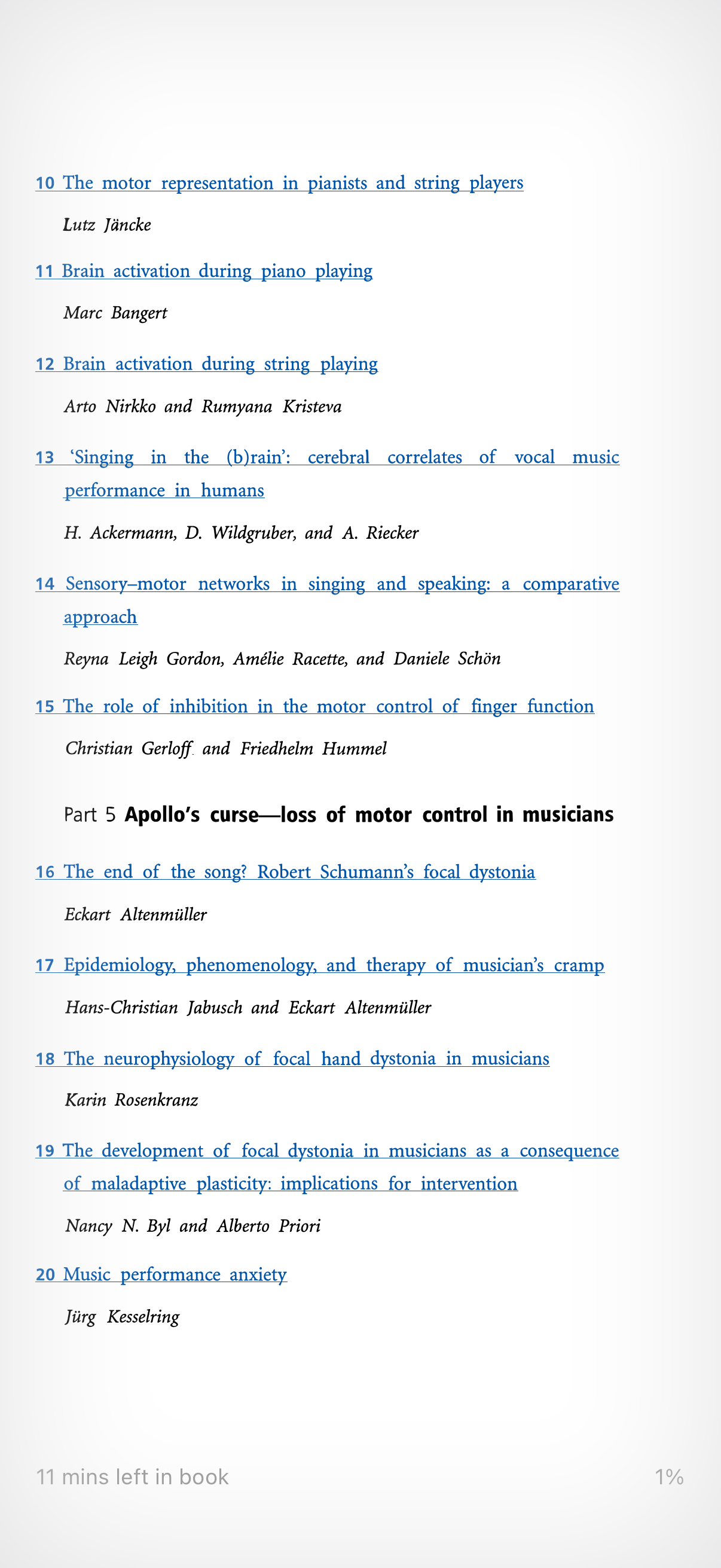
Music, Motor Control, and the Brain by Eckart Altenmüller
-
- hot4euterpe
- 2 wk ago
- Reported - view
Larry K said:
Dustin Anderson You are describing the aims of piano pedagogy. I am describing how the brain stores and executes a learned passage.
These are different things.I'm not sure what 'aim' of piano pedagogy I would be describing other than an aim to clarify language commonly used when discussing piano and memory in performance. If what you are saying is that terminology varies slightly between cross-disciplinary fields I can agree with that... but I am a pianist and we are talking about piano performance on a piano forum.
If your way of thinking of these things is working for you and is leading to stable, successful performances, then by all means stick with it! I do personally find your way of saying it to be rather confusing and (perhaps unintentionally) implying that artistry is something you train to be an unconscious process.
-
- Noel_Nguyen
- 2 wk ago
- Reported - view
This is an interesting topic, the conscious vs unconscious. The only remotely intelligent thing I can say about this is that during performance my conscious control is much less present than during practice😂.
But if I remember what most if my teachers said, musical intention is mostly a conscious process.
-
- Larry_K
- 2 wk ago
- Reported - view
Yes, I am saying that trained unconscious processes are part of artistry.
Many hours of practice go into that training, and it shows itself on the concert stage.
All pianists convert conscious practice to unconscious processes. It is the nature of how the brain is trained to perform a complex motor activity.
-
- Larry_K
- 2 wk ago
- Reported - view
Why, yes, that’s as it should be. Your performance should come mainly from unconscious processes, with monitoring and oversight.
Unconscious processes give you fluidity and speed.
Your musical intention gets baked into your unconscious processes when you practice consciously.
.
-
- hot4euterpe
- 2 wk ago
- Reported - view
I don't disagree that this is part of creating musical art in the sense that you need the ability to physically execute your intent. However, I think you are oversimplifying the realities of both practice and performance by describing it that way. There is much more to it than just programming ourselves in a practice room for hours to execute that complex motor activity on the stage.
Students demonstrate the failings of this simplified perspective all the time by trying to get through a performance by 'not thinking' because they successfully execute it "at home all the time". Or when they have played a piece well for months and then out of the blue they have a massive memory lapse and can't recall how to play a passage. Or when they execute a piece with absolute security in note work but have a completely soulless performance.
-
- Noel_Nguyen
- 2 wk ago
- Reported - view
The automatic processes must definitely be able to survive the occasional temporary "de-automation" that inevitably happens when one performs live.
-
- Larry_K
- 2 wk ago
- Reported - view
I don’t mean to simplify the process or reduce it to just the creation of unconscious processes.
It is far more than that.
Learning music is a complex undertaking that involves many parts of the brain and nervous system working together, and, it has to be resilient enough to survive the stress of playing on a concert stage, as has stated.
I am simply curious about what we are doing when we learn music.
In my own study of simple pieces, I see how my struggle with conscious practice leads, in time, with repetition, to unconscious, fluid playing.
When I play this way in a lesson, my teacher says, you’ve got it.
Measure by measure, hands separate then hands together, in sections, then forming larger chunks, it takes shape, it comes together. I have built structures and connections in my brain that allow me to play a new piece.
I know that there have been MRIs taken that show the connections in the brain between the motor and auditory regions.
I am not a brain researcher and do not pretend to understand all of the ways that the brain and the nervous system function in order to play at a high level.
-
- Peter_William
- 2 wk ago
- Reported - view
Terrific.! I arrived at the same learnings by personal experimentation trying to learn Bach's C maj invention.
1. Visualizing fingerings on very small sections - so we don't have to rely on muscle memory alone. I thought of writing the fingering on every note. For me the most important learning was 'look at the notes hands together then look at the hands whils't playing' I call it "the 1/2 bar 2 hands together calculus" method. lol!
2. Random sections - play from memory -small sections.
3. Most importantly - reduce tempo to 1/3 or 1/2 of suggested tempo. This works well for me.
At first it took me a few weeks to get the first page.. but the 2nd page is much easier.
You are a lot more advanced so may find all of this quite obvious but this works well for my level of players I think.
-
- Peter_William
- 2 wk ago
- Reported - view
The piece of advice what you wrote above is great!( somehow inline comments don't get placed right in the app). It works very well for even my level of players( not advanced) , see my note on personal experimentation on Bach's C maj invention above to Maria.
-
- hot4euterpe
- 2 wk ago
- Reported - view
I definitely agree that it is fascinating and I know you have expressed an interest in the brain and music before. GIven that we are still learning so much about the brain, music and the brain does seem like an exciting field to be a part of right now. One reason I think so many enjoy Molly Gebrian's book is that she discusses the brain and practice but ultimately keeps it more about improving one's music habits than about neurology since, to her and most musicians, the latter serves the former.
You seem to have a deeper interest in the neurology itself. For that, I do appreciate the book recommendation. It appears to be rather hard to purchase it in Canada but I have added it to my library list.
-
- Akzent oder Diminuendo?
- Maria_F
- 2 wk ago
- Reported - view
I think that this discussion should maybe be continued here:
https://piano-community.tonebase.co/t/h7y8wth/how-do-you-memorize-music
-
- Larry_K
- 2 wk ago
- Reported - view
I want to create a new thread on motor control and the brain.
I believe the topic encompasses more than just memorization, although memorization is an important part of it.
I went ahead and ordered that book. I have attached the table of contents.
I will try to summarize a paper that people are interested in. Feel free to vote!
By the way, Claude AI pointed me to this book, and others, as well as the Gebrian book.
Claude and I have been having quite an interesting conversation about motor control and the brain. The more I try to dismiss AI, the more I find AI exposing me to new ideas.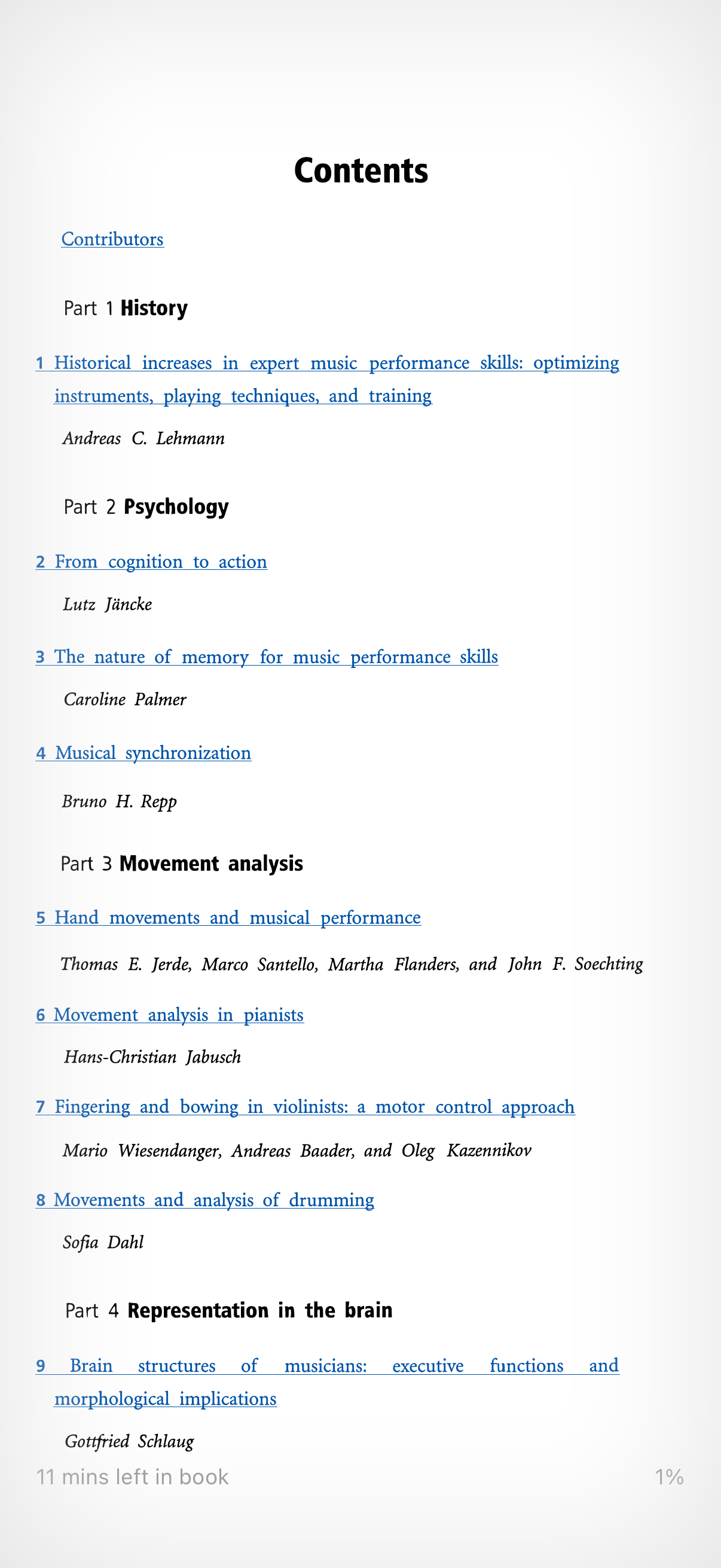
-
- Sam_Smith
- 2 wk ago
- Reported - view
Wow, I played the c minor p&f in a student recital way back in August of 2018. How time flies when you are having fun! Looked up the score - it is so covered with pencil marks I can barely see the actual music - this was before I started using an ipad. I even have video evidence that I actually did it - on a harpsichord that I owned at the time. Looks like I worked on it off and on for a year before performing it, on piano, in a recital. Now, is it possible to bring it back to life in only a month? Doubtful...
-
- Larry_K
- 2 wk ago
- Reported - view
Ha, it is a difficult piece, and certainly beyond me at this time.
Bach, with all of his small movements in the inner voices, is something that I feel is much more difficult than striking a chord.
It’s cool that you owned a harpsichord. At one point, I wanted one. Maybe if my hands become too crippled for the piano, I will turn to the harpsichord, which has a lighter action.
At one of my lessons a few weeks ago, my teacher erased 95% of my pencil marks. I discovered that I didn’t really need them as I had already encoded them in my brain.
So, in the future, I will write the initial fingerings on a clear sheet of plastic with a wet erase marker and only transfer the essential ones after I have a handle on the piece.
-
- Ursina_Boehm
- 2 wk ago
- Reported - view
I would love to join the challenge! This is the first prelude and fugue that I learned as a child many years ago with my first piano teacher. I hope to find the old Henle edition that I used at that time somewhere in my music room. Otherwise it should be at my parents place. Thank you so much for organizing this 🤩
-
- Paul_Miller
- 2 wk ago
- Reported - view
likewise it was my first Bach Prelude and Fugue-60 years ago. I hope I can make some improvements.
-
- Larry_K
- 2 wk ago
- Reported - view
Wow, 60 years ago. How old were you? Just curious, lol. I may not have enough runway left to learn this piece but, no matter, I will keep studying with my teacher.
Do you you know the film “Groundhog Day”? In that film, the main character is stuck in a time loop, repeating the same day but not getting older.
As a result, he gets very good at the piano. That’s what I need.