Week 3: Keep the Momentum

By now, the challenge is getting real!

You’ve chosen your piece, spent time with it, and hopefully started to hear it take shape. But this is also the point where things can get hard. The easy excitement of beginning fades a little, and you’re left with the more important part: staying with it.


That’s what Week 3 is about.

Not perfection. Not having everything solved. Just continuing, even when the going gets tough.


Maybe you’ve hit a section that still won’t settle. Maybe progress feels slower than you hoped. Maybe you’re realizing how much more there is to do. That’s normal. In fact, it’s part of the process. This is often the exact moment when real growth happens, if you just keep showing up!


This week, the goal is simple: keep the moving forward!

Even a small step matters:

  • one passage a little steadier
  • one phrase a little freer
  • one practice session where you stayed patient
  • one moment where the music started to sound as you like

That is momentum.

This week, share where you are right now:

  • a short clip from your practice
  • a passage that’s improving
  • a place where you’re still stuck
  • or a few thoughts on what it’s been like to stay with the piece

And if you need, share what might be frustrating you, too.

We are all in this together.


Week 4 will be about recording. This week is about building the resilience to get there.

Keep going. Stay with it. You may be closer than you think.

167 replies

null
    • Mark_Cooper
    • 1 mth ago
    • Reported - view


    Hi all

    Further progress week 3

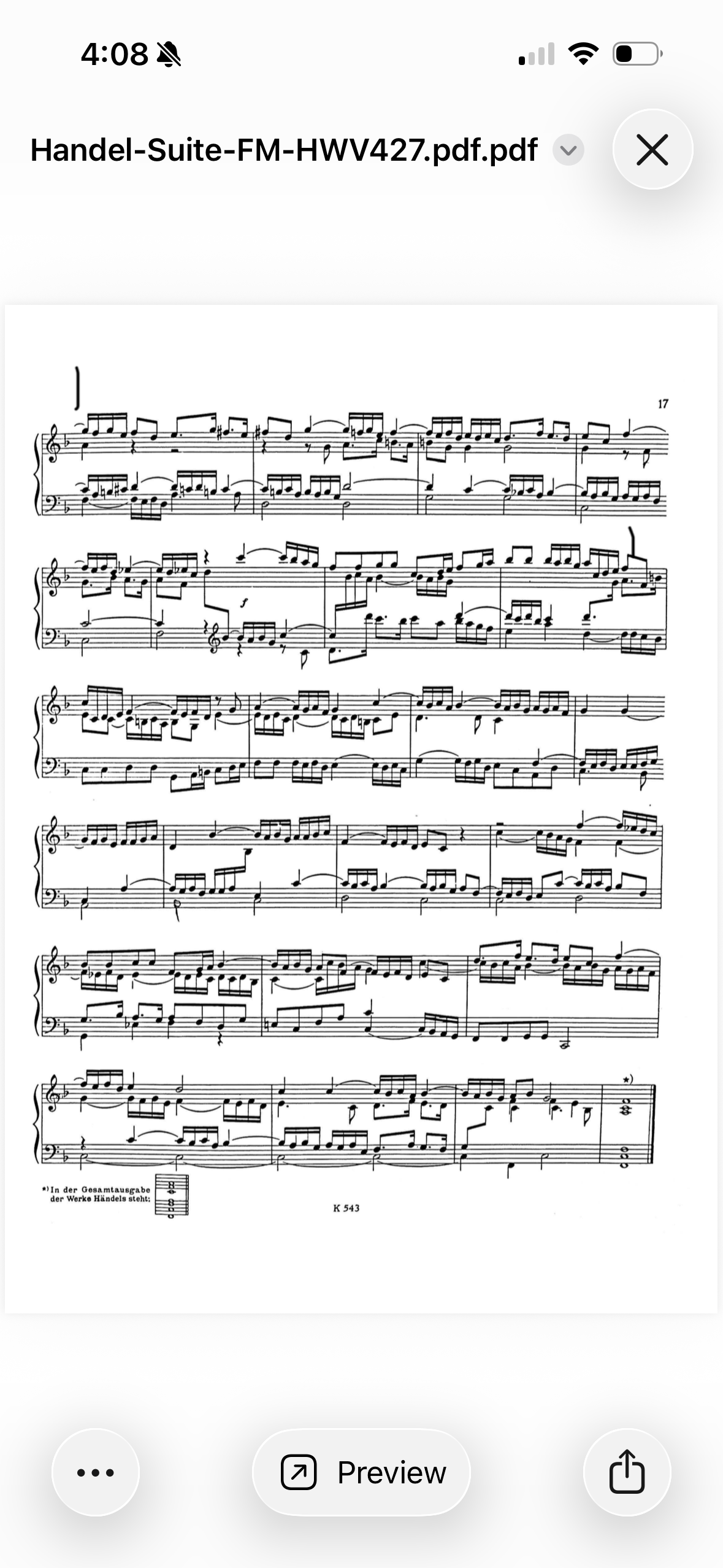
    this is a tricky section of this Handel fugue, top of 3rd page as marked 

    I use the same process as in the last post , hands separately and together (memorised)

    interestingly , hands together is actually more secure , and played at a higher tempo , I think this is because having practiced hands together mostly , there is more muscle memory there .


    Handel fugue practice 


    https://youtu.be/H-DVKcy_Fp0?si=hofVsX5RbKKAUIOU

      • Mark_Cooper
      • 1 mth ago
      • Reported - view

       thanks so much Juan Carlos!

      I am applying this idea of separate hand memorisation to other pieces.

      my feeling is that not doing this could be the source of the dreaded memory slip. For example, if I take passages that I have memorised with both hands and then attempt to play the part with one hand , even the right hand   , more often than not it falls apart . So I believe that the combined  hand memorisation is very susceptible to being played largely by muscle memory which is high  risk!!  In the above passage from the Handel fugue  , as I said , it’s more secure for now because it’s largely played from muscle memory 

      further , I think this problem particularly applies to pieces that have ‘layers’ such as these contrapuntal compositions , and similarly pieces by Brahms for example , and maybe less of a problem where there is a simpler left hand chordal accompaniment 

      • Unfrozen Barroom Piano Player
      • Peter_G
      • 1 mth ago
      • Reported - view

       Mark it's very impressive to see the disciplined approach you have taken to learning this piece and memorizing the two hands separately, both here and in your prior video. The results when you put your hands together speak for themselves:  such clarity of line and texture and security in execution!  So now this is kind of like Enhanced Muscle Memory, with 3 different interlocking sets supporting the performance. Do you find that sufficient to rely on in a performance, or are you also planning to invoke some of the other "modalities" of memorization (to use  's very apt term)?.

      • Mark_Cooper
      • 1 mth ago
      • Reported - view

       thank you Peter. 
      In addition to what I have shown in the videos, I also do a detailed chords/harmonic analysis. In this Handel piece , the changes are usually quite clear , so this is also helpful 

      • vbashyam
      • 4 wk ago
      • Reported - view

       What a great practice technique! Your playing sounds very secure!

      • Philosophy teacher and piano lover
      • Juan_Carlos
      • 4 wk ago
      • Reported - view

       You're completely right. I should apply your approach to practicing more often.

      • Larry_K
      • 2 wk ago
      • Reported - view


      I’ve always had trouble with this term “muscle memory” because muscles have no memory.

      What we are doing is training the brain to fire small muscles in sequence to play the notes.

      • Mark_Cooper
      • 2 wk ago
      • Reported - view

       yes I agree 100%
      Its basically the brain firing neurons in sequence to activate the muscles . By implication, the brain may not necessarily know the individual notes or understand the chord sequence at all . Therefore, if the sequence is interrupted in the middle , the brain will require you to start the sequence from the beginning. 
      this is obviously problematic , but muscle memory is needed especially if there are long and rapid runs of music , where it would be very difficult to physically memorise each individual note , but knowledge of typical patterns helps enormously.

      • Larry_K
      • 2 wk ago
      • Reported - view

       Yes, we are in agreement. The muscles are controlled by the brain.

      Musicians have been called “athletes of the small muscle groups.”

      Patterns are memorized and then played back in chunks. Memorization is not perfect, though, and it fades without reinforcement.

      And, yes, we may not be able to name every note we play but we can recognize when we play a wrong note in the pattern, if we have previously memorized the pattern.

      • Unfrozen Barroom Piano Player
      • Peter_G
      • 2 wk ago
      • Reported - view

       yes, “muscle memory“ is a shorthand phrase, not intended to have precise accuracy from a biological standpoint, but anyone who has labored to memorize a piece knows instantly what you are talking about. Essentially, it is a very useful metaphor for talking about this phenomenon  

      Biologically,, the motion is probably somewhere between an involuntary reflex and a voluntary, conscious placement of the fingers on each note. Your brain (or my brain anyway) and your muscles cannot operate quickly enough for there to be a conscious signal to the fingers to execute each specific note. Instead, a series of movements is learned, and they become more or less automatic, until those fateful moments when they are not! That’s when you need the conscious brain to rush in and remember the specific notes, in order to reinitiate the learned pattern of movement.
       

      The more you have worked on consciously remembering the details underlying  the movements, the better prepared you are for your brain to jump in and bail out the muscle memory when it gets thrown off. Remembering the harmonies, the voicing, the scale patterns, or really anything specific about the passage can serve as a conscious  “hook“ into restarting the movements at one of those moments when your other option is to panic!

      That’s where a knowledge of harmony, or other theoretical concepts is very useful. For example, if you remember that the passage starts with an A flat chord, you’ve just learned three notes for the price of one unit of memorization.

      I like that phrase “athletes of the small muscles”

      • Larry_K
      • 2 wk ago
      • Reported - view

       It is a great phrase, and it is true, pianists are athletes, they are performing a physical feat.

      So, what about the athletes of the large muscle groups?

      When I was running seriously, I read a little bit on how the brain works with the muscles.

      So, imagine yourself standing on the start line of a race, say a 5k.

      How does the brain set a firing speed for the leg muscles for a course it has never seen? 

      Well, the brain forward plans based on the paces you have run in practice.
       

      The brain knows the distances you have practiced and the paces you have run, so, it sets a firing rate based on that information. 
       

      I think something similar is happening when one sits down to play a piece at the piano. 

      • hot4euterpe
      • 2 wk ago
      • Reported - view

       There is an excellent book about practice / playing instruments and the brain that has actually just been recently discussed in one of the threads: Learn Faster, Perform Better: A Musician’s Guide to the Neuroscience of Practicing by Molly Gebrian. It is quite insightful. The author discusses what I think many piano pedagogues would just call "deliberate practice" but she reinforces it with actual science about the brain and why things work and don't work when learning an instrument.  

      Highly recommend. She has a very engaging writing style; you do not need to be professional musician or neuroscientist to follow at all. I've been giving copies out to students this year. I have asked students for many years to do the same things she discusses in the book but she 'backs me up' with hard brain science!  

      • Larry_K
      • 2 wk ago
      • Reported - view

       I have sent a sample of that book to myself on my Kindle. That’s how I manage my To Be Read list.

      Don’t worry, there are only 1500 books on the list. 

      People on another piano forum have been taking her to task and saying she doesn’t have a deep neuroscience background. 

      For a while, I dated a brain researcher. She messed with my head. She told me that all that calculus I learned in college is gone, that the structures have been repurposed for other knowledge. You can’t just recall that knowledge because it no longer exists. 

      I assume this is the case for the knowledge I constructed from 10 years of violin lessons and 10 years of classical guitar lessons.

      Mastering an instrument takes years because it requires physical changes in the brain, and that’s a slow process.

    • Noel_Nguyen
    • 1 mth ago
    • Reported - view

    Time sure goes real fast suddenly, doesn't it?

    Here is my practice video for this week. During practice I'm mostly trying to disengage my training wheels, which means my muscle memory. I don't believe muscle memory ever needs to be deliberately practiced, as it comes with the repetitions anyway. In fact, I find it better to forcefully try to disengage it during practice, in order to reinforce the other memory modalities., hence all the pauses. Most of the time I fail, but when I succeed, it reveals weak spots that would  otherwise only be revealed in performance (when it matters). I call it unmasking the devil! Remember, the devil's ultimate treachery is convincing the world the devil does not exist. So when I can unmask it during practice, it is a major victory, albeit uncomfortable, as you can see and hear in the video. (Warning: there will be screams and grunts, but the cursing has been removed.) And oh yea, there is also a head transplant. The reason for this is that I tried to replicate  's top down camera view, only to be horrified to see that my giant head was obstructing the view of the keyboard! I couldn't decapitate it, but I did plaster a picture of a random guy's head on mine, because I don't like my gray hair. The vanity! The plus side is that it makes the video more interesting, not to mention extremely funny:
      • hot4euterpe
      • 1 mth ago
      • Reported - view

       Very beautiful, lush playing Noel =) Such lovely voicing to your thick chords. Listening in on your practice reminds me of the practice rooms at university as you react and adjust to your own playing!

      Your head transplant made me laugh, particularly how it moves with you as you play haha. For what it's worth, I have to be careful how I position my setup as well. I have a really sturdy boom mic stand and a camera that mounts on to it with its own flexing adjuster to fine tune the camera angle. I shared a picture in one of the other threads (I think week 1 of this one). Happy to re-share what I use with anyone if they are interested - it's pretty simple as I am not a big audio / visual person at all!

      • Noel_Nguyen
      • 1 mth ago
      • Reported - view

        thanks for your encouraging words! And get better, although you don't sound sick in your recording at all, quite the contrary!

      • Akzent oder Diminuendo?
      • Maria_F
      • 1 mth ago
      • Reported - view

       Excellent performance, excellent chord voicing, and excellent editing! How did you do that?

      Also, your dramatic "catching of pigeons," as Chopin put it, is entertaining!

      • Noel_Nguyen
      • 1 mth ago
      • Reported - view

       Haha thanks! I used the Openshot Video Editor software.

      And thanks for pointing out my desperate attempts to sabotage myself! For years I tried in performance to replicate what I did in practice and realized that I will always fail to do so. There will always be distortion, with many things lost in translation. So I decided to make the process work in my favor and practice in such a way that a failure to replicate what I do in practice would actually turn into a good performance! I can say this approach has been working in my favor so far.

      • Akzent oder Diminuendo?
      • Maria_F
      • 1 mth ago
      • Reported - view

       You're welcome!

      That is an interesting practice strategy. Maybe I should try that. Was your "catching of pigeons" a way to, as you had mentioned, break/disrupt your muscle memory? 

      • Noel_Nguyen
      • 1 mth ago
      • Reported - view
      • Unfrozen Barroom Piano Player
      • Peter_G
      • 1 mth ago
      • Reported - view

       Noel this video caused me much conflict -- laughing convulsively at the incongruity of the  ridiculous false head dutifully tracking your motions and the hands flying all over the place while also marveling with reverence at such sublime sounds that were emerging from your piano-.  I'm afraid I'm going to need a few sessions with Dr. Dahl before I can regain my emotional stability.

      I've only listened to this piece a few times, each time as played from start to finish, most recently in an awe inspiring recital by a young pianist named Leyla Zeynalova.. It's too much to absorb in a single seating like that. With your video, I felt like I was inside the  edifice, looking up into some of its most intricate gearwork, which was lit up from behind by the sunlight of inspiration shining through.

      sorry to get so poetic about it.  i guess that's just the effect that a floating disembodied head has on me. 

      But also, the process and pitfalls of memorization have been much on my mind these days, and your quest to outwit and subjugate your muscle memory is very much on point and as instructive as it is ingenious. So thank you for all of this

      • vbashyam
      • 1 mth ago
      • Reported - view

       Wow. Bravo! Love the editing too!

      • Noel_Nguyen
      • 1 mth ago
      • Reported - view

        Peter, it looks like I'll need to book a visit with the great Dr. Dahl as well, since I am on the one hand extremely flattered by your glowing review, but on the other hand I realize I may have made a mistake by adding a giant distraction to the video to compete with my own playing!

      But seriously, I really like your analogy of being inside the building and seeing the gears, because that was the main goal of the practice videos I've been sharing, which are meant to show what is happening behind the scenes, so to speak. In the past I used to be reluctant to show this aspect of my music making, following some silly code of secrecy like magicians never revealing their secrets. That was until I realized that I'm no magician (who am I kidding), so I might as well share all the aspects of my hobby, including the ecstasy and agony of practice, the screams and grunts, the flying hands, and yes, the floating fake head.

      • Mark_Cooper
      • 1 mth ago
      • Reported - view

       this was great Noel!

      I might try and emulate the ‘catching the pidgeons’ exercise but I don’t think it will work well with my Handel fugue…

      btw Also loved those little finger stretches too!

      • Pianist, composer and piano teacher
      • Sindre_Skarelven
      • 1 mth ago
      • Reported - view

       Wow, Noel! I don’t think I’ve witnessed anything like this in all of Tonebase history. All your thinking, playing and editing is outside the box - it’s just your head that stayed inside :P Loving your approach to this - detaching from muscle memory etc. Great playing! Also the Chasse-neige ending gives chills. 

      • TT2022
      • 4 wk ago
      • Reported - view

       thanks for this informative and refreshing take! I really enjoyed watching your responsiveness to the color changes, and to see your arms twirling around in the air. 
      Your practice reminds me of a past Graham Fitch YT Piano Magazine video where he said to reinforce memory and prevent “memory holes”, one could practice by playing 1-2 bars and then doing the next bars 3-4 in your head (with your hands away from the keys), then play bars 5-6 with your hands, then bars 7-8 in your head with your hands off the keyboard, etc. etc. It’s a similar concept to what you’re doing — breaking the muscle pattern so we don’t go into autopilot mode! 

Content aside

  • 4 Likes
  • 5 days agoLast active
  • 167Replies
  • 590Views
  • 27 Following