Week 3: Keep the Momentum
By now, the challenge is getting real!
You’ve chosen your piece, spent time with it, and hopefully started to hear it take shape. But this is also the point where things can get hard. The easy excitement of beginning fades a little, and you’re left with the more important part: staying with it.
That’s what Week 3 is about.
Not perfection. Not having everything solved. Just continuing, even when the going gets tough.
Maybe you’ve hit a section that still won’t settle. Maybe progress feels slower than you hoped. Maybe you’re realizing how much more there is to do. That’s normal. In fact, it’s part of the process. This is often the exact moment when real growth happens, if you just keep showing up!
This week, the goal is simple: keep the moving forward!
Even a small step matters:
- one passage a little steadier
- one phrase a little freer
- one practice session where you stayed patient
- one moment where the music started to sound as you like
That is momentum.
This week, share where you are right now:
- a short clip from your practice
- a passage that’s improving
- a place where you’re still stuck
- or a few thoughts on what it’s been like to stay with the piece
And if you need, share what might be frustrating you, too.
We are all in this together.
Week 4 will be about recording. This week is about building the resilience to get there.
Keep going. Stay with it. You may be closer than you think.
8 replies
-
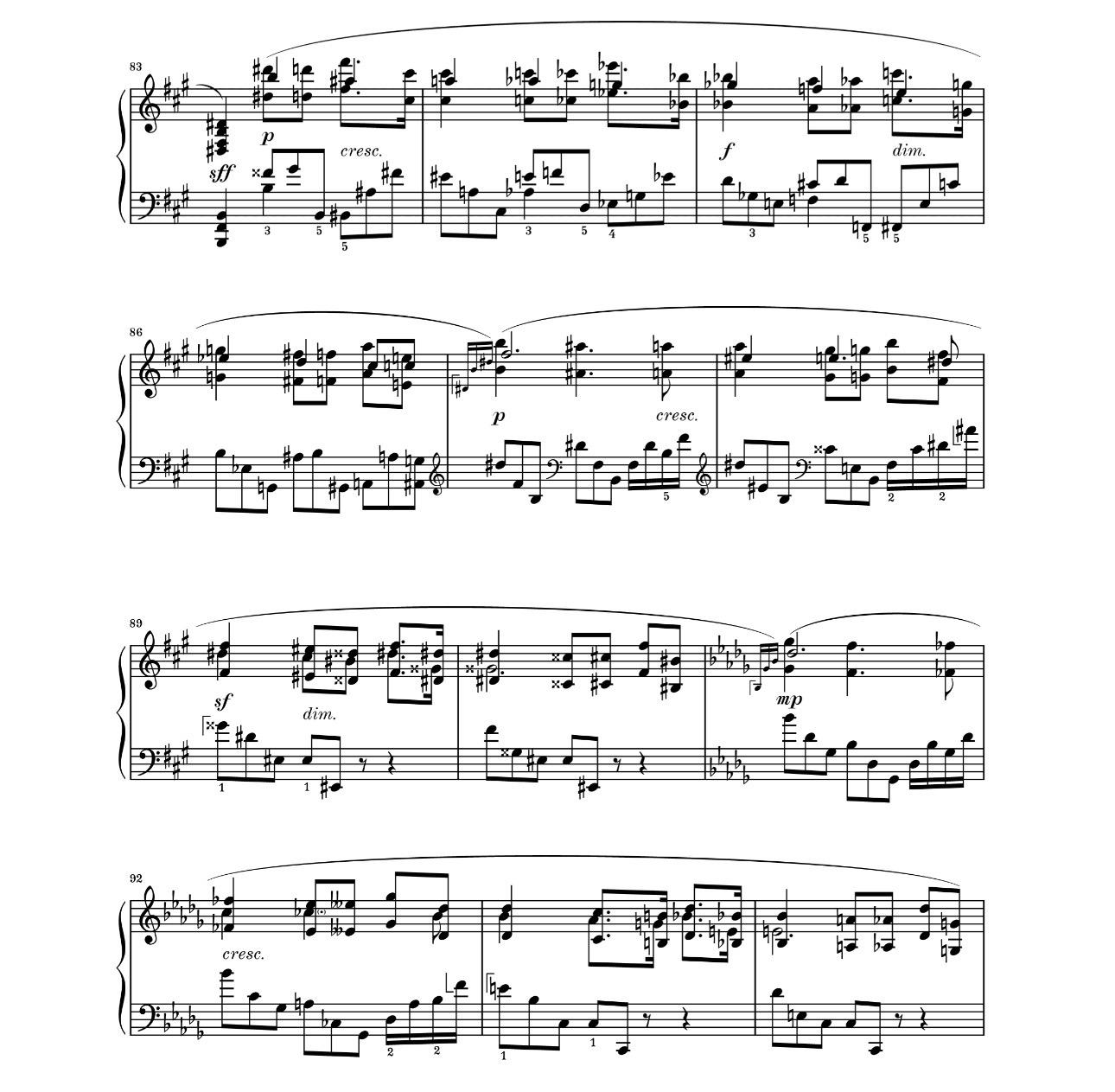
My task for Week 3 is to once again face the Six Heads of Scylla (the six sections in which the main subject and its variants are presented, accompanied by widely arpeggiated figures in the left hand), but this time playing them with both hands, while in Week 1, I practiced the left hand only. I will choose a moderate tempo and try to still play them mostly without pedal. Attached, as an example of what I’ll be facing, is the back end of the particularly nasty Fourth Head.
-
My goal for week 3 is to master the three 1,7,10 LH chords in bar 95 of Heartland. Here are bars 76 to 96, along with a rather abrupt end at bar 96 as I realised that I almost hit the three chords in bar 95 :)
-
Week three update and goals: I'm feeling fairly confident with the first half (mm 1-22). I'm still finding mm 23-32 to be a challenge, but 33-end is coming along nicely. I'm playing around with dynamics and articulation a bit, and look forward to being able to put it all together next week.
-
Chopin prelude op.28/13: I will continue working toward the last section, recap and coda. I'm guilty of omitting hands separate practice … so I aim to practice this section hands separate. RH appears tricky to me.
-
Scriabin op.9-2: My main problem is too much hesitation between phrase transitions. Sometimes it can be sold as rubato, but not in this amount. I’m working with my metronome and hope it will just steady the pulse.
-
Re: Schumann Fantasie Op. 17, 1st movement:
Keeping the Momentum ? I'm not sure? Yes, I've made serious progress and gains for sure but all the hot spot problem areas seem to be getting more challenging despite knowing them more and working hard on them. I'm willing to work tirelessly on this and apply extreme long-suffering (this isn't possible in three weeks) because I know this journey and others like it are worth it. So I'm eating my crust first and not avoiding or deferring the pain (entirely) early on to give myself false hope or seeing my position with rose coloured glasses.
I correctly assessed the most problematic areas in the first week. More broadly, it's the left hand, stupid! For the left hand only, I am spending 90% of my practice time on 33% of the piece. Sure, I just made up this fact because it just happens to be true ;-)
In addition , I also have established in my mind the final tempo I want. Working on the piece for several weeks now has informed this decision. And as said so astutely above by Astrida, I'm not selling (or buying) rubato here. Sure, I don't want to play like a robot and I do play with the time a little. When it comes to music though say earlier than 1850 or so I don't buy the style of playing where you can change the tempo bar by bar. And I'm not being factitious here either. Or in other words, play as fast as possible all the time until you can't. Then slow down and sell it as artistic interpretation or rubato etc. I think later music this is pretty much in the DNA of the music already so whatever. I doubt the pre-1850 or 1860 composers would have even considered this kind of drunken wildness. (my opinion only, of course)
The problem I am trying to balance out (specifically for the left hand) is coming to a nice balance of clarity with a touch of pedal. This is a Fantasie and not Bach after-all but too much pedal is cheating ones ear and mind of so much great detail here. Everything though I speak of here is my aspiration or desire but having the technique and skill to produce my vision of this is still miles off if not down right impossible at this point.
I'd like to illustrate the goals and some of the problems next.
As a reminder, at the beginning of this Fantasie Schumann included a short poem by Friedrich Schlegel. Everyday I practice or think about this work I remind myself of it and try to apply it to my thinking as I get deeper into the piece. I'm sure there is a good reason for it to be there and so I will continue trying to understand its true meaning. As a reminder, here it is again with a rough translation.
Durch alle Töne tönet / Im bunten Erdentraum / Ein leiser Ton gezogen / Für den der heimlich lauschet
Resounding through all the notes / In the colorful earthly dream / There sounds a faint long-drawn note / For the one who listens in secret.
Another reminder (for me) when playing Schumann is to understand his imaginary world. Everything will always lead or be connected to Clara and then Florestan & Eusibius (in other words, Schumann himself - his alter egos). Either in the form of a direct (but hidden) message to Clara or him pretending to navigate situations of what he feels or wants to act like.
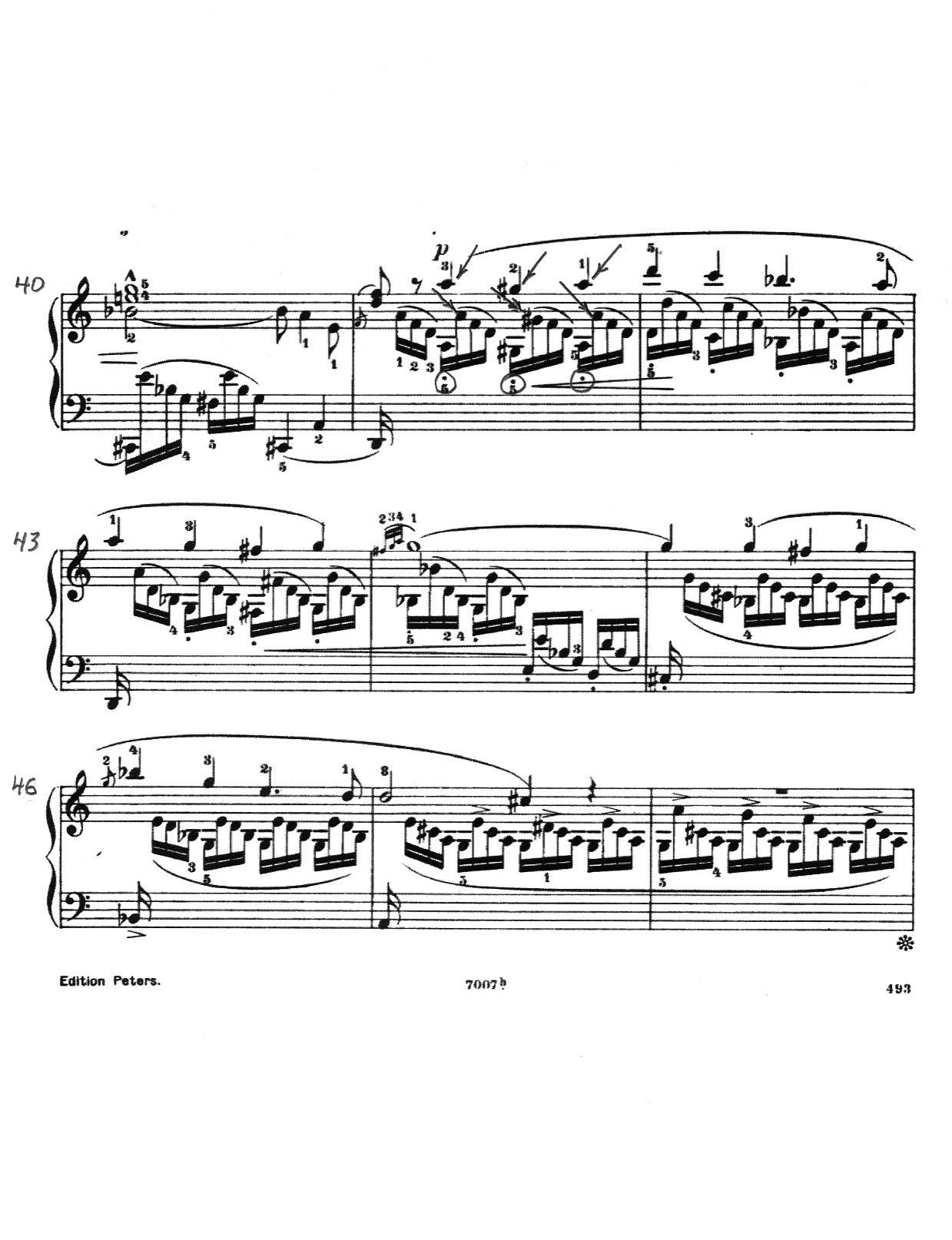
One of the obvious highlights of this movement is presented in bars 41 through 48. It is repeated only once again at bars 233 through 240 in a different key and a tone lower. The first difficulty is the huge left hand leaps in bar 41, 43, 45, 46, & 47. Somewhere in the Forum last week I think I read someone else talking about 'playing blindly or blindfolded' sometimes. Well, this is definitely a spot where your faith will save you. There is no time or possibility to really look or see - just do. (unless of course you believe in "rubato" cough cough).
So this section being the highlight and height of emotion, I believe Schumann would have had to connect this to the main impetus of the piece. Maybe some of these secret notes and messages to Clara?
You have to understand that for years and decades my only conception of this passage was the obvious, that being, the top RH quarter notes mainly from bars 41 to 47. My only challenge was to play this piano and keep the left hand pianissimo (or less). The epiphany in the last weeks allowed me to suddenly see the top note played by the thumb in the LH one-sixteenth of a beat after the main RH note as a song of two (Robert & Clara). This softer, undertone echo, to me, represents the union or connection of what he and Clara have - their intimate connection.
So either I'm the world's slowest learner or I'm completely bonkers to come to this conclusion but it works for me and my fantasie world. The staccato on the lower LH note has always been there (and yet I was blind and didn't REALLY see it) and to me is further proof of placing importance on the next note that follows.
Now saying all this is one thing. Articulating this (mainly left hand work) is my greatest challenge these days. I have a long way for my technique to catch up to my heart.
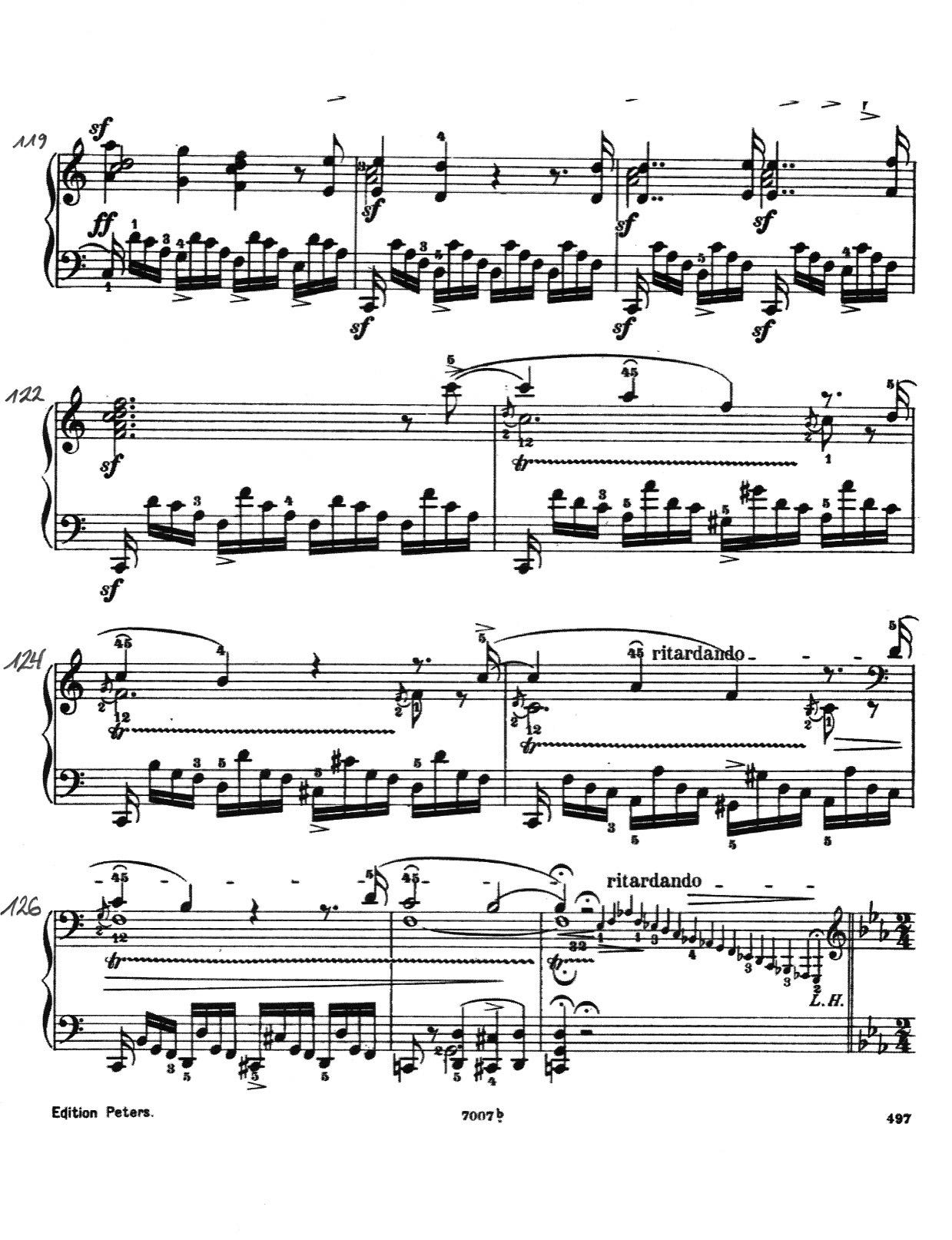
Next example, is bars 119 to 122. One of my favourite parts. It is the opening theme at double speed but the cool part is the left hand accents added. Again, lots of leaps and very satisfying to land them.
Lastly, the dreaded trill. Again, th RH trill (1st and 2nd fingers) going on combined with the typical left hand in addition to playing other notes with the 5th and 4th fingers of the RH. It's not terribly complicated on its face but for me it is difficult to independently voice the 3 main lines of action. In my mind, the trill is to be barely heard, then the RH top notes should be clear but not the main focus followed by the LH which I think is the main point of interest. Hands separately is mostly there but hands together is tougher to accomplish.
Thank you for coming along for the ride, if you made it this far, and allowing me to indulge myself in this Fantasie. I'm super happy to be doing so but my other Fantasy (Schubert) isn't quite agreeing about this.