Week 3: Keep the Momentum

By now, the challenge is getting real!

You’ve chosen your piece, spent time with it, and hopefully started to hear it take shape. But this is also the point where things can get hard. The easy excitement of beginning fades a little, and you’re left with the more important part: staying with it.


That’s what Week 3 is about.

Not perfection. Not having everything solved. Just continuing, even when the going gets tough.


Maybe you’ve hit a section that still won’t settle. Maybe progress feels slower than you hoped. Maybe you’re realizing how much more there is to do. That’s normal. In fact, it’s part of the process. This is often the exact moment when real growth happens, if you just keep showing up!


This week, the goal is simple: keep the moving forward!

Even a small step matters:

  • one passage a little steadier
  • one phrase a little freer
  • one practice session where you stayed patient
  • one moment where the music started to sound as you like

That is momentum.

This week, share where you are right now:

  • a short clip from your practice
  • a passage that’s improving
  • a place where you’re still stuck
  • or a few thoughts on what it’s been like to stay with the piece

And if you need, share what might be frustrating you, too.

We are all in this together.


Week 4 will be about recording. This week is about building the resilience to get there.

Keep going. Stay with it. You may be closer than you think.

167 replies

null
    • Mom, fitness instructor, lover of music
    • Michelle_Russell
    • 1 mth ago
    • Reported - view

    Today for the first time, I moved the metronome to quarter note rather than eighth note, and had a lot of challenges with that! I'm also thinking of my ultimate goal tempo-range, the range where it feels con moto. Here is a snippet of this piece played at what I think wll be an appropriate "final" tempo (not this week, but maybe in a month or so). What do you think?

    https://youtu.be/RVUje_kuOXo

      • Peter_William
      • 1 mth ago
      • Reported - view

       ok thanks!  I see. Heard the clicks on the first 4 secs and matched it  at 90 bpm - after watching again. The playing seems a bit faster though.. 

      • Mom, fitness instructor, lover of music
      • Michelle_Russell
      • 1 mth ago
      • Reported - view

       yeah, it's in 3/4 with sixteenth note figures in the right  hand, so it does sound faster. To stay with the metronome I have to say "takadimi" a few times before starting so I can feel the feeling of where the sixteenth notes are within the quarter note pulse. (Takadimi is a rhythm syllable system.) If you listen to the left hand, you'll hear a quarter note on the down-beat, and then two eighth notes on the third/final beat of each measure.

      • Akzent oder Diminuendo?
      • Maria_F
      • 1 mth ago
      • Reported - view

       I often set my metronome for eighth notes if I am playing a piece with many sixteenth/thirty-second notes or if I have to practice a piece under 40 BPM. 

      • Peter_William
      • 1 mth ago
      • Reported - view

       ah yes! Interesting - I use my digital metronome -almost all the time- for anything new. But it being digital I can set it to accent the first beat - this tells me whether I am in 4/4, 3/4 or 6/8 ( on the Beethoven piece for example ) . .Then it allows me to seamlessly switch to quarter notes per tick or 16th per tick.. ( I hear tin-ta-ta-ta -for the 16th - but hear four ticks on each beat -really fast) and if it is set to just the quarter.. 1 tick for each quarter note. I must confess I didn't pay attention to the metronome on your recording the first time around -as I missed the first 4 seconds.. and there were no accented beats - rendering it impossible to determine the time signature :-)  But you have explained very well.. Thank you!

      • Mom, fitness instructor, lover of music
      • Michelle_Russell
      • 1 mth ago
      • Reported - view

       I do the same, but it's also good for me to feel the larger pulse and learn how to stay steady within it! 

       as you get more experience, you'll start hearing the time signature when you listen to pieces, at least in a general sense. If you listen to someone more experienced than I, you'll hear the rhythmic structure more clearly in this piece. I hope to eventually find my way to having it be felt/heard in one rather than three beats per measure. 

      For example, though I don't prefer his interpretation, Glenn Gould is at a tempo that allows me to feel this in one: https://youtu.be/M42Ktp5VQas?si=wVjubNmfw3P_zSku

      I do like this one: https://youtu.be/E54a_grgc5A?si=X6nkyCXzWcjOlzvt

      • Peter_William
      • 1 mth ago
      • Reported - view

       ah yes! I have listened to Gould a lot !! heavenly.  I hear the accent on 1 (1e&a,2e&a,3e&a, ... repeat on & on) on Gould's playing. Thanks. 

      You may like Lifschitz playing the same piece here .. https://www.youtube.com/watch?v=jmJ0gv2xNUo&list=RDjmJ0gv2xNUo&start_radio=1

      Just peeked at the score for the first time ( never played it) and tried the first line also. It is quite nice to try. The notes seem all even if you include the left hand ( .. so flows very evenly..)

      • Akzent oder Diminuendo?
      • Maria_F
      • 1 mth ago
      • Reported - view

       I definitely do set it to quarter notes, but only above 40 because my metronome can't go that slowly. 

      • Akzent oder Diminuendo?
      • Maria_F
      • 1 mth ago
      • Reported - view

      another version of BWV 999:

      https://www.youtube.com/watch?v=xD5H3bz_9KQ

      • Peter_William
      • 1 mth ago
      • Reported - view

       Angela Hewitt.. superb!

      • hot4euterpe
      • 1 mth ago
      • Reported - view

       I actually met Angela Hewitt a few years ago. She did a recital at a small venue where I live as well as a masterclass for several local students. I spoke with her a bit after the recital - she's quite wonderful, charming and kind. I got her to sign my copy of the two and three part inventions so I have street cred with my students haha!

      • Larry_K
      • 1 mth ago
      • Reported - view

       Ha, wonderful! 
      I saw her a number of times at her Bach series at the 92nd St Y in New York. She is charming and hosts her own music festival in Italy. 

      https://trasimenomusicfestival.com

      • Peter_William
      • 1 mth ago
      • Reported - view

       Absoultely wonderful that you met Angela Hewitt!  I have a list of world renowned pianists - whose concerts I will be happy to drive 50 miles to go and attend - taking a day off from work!.. lol!. A few years ago before I joined TB - Evgeny Kissin had come to Duke - 5 mins from where we are - and I missed it completely. Such a thing will not happen again.!

      • Peter_William
      • 1 mth ago
      • Reported - view

        My apologies I didn't realize and went searching on the web for this piece. There is a Prof. Magdalena Stern explaining this piece in great detail for 25 mins.. here on ToneBase ! itself.  I am going to start learning there this weekend.. Not sure if you had already seen this class. 

      https://app.tonebase.co/piano/courses/player/magdalena-stern-baczewska-teaches-intro-to-bach-3-little-prelude-in-c-minor-bwv-999?moduleSlug=magdalena-stern-baczewska-teaches-intro-to-bach-3-little-prelude-in-c-minor-bwv-999

      • Akzent oder Diminuendo?
      • Maria_F
      • 1 mth ago
      • Reported - view

       I have not done that course as I learned the piece a long time ago, but I have seen it listed. 

      • Peter_William
      • 1 mth ago
      • Reported - view

       This is definitely a class even I could understand after 1 viewing. I will be using the class to learn the piece for the first time.  I will start at 60 bpm and then see if it can be moved up in a few sessions.

    • Ken_Radford
    • 1 mth ago
    • Reported - view

    I bought an expensive analog metronome and my teacher advised me to avoid using it. He said “use it to set the rhythm, but don’t use it while you’re playing“. I questioned his logic and he explained that rhythm should come from within, not from without.

      • Mom, fitness instructor, lover of music
      • Michelle_Russell
      • 1 mth ago
      • Reported - view

       I tend to use it about 10% of the time I'm working on a piece, rarely the entire way through (unless I need it to add a bit of pressure, or if it's just really working for me in the moment). I find it most helpful in places I tend to rush, or less often if the tempo drags. I wish I could have a voice activated metronome that could turn on for certain sections or only for the beginning of a piece. My teacher generally prefers non-metronome ways of feeling the pulse (using a yoga ball to bounce on while playing, marching while playing, counting out loud, etc....), that way I'm feeling the pulse physically in my body rather than having an external machine feel the pulse for me.

      • Peter_William
      • 1 mth ago
      • Reported - view

       If you are an advanced player your teacher is echoing what the very great Leon Fleischer along with the legend Yo Yo Ma said about rhythm. 

      At a beginner level ( like mine ) I feel it is better to use the metronome correctly and eventually our internal rhythm will set in and then most likely you won't need the metronome( most conservatory types - have little use for the metronome apart from occasionally checking their work - is what I have read). Here is the link to Leon Fleischer's master class.. just by chance I watched it a few days ago.  You will get a lot more out of it than I would  :-) 

      https://www.youtube.com/watch?v=S9TDlYq95zk&t=6s

      • hot4euterpe
      • 1 mth ago
      • Reported - view

       To add you your point, a metronome is also invaluable for ensemble work. Even in a duet, you now have two people with their own internal rhythm and little agogic moments, rubato, unintentional slowing due to insecurities or acceleration from adrenaline all compound quickly if the players have not also trained to play to an external beat as a baseline.

      I find that most people (including myself) overestimate their ability to maintain a steady pulse throughout their playing of new pieces. In the past, when pianists would have multiple lessons in a week and would play for, and with, others constantly, there were many opportunities for little corrections from a teacher / colleague. With the culture of piano studies today, we practice in isolation for long periods so checking passages with a metronome is an objective stress-test that our internal rhythm is not being overwhelmed by the act of playing.

      Someone was discussing Molly Gebrian's book recently in a thread. She talks about how the metronome can be used positively and negatively. Most pedagogy books discuss it as something to use in moderation and for checking tricky passages / small sections, but not while playing through a large section or the whole piece. 

      • Peter_William
      • 1 mth ago
      • Reported - view

       I am in complete agreement with what you have said. For years since my first exposure to the piano I totally neglected !! the metronome. I heard statements like "oh the metronome is a royal pain.. just play by feel - you will be automatically musical " lol!... Nothing that my past 2.5 years of serious playing validates the previous statement. On the contrary when I used the metronome I immediately found that I couldn't keep time to save my life . ha ha ha lol!.. Then on a bit of thought I slowed it down for a line and found wow this may even be possible. So every piece I start with the metronome. So as a result my reading became a lot more fluent as I started using music scores like a library. Play a bit - on time and move on.. This method actually works for me. The proof is that scores which were totally inaccessible before are now readable slowly.  The one "super power" that I would love to have is what I have seen some musicians do that is they look at the score and can hear the music or hum it without touching the keyboard. This I have 0 ability for.  Unless I am at the keys I cannot hear the music at all. 

      For whatever I play no one will convince me that using a metronome to check the time initially at least is a bad idea  - at least for me. Others may have an innate sense of timing where they don't need it but for me it is absolutely necessary. :-).

      Also I have seen some wonderful musicians use harmony to great benefit. In real time I have seen a friend say things like " oh we are in the dominant .. now we move to the sub.. and back to the dominant.. oh just a cadence here.." and almost immediately they have played out 4 lines of dense lines from a Beethoven Sonata effortlessly to my absolute wonderment.. Then they proceed to read through 3 pages and it looks rather hopeless for us.. loL.. But the most important point is beginners will  save so much time understanding harmony, understanding sequences of chords and playing blocked chords.. This can be learn't quite quickly is what I think.. 

      • Larry_K
      • 1 mth ago
      • Reported - view

       There are teachers who say that you should count the piece out loud all the way through every time and not use a metronome. 

      I think that’s useful but I still use a metronome to find out where I am not able to maintain the beat. It’s common to lose time in complicated measures.

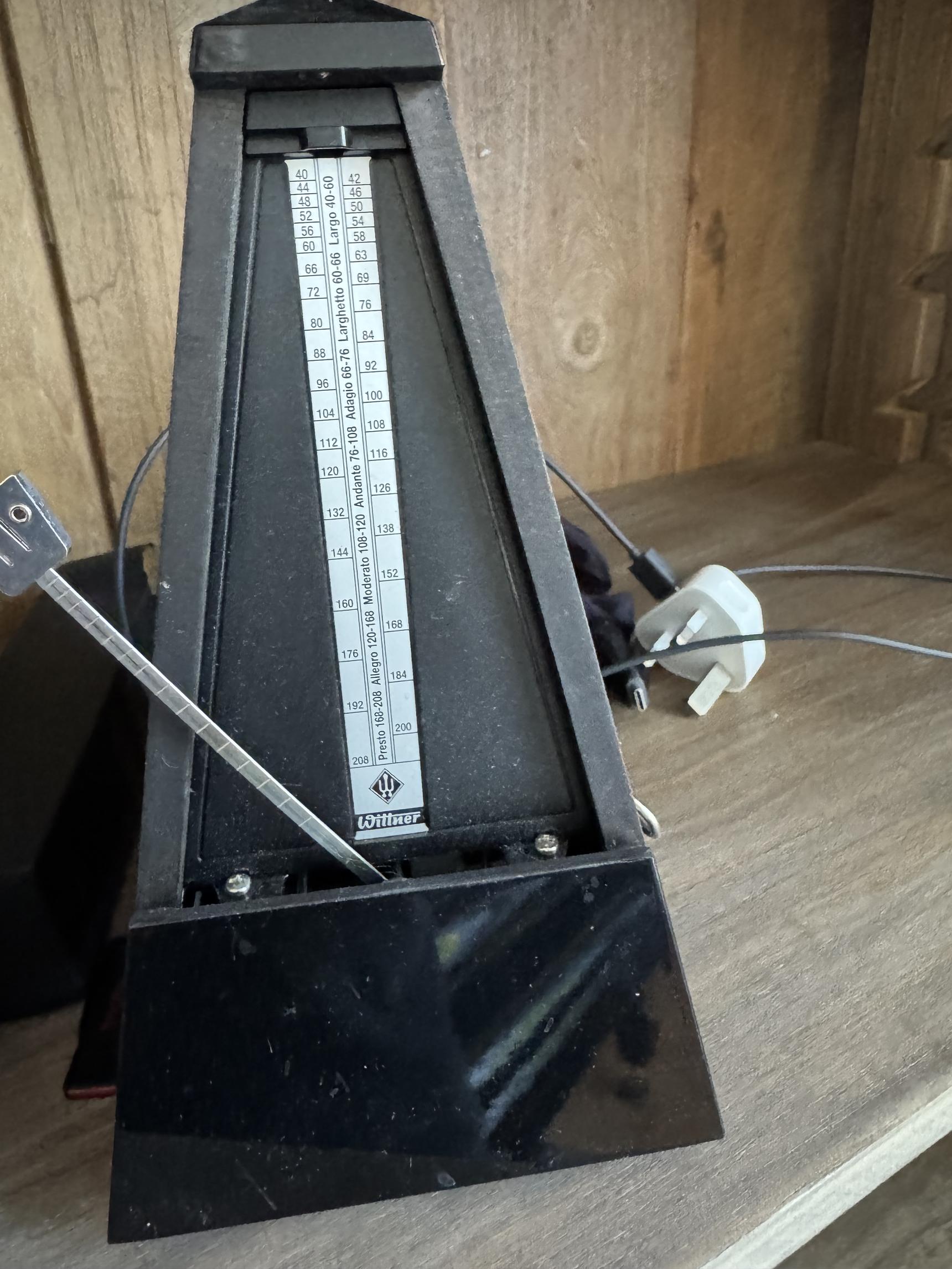
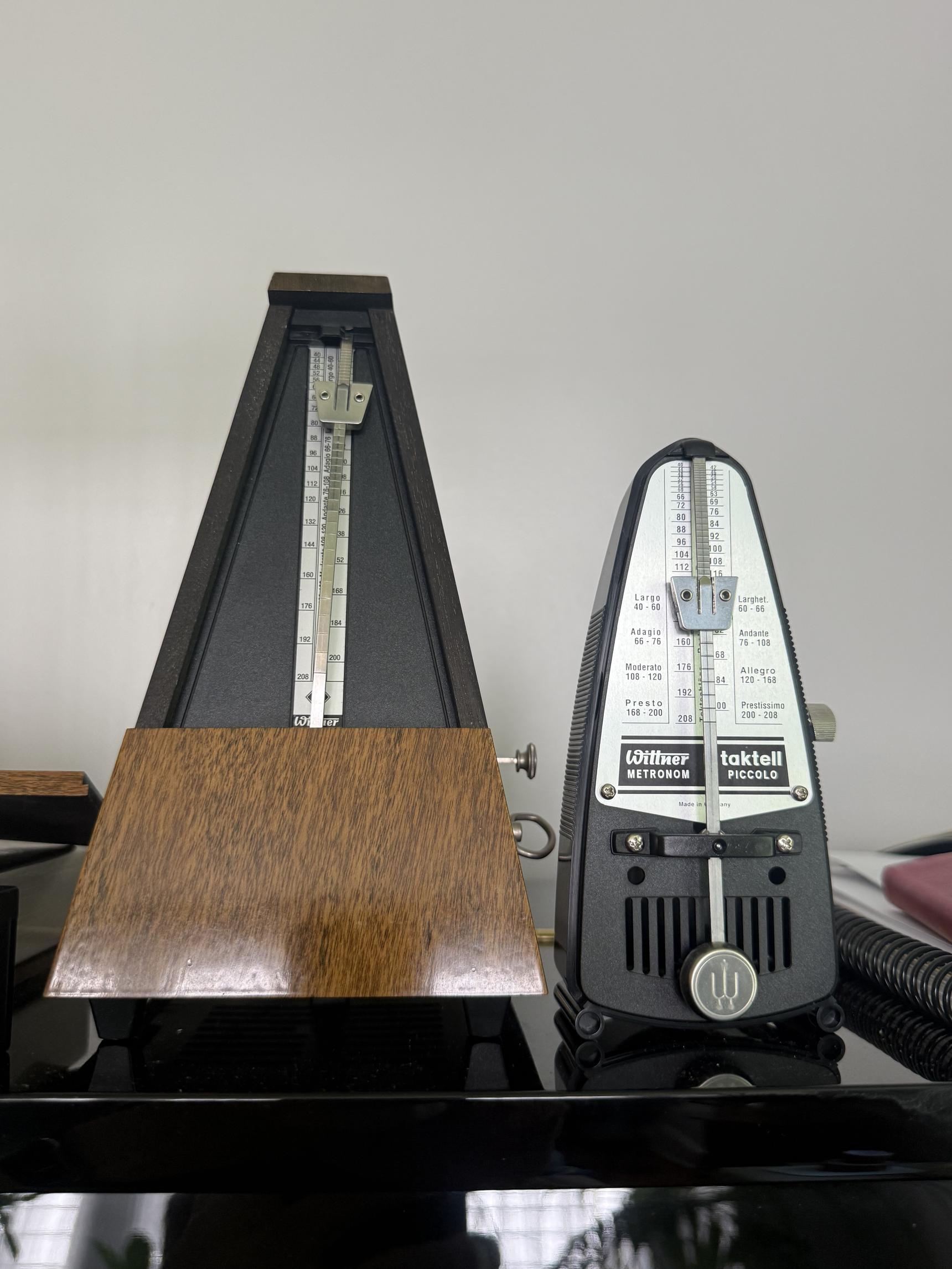
      Which analog metronome did you buy? I have the bell one from Wittner but I am very excited about a true analog metronome that is shipping at the end of the year. 
       

      https://www.kickstarter.com/projects/lupine/ap-1


      I can’t wait to play with a cowbell, wooden block, or maybe a xylophone key. 

      Yes, I am Backer #1, lol. I will be able to upload a midi track to it so that I can create any kind of click track.

      • Ken_Radford
      • 1 mth ago
      • Reported - view

       I have a Wittner and I last used it around 3 years ago.

      • Ken_Radford
      • 1 mth ago
      • Reported - view

       Thanks for sharing the video Peter. Leon’s playing captures for me the concept of freedom and it sounds so, well, human.

      • Larry_K
      • 1 mth ago
      • Reported - view

       I use my Wittners a lot, pretty much every day.

      I’m not buying the dire warnings against the use of metronomes after thirty years of private lessons on violin, classical guitar, and piano.

      My classical guitar teacher studied at Juilliard with Sharon Isbin. At one of his first lessons, she pulled out a metronome. He said, I don’t need that. She said, oh, really?

      She then went on to show him that he absolutely did need to use a metronome, lol.

      One classical guitarist at an impromptu recital mentioned that her use of the metronome showed her how she was slowing down in long pieces because of fatigue. 

    • TT2022
    • 1 mth ago
    • Reported - view

    My update for the week is that I have no update! I had to travel for work and didn’t touch the piano for the week. I just flew back home today and now have to play a part of Rach 2 in a masterclass tomorrow so I gotta clean that one up 😬 That piece is also an unfinished business situation…
Content aside

  • 4 Likes
  • 1 mth agoLast active
  • 167Replies
  • 699Views
  • 27 Following