Anyone like to improvise?

Hi. I have always had a desire to be able to sit at the piano and just play - without knowing what I will play. It seems to be a daunting task, but since I found a great teacher who was classically trained before becoming a professional jazz pianist, I have made some progress. When I don’t feel like practicing I sit at the piano and play a simple chord sequence - for example Fm7, Bbm7, Cm7, Fm7 - and find notes and phrases that sound good to me.


Does anyone else improvise or plan to learn how to? It would be good to share ideas.

141 replies

null
    • Ken_Radford
    • 3 wk ago
    • Reported - view

    After looking through some of the partimenti.org web pages that Maria kindly posted and watching the tonebase interview with John Mortensen I decided that I have to learn how to improvise fugue. I bought John’s book Improvising Fugue - A Method for Keyboard Artists and am currently practicing simple rule of the octave (RO) in seven major and parallel minor keys. I will not move on until I can play them all at a decent tempo without any errors.
    I am doing this in addition to learning jazz improv and I have set a goal to be proficient in fugue by June 9th 2032 (yes, that is 6 years.)

    Any ideas, suggestions, tips, and so on will be appreciated. 

      • Ken_Radford
      • 3 wk ago
      • Reported - view

       “…advanced players like yourself…” 😂 Thank you for the compliment Peter, but that is not what I would say about my level. Maybe when I am improvising fugue in 2032…

      When it comes to speed, for me, less is more.

      As you point out above, we have to be very careful from whom we take advice. 

      • Mom, fitness instructor, lover of music
      • Michelle_Russell
      • 3 wk ago
      • Reported - view

       My teacher teaches how to improvise fugues; he does this primarily through zoom (unless you happen to be in Portland, OR) since not many people teach this skill. Here is an article from 10 years ago when he was more active in this world of teaching improvisation. We also had an artist at our chamber music festival last year who was doing her doctoral research on teaching improvisation to classical musicians. I haven't checked in on her since last year, but this might give you another place to begin looking for resources.

       my teacher says that if anyone ever says "finger exercises" I should turn around and run away as fast as I can! And also, though there are techniques and drills which help, speed comes with time and patience. Some people (my son, for instance) have more of a natural ability to play quickly, but our initial practice should not be for speed. I've coached gymnastics and/or been a personal trainer for nearly 40 years, and it has been my experience that those who begin slowly, learning the form and technique first - these are the ones who end up being the most efficient in their learning process. My vocal teacher reinforced this yesterday, since I'm needing to learn a new song with less than a week's notice: beginning slowly and methodically aids the learning process and, in what seems like a paradox, makes it more efficient. If you just jump right in and try to sing the song without all the initial prep work (he calls them 'layers of learning'), it typically results in tension which you then have to take extra time to untrain! 

      • Ken_Radford
      • 3 wk ago
      • Reported - view

       Thanks for the information Michelle. I am going to speak to my teacher about improvising fugue at my lesson tomorrow and see what his thoughts are. He is a classically trained jazz performer so I believe he will be able to help me. If not, I will be looking for an additional teacher.

      • Peter_William
      • 3 wk ago
      • Reported - view

       Thanks for the response!. Yes I wanted to ask you earlier. Your son is quite a fabulous pianist! I saw some videos.. :-) . Your info on gym is quite similar to mine in tennis.

      With fast playing there may be a method that concert pianists have that got them to ridiculous speeds. I have seen pianists play scales flawlessly  at 180bpm to the sixteenth note and so was wondering. how do they practice? from slow speeds  at 60 bpm to 130 bpm and above.. ? is it even possible for older beginners ? So many questions .. :-) 

      • Peter_William
      • 3 wk ago
      • Reported - view

       Unfortunately I am not able to attend the session with David Chang - happening soon.  It would be wonderful if anyone can ask him. His scales and Chopin Etudes are stunningly fast. There is a video of him demonstrating it on the internet with Garrick Ohlson watching and saying " that was very good ! !".. just imagine how good it would have to be to get that kind of a compliment.

      So if you do attend this webinar.. could you ask? I am away from the piano for the next few days.. 

      • Ken_Radford
      • 3 wk ago
      • Reported - view

       I will not be at that livestream so won’t be able to ask.

    • Ken_Radford
    • 10 days ago
    • Reported - view

    And here we are with month 3 of the 12 month Major II-V-I-VI and minor ii-v-i challenge travelling anticlockwise round the circle of fifths. This time round I introduce some triad pairs and as always, keep it simple.

      • Mark_Cooper
      • 10 days ago
      • Reported - view

       fantastic video Ken , lots to learn here , loved those triad pairs 

      is there a particular rationale for choosing those particular triads ? They sounded great 

      the F and B over F dominant is particularly interesting, the B is the tritone sub I suppose 


      btw good luck with the fugue improv, not sure I’ll be treading there anytime soon!!

      • Ken_Radford
      • 10 days ago
      • Reported - view

       Thanks for your comments Mark. I will say more about triad pairs soon.

      Learning fugue improv is a hard job that someone has to do. If it was good enough for JSB...

      • Mark_Cooper
      • 10 days ago
      • Reported - view

      I just realized that these triad pairs are probably similar in principle to the upper structure triads I discussed in an earlier video 


      • Ken_Radford
      • 9 days ago
      • Reported - view

       Good point about the similarities between the triad pairs (TPs) and the upper structure triads (USTs). I am glad you made this observation because I didn’t pick up on your comments about USTs in your F Major video, and it is definitely something I will be learning to use in my improv.

      My understanding is that USTs are used mainly with dominant chords, whereas TPs can be used with all types of chords. Is it also the case that USTs are considered to be chord extensions (harmony) whereas PTs are used to create melodic lines (motifs)? I will have a go at creating motifs with USTs and see what transpires.

      There are many TPs that can be used to create interesting motifs, and the ones I use as my “go-to” are as follows (using II-V-I-VI in Bb major):

      Over the II chord (Cm7) - I treat this as chord II in Bb major and build a PT using the I and II tones in the Bb Major scale. This gives us Bb major and C minor.

      Over the V chord (F9) - I treat this as chord IV and V of C JMM. This gives us F major and G major.

      Over the V chord with a # or b9 we have a choice of two TPs. The first is built by treating it as chord I and V of F diminished. This gives us F major or minor and B major or minor. The second TP s built by treating it as chord III and VII of F diminished. This gives us Ab major or minor and D major or minor. I normally use the major chords

      Over the I chord (Bb major 7) - I treat this as chord V and VI of Bb major. This gives us F major and G minor.

      Over the VI chord (G+7#9) - I treat this as chord IV and V of Ab JMM. This gives us Db major and Eb major.

      Using the Bb major II-V-I-VI and comparing the five main USTs with TPs:

      UST II major (G major over F7) gives us F7(#11add13)

      UST bIII major (Ab major over F7 gives us F7(#9)

      UST bV major (B major over F7 gives us F7(b9#11)

      UST bVI major (Db major over F7 gives us F7(#9b13)

      UST VI major (D major over F7 gives us F13(b9)

      With the two TPs mentioned above over the V chord in the Bb major II-V-I-VI with # or b 9 we have F major or minor and B major or minor and Ab major or minor and D major or minor.

      F major over F7 gives us, well, F7.

      F minor over F7 gives us F7(#9), which is the same as UST bIII.

      B major over F7 gives us F7(b9#11), which is the same as UST bV.

      B minor over F7 gives us F7(#11add13), which is the same as UST II.

      Ab major over F7 gives us F7(#9), which is the same as UST bIII.

      Ab minor over F7 gives us F7(#9#11)

      D major over F7 gives us F13(b9), which is the same as UST VI.

      D minor over F7 gives us F7(add 13).

      I look forward to hearing your thoughts on the connection between USTs and PTs, along with any other comments or corrections.

      • Mark_Cooper
      • 8 days ago
      • Reported - view


      Wow Ken, this will require some study , you put in a huge amount of work here , thanks !!

      as far as I understand it now , UST are essentially used in a chord progression whereas the triad pairs are use repeatedly in patterns but the principle of their formation is the same 

      I had a lesson today with my jazz piano teacher and I mentioned that we were studying this topic of triad pairs and he came up with the following 

      1. it’s probably a bit trite but he said you can essentially play any triad you want as long as it sounds good , which is subjective

      2. the triads sound better in first and second inversion rather then the root 

      3. triad pairs are often practiced by single line instruments such as saxophone as this a good way of outlining chords . No doubt you know that John Coltrane obsessed over these and created an entire language based on this concept 

      the improv possibilities are endless….

      • Ken_Radford
      • 8 days ago
      • Reported - view

       I am fascinated by the mathematics that underlie music and discovering connections between musical constructs is right up my street! Thanks for mentioning the link between USTs and PTs.

      1. I agree that we can play any chord we like as long as it sounds good to us. I am reminded of the way I used to wince over the leading tone in JMM scales. I am used to that sound now and no longer wince when I hear it.

      2. When I use PTs I mix it up with, for example, 5, 3, 1, 5 and variations thereof. So, over A+7#9 (PTs Eb and F major) I might play Bb, G, Eb, Bb, C, A, F, C.

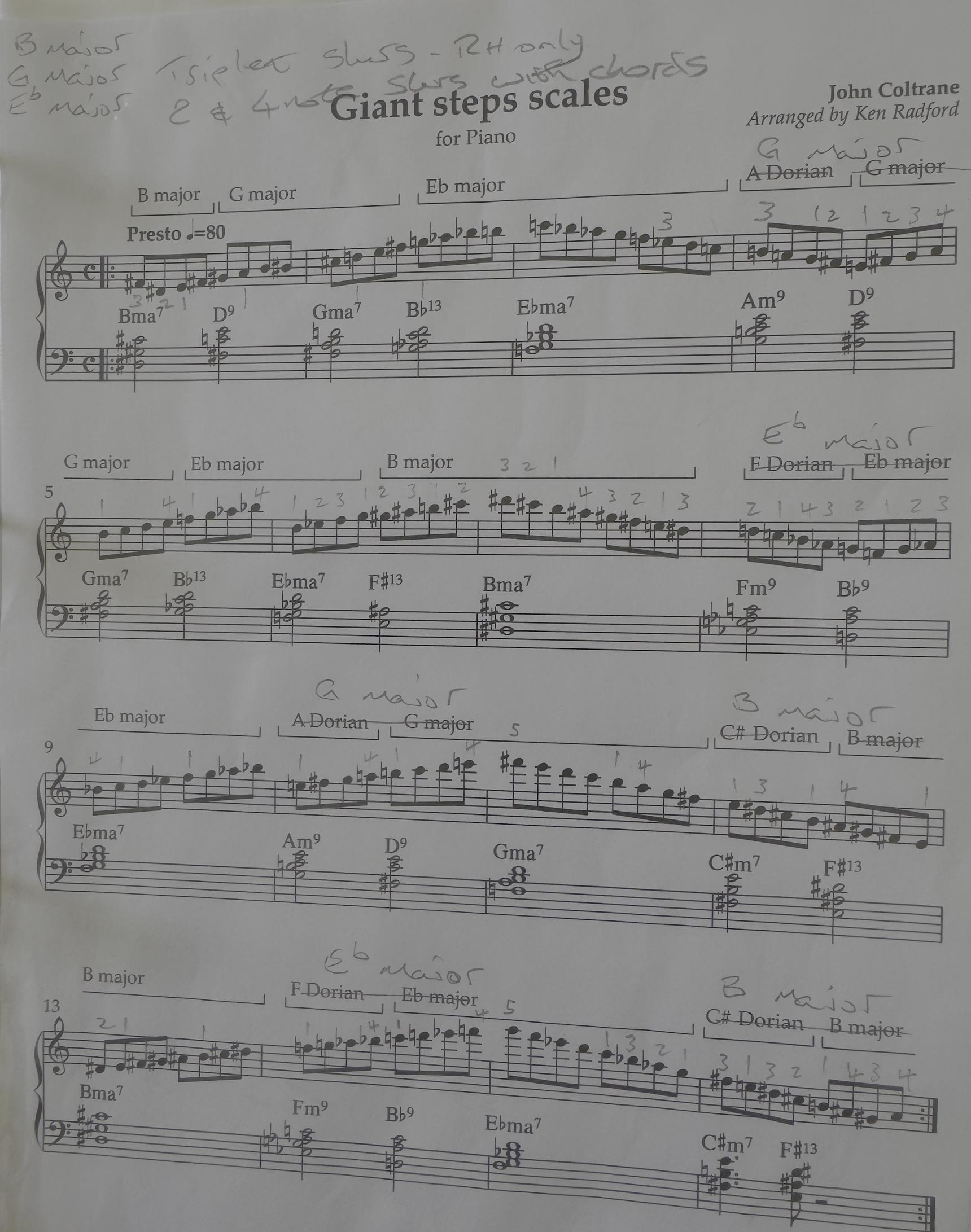
      3. Funny you should mention John Coltrane as I am working on an exercise where I play the three scales he uses in his masterpiece Giant Steps. As you can see from the image below, I am starting with keeping it simple by playing the scales ascending and descending. When I have this under my fingers I shall attempt some improv.

      • Mark_Cooper
      • 7 days ago
      • Reported - view

      Good luck with Giant steps !

      I had a look at this one a few years ago , definitely challenging !

      if you also want something similar check out Coltrane’s  ‘moments notice ‘ , I think this tune is even more challenging than giant steps ! 


    • Mark_Cooper
    • 9 days ago
    • Reported - view

    Hi all

    here is my take on Bb 2-5-1-6

    just to recap 

    the progression is:

    C minor 7

    F dominant 

    Bb major 7

    G  altered dominant 

    I include a sample tune Perdido which was composed by the trombone player in Duke Ellington’s band,   Juan Tizol , in around 1941


    B-flat major 

    2-5-1-6 progression 


    Sample tune.  Perdido 


    https://youtu.be/QCUaNw4CQOo?si=ZXF9tccf8_a085-L


      • Ken_Radford
      • 9 days ago
      • Reported - view

       Sounds great Mark and I like the way you use the guide (chord) tones to create interesting motifs.

Content aside

  • 1 Likes
  • 8 days agoLast active
  • 141Replies
  • 841Views
  • 13 Following